Which of the following terms describe human dentition ?
- Thecodont, Diphyodont, Homodont
- Pleurodont, Monophyodont, Homodont
- Thecodont, Diphyodont, Heterodont
- Pleurodont, Diphyodont, Heterodont

The Correct Option is C
Solution and Explanation
To determine which terms describe human dentition, let's analyze each option and understand the relevant concepts.
-
Thecodont,
Diphohydont, Heterodont:
- Thecodont: This term indicates that teeth are embedded in the jawbone. Humans have thecodont dentition since our teeth are set in sockets in the jawbones. - Diphyodont: This indicates the presence of two sets of teeth in a lifetime. Humans first develop milk teeth which are replaced by permanent teeth, thus we have diphyodont dentition. - Heterodont: This describes a dentition where different types of teeth exist, such as incisors, canines, premolars, and molars. Humans possess heterodont dentition.
Therefore, this option accurately describes human dentition.
-
Pleurodont, Monophyodont, Homodont:
- Pleurodont: This term refers to teeth that are fused by their sides to the inner part of the jawbone. This is not seen in humans. - Monophyodont: It describes having only one set of teeth in a lifetime, which doesn't apply to humans who have two sets. - Homodont: This implies all teeth are of the same type; human teeth are heterodont, not homodont.
Thus, this option does not describe human dentition.
-
Thecodont, Diphyodont, Homodont:
- While thecodont and diphyodont correctly apply to humans, the term homodont doesn't, since humans have different types of teeth.
This option is partially correct but includes an incorrect term for human dentition.
-
Pleurodont, Diphyodont, Heterodont:
- While diphyodont and heterodont are correct, pleurodont is not applicable as mentioned earlier.
This option includes both correct and incorrect terms for human dentition.
Based on the above analysis, the correct answer is: Thecodont, Diphyodont, Heterodont.
Top NEET Biology Questions
- The chronological order of human evolution from early to the recent is
- Upper part of sea/aquatic ecosystem contains
- Where is respiratory electron transport system (ETS) located in plants ?
- Which among the following are the smallest living cells, known without a definite cell wall, pathogenic to plants as well as animals and can survive without oxygen ?
- Three of the following pairs of the human skeletal parts are correctly matched with their respective inclusive skeletal category and one pair is not matched. Identify the non-matching pair. .
Pair of skeletal parts Category (a)$\,\,$ Sternum and ribs$\,\,$ Axial skeleton (b)$\,\,$ Clavicle and glenoid cavity$\,\,$ Pelvic girdle (c)$\,\,$ Flumerus and ulna$\,\,$ Appendicular skeleton (d)$\,\,$ Malleus and stapes$\,\,$ Ear ossicles
Top NEET Human body Questions
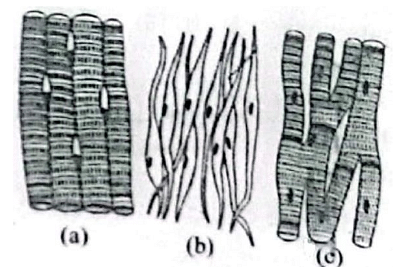
- Three types of muscles are given as a, b and c. Identify the correct matching pair along with their location in human body :
- Given below are two statements:
Statement I: The cerebral hemispheres are connected by nerve tract known as corpus callosum.
Statement II: The brain stem consists of the medulla oblongata, pons and cerebrum.
In the light of the above statements, choose the most appropriate answer from the options given below: - Match the following columns and select the correct option.
Column I
Column II A Floating Ribs I Located between second and seventh ribs B Acromion II Head of the Humerus C Scapula III Clavicle D Glenoid cavity IV Do not connect with the sternum
Top NEET Questions
- A $100.0\, mL$ dilute solution of $Ag ^{+}$is electrolysed for $15.0$ minutes with a current of $1.25 \,mA$ and the silver is removed completely. What was the initial $\left[ Ag ^{+}\right]$?
- The time constant of C-R circuit is
- The chronological order of human evolution from early to the recent is
- The correct Boolean operation represented by the circuit diagram drawn is :
- The driver of a car travelling with speed $30\, m/sec$ towards a hill sounds a horn of frequency $600\, Hz.$ If the velocity of sound in air is $330\, m/s,$ the frequency of reflected sound as heard by driver is