What type of bonds are present in molecular crystals?
What type of bonds are present in molecular crystals?

Solution and Explanation
Molecular Crystals:
Molecular crystals are made up of individual molecules that are held together by intermolecular forces. These crystals have a unique structure, and the bonding between the atoms within each molecule is typically covalent in nature. This means that electrons are shared between adjacent atoms within the molecule to form molecular bonds, creating a stable structure within the individual molecules.
Types of Bonding:
- The bonding within the molecules is covalent, meaning that atoms within a molecule share electrons to achieve a stable electron configuration, typically resulting in strong and directional bonds.
- However, the forces that hold the individual molecules together in the crystal lattice are weaker than the covalent bonds and are known as intermolecular forces. These forces arise from interactions between partially charged atoms or molecules within the crystal lattice.
Intermolecular Forces:
The key types of intermolecular forces that play a role in the formation of molecular crystals are:
- London Dispersion Forces: These are temporary attractive forces that arise from the movement of electrons, creating temporary dipoles in molecules. They are present in all molecular crystals, even in nonpolar molecules, and are generally weak.
- Dipole-Dipole Forces: These occur between molecules that have permanent dipoles. In polar molecules, the positive end of one molecule is attracted to the negative end of another molecule, which can contribute to the stability of the crystal structure.
- Hydrogen Bonding: This is a special type of dipole-dipole interaction, which occurs when a hydrogen atom covalently bonded to a highly electronegative atom (such as oxygen, nitrogen, or fluorine) is attracted to another electronegative atom. Hydrogen bonding is stronger than other intermolecular forces and plays a crucial role in the formation of molecular crystals, especially in compounds like water and ammonia.
Conclusion:
In a molecular crystal, covalent bonds are responsible for holding the atoms together within each individual molecule, while the intermolecular forces, including London dispersion forces, dipole-dipole forces, and hydrogen bonding, are responsible for holding the molecules together in the crystal lattice. The presence of these weaker forces between molecules results in a more flexible and lower-melting structure compared to ionic or metallic crystals.
Top MHT CET Chemistry Questions
- The temperature of $32^{\circ}C$ is equivalent to
- The heat of formation of water is $ 260\, kJ $ . How much $ H_2O $ is decomposed by $ 130\, kJ $ of heat ?
- If a metal crystallises in bcc structure with edge length of unit cell $4.29 \times 10^{-8}\, cm$ the radius of metal atom is
- Which of the following oxides can act both as an oxidising agent as well as reducing agent ?
- "The mass and energy both are conserved in an isolated system", is the statement of
Top MHT CET The solid state Questions
- In which among the following solids, Schottky defect is NOT observed?
- How many total constituent particles are present in simple cubic unit cell ?
- Which among the following metals crystallise as a simple cube ?
Edge length of a unit cell of a crystal is 288 pm. If its density is 7.2 g/cm3, then determine the type of unit cell assuming mass = 52 g.
For a BCC structure, if a = 351 pm, find r. Lithium forms a BCC structure having an edge length of a unit cell 351 pm, then find the atomic radius of lithium.
Top MHT CET Questions
- During r- DNA technology, which one of the following enzymes is used for cleaving DNA molecule ?
- In non uniform circular motion, the ratio of tangential to radial acceleration is (r = radius of circle, $v =$ speed of the particle, $\alpha =$ angular acceleration)
- The temperature of $32^{\circ}C$ is equivalent to
- The line $5x + y - 1 = 0$ coincides with one of the lines given by $5x^2 + xy - kx - 2y + 2 = 0 $ then the value of k is
- The heat of formation of water is $ 260\, kJ $ . How much $ H_2O $ is decomposed by $ 130\, kJ $ of heat ?
Concepts Used:
Solid State
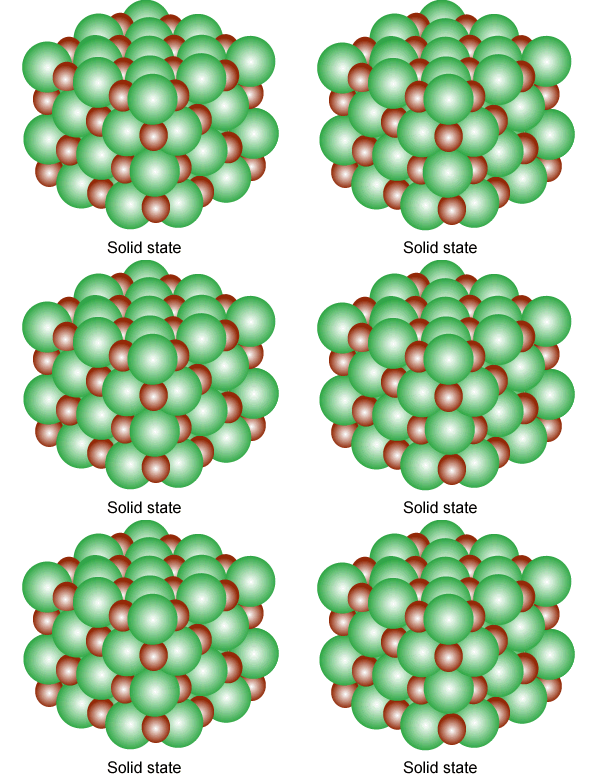
Solids are substances that are featured by a definite shape, volume, and high density. In the solid-state, the composed particles are arranged in several manners. Solid-state, in simple terms, means "no moving parts." Thus solid-state electronic devices are the ones inclusive of solid components that don’t change their position. Solid is a state of matter where the composed particles are arranged close to each other. The composed particles can be either atoms, molecules, or ions.
Types of Solids:
Based on the nature of the order that is present in the arrangement of their constituent particles solids can be divided into two types;
- Amorphous solids behave the same as super cool liquids due to the arrangement of constituent particles in short-range order. They are isotropic and have a broad melting point (range is about greater than 5°C).
- Crystalline solids have a fixed shape and the constituent particles are arranged in a long-range order.