Question:
What is the output voltage \( V_{{out}} \) for the circuit shown below?

What is the output voltage \( V_{{out}} \) for the circuit shown below?
Show Hint
In a summing amplifier configuration, the output voltage is the weighted sum of the input voltages, where the weights are determined by the ratios of the feedback resistor to the input resistors.
Updated On: Jan 31, 2026
Show Solution

Verified By Collegedunia
Correct Answer: -14
Solution and Explanation
In this case, we have a summing amplifier configuration, where the output voltage \( V_{{out}} \) is given by the formula:
\[
V_{{out}} = - \left( \frac{R_f}{R_1} V_1 + \frac{R_f}{R_2} V_2 + \frac{R_f}{R_3} V_3 \right)
\]
where:
\( R_f = 10 \, k\Omega \) is the feedback resistor
\( R_1 = 5 \, k\Omega \), \( R_2 = 4 \, k\Omega \), and \( R_3 = 2 \, k\Omega \) are the resistors associated with \( V_1 \), \( V_2 \), and \( V_3 \), respectively
\( V_1 = 2 \, {V} \), \( V_2 = 2 \, {V} \), and \( V_3 = 1 \, {V} \)
Step-by-Step Calculation:
1. Calculate the individual contributions to the output voltage: \[ \frac{R_f}{R_1} = \frac{10 \, k\Omega}{5 \, k\Omega} = 2 \] \[ \frac{R_f}{R_2} = \frac{10 \, k\Omega}{4 \, k\Omega} = 2.5 \] \[ \frac{R_f}{R_3} = \frac{10 \, k\Omega}{2 \, k\Omega} = 5 \] 2. Multiply each by the corresponding voltage: \[ 2 \times V_1 = 2 \times 2 \, {V} = 4 \, {V} \] \[ 2.5 \times V_2 = 2.5 \times 2 \, {V} = 5 \, {V} \] \[ 5 \times V_3 = 5 \times 1 \, {V} = 5 \, {V} \] 3. Sum the contributions: \[ V_{{out}} = - \left( 4 \, {V} + 5 \, {V} + 5 \, {V} \right) = -14 \, {V} \] Thus, the output voltage \( V_{{out}} \) is \( -14 \, {V} \).
\( R_f = 10 \, k\Omega \) is the feedback resistor
\( R_1 = 5 \, k\Omega \), \( R_2 = 4 \, k\Omega \), and \( R_3 = 2 \, k\Omega \) are the resistors associated with \( V_1 \), \( V_2 \), and \( V_3 \), respectively
\( V_1 = 2 \, {V} \), \( V_2 = 2 \, {V} \), and \( V_3 = 1 \, {V} \)
Step-by-Step Calculation:
1. Calculate the individual contributions to the output voltage: \[ \frac{R_f}{R_1} = \frac{10 \, k\Omega}{5 \, k\Omega} = 2 \] \[ \frac{R_f}{R_2} = \frac{10 \, k\Omega}{4 \, k\Omega} = 2.5 \] \[ \frac{R_f}{R_3} = \frac{10 \, k\Omega}{2 \, k\Omega} = 5 \] 2. Multiply each by the corresponding voltage: \[ 2 \times V_1 = 2 \times 2 \, {V} = 4 \, {V} \] \[ 2.5 \times V_2 = 2.5 \times 2 \, {V} = 5 \, {V} \] \[ 5 \times V_3 = 5 \times 1 \, {V} = 5 \, {V} \] 3. Sum the contributions: \[ V_{{out}} = - \left( 4 \, {V} + 5 \, {V} + 5 \, {V} \right) = -14 \, {V} \] Thus, the output voltage \( V_{{out}} \) is \( -14 \, {V} \).
Was this answer helpful?
0
0
Top GATE BM Electrical Circuits Questions
- The circuit shown in the figure functions as which one of the following digital circuit blocks ?
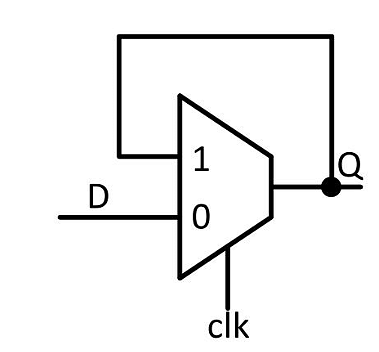
- The measured current through a device is 5 A, the voltage measured across the device is 20 V. The ammeter and the voltmeter used for these measurements have a measurement uncertainty of 1% each. The maximum error in estimation of impedance of the device is ______ mΩ. Give your answer rounded to the nearest integer.
- The Larmor frequency of a Na nucleus when placed in a magnetic field strength of 3 T is _______. (The gyromagnetic ratio of Na is given as γ = 11.26 MHz/T.)
Give your answer in MHz rounded off to the nearest integer. - Which of the following waveforms represents the output V. of the circuit given below? The Zener diode used has a Zener breakdown voltage of 1 V and can be assumed ideal while in forward bias.
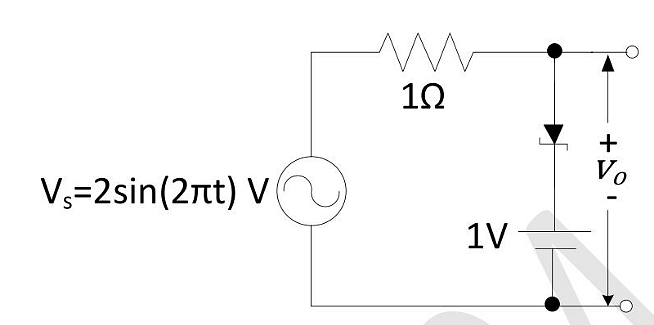
- In the circuit below, what is the value of IL to transfer the maximum power to load ?
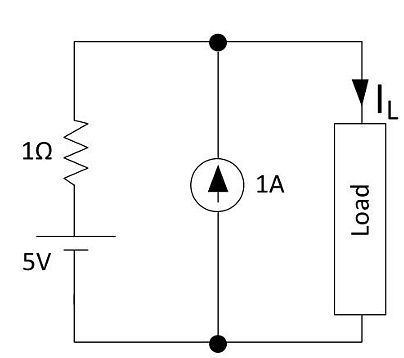
View More Questions
Top GATE BM Electrical Circuits Questions
In the circuit shown below, assuming an ideal op-amp, for an input voltage \( V_{in} = 1 \, V \), the output voltage \( V_{out} = ? \, \) (in vol)

- A voltage source \( V_s = 5 \sin \left( 100t + \frac{\pi}{2} \right) \) volts is driving a current \[ I = 10 \sin \left( 100t + \frac{\pi}{6} \right) \, {mA} \] through a circuit. The average power dissipated in the circuit is ________mW.
In the circuit shown below, \( V_{{in}} = 10 \cos(1000t) \) volts. The magnitude of the input impedance of the circuit is _______k\(\Omega\). (rounded off to one decimal place)

What is the output voltage \( V_{{out}} \) for the circuit shown below?

For the RLC circuit shown below, the root mean square current \( I_{{rms}} \) at the resonance frequency is _______amperes. (rounded off to the nearest integer)

\[ V_{{rms}} = 240 \, {V}, \quad R = 60 \, \Omega, \quad L = 10 \, {mH}, \quad C = 8 \, \mu {F} \]
View More Questions
Top GATE BM Questions
- What is the value of the following complex line integral counter-clockwise ?
\(\oint_{|z|=3}\frac{8}{z(z-2)(z-4)}dz\) - To solve the equation x = 2 cos x using Newton-Raphson's method, which one of the following iterations should be used ?
- During the repolarization phase of a neuron, the cell is brought back to the resting potential by the action of a Sodium-Potassium pump. Which one of the following statements is TRUE for the active transport of Na+ and K+ ions through the cell membrane ?
- The cardiac rhythm in a healthy human heart originates from ______.
- Which one of the following events is NOT typically encountered in diagnostic X-ray projection radiography ?
View More Questions