Question:
A voltage source \( V_s = 5 \sin \left( 100t + \frac{\pi}{2} \right) \) volts is driving a current
\[
I = 10 \sin \left( 100t + \frac{\pi}{6} \right) \, {mA}
\]
through a circuit. The average power dissipated in the circuit is ________mW.
A voltage source \( V_s = 5 \sin \left( 100t + \frac{\pi}{2} \right) \) volts is driving a current
\[
I = 10 \sin \left( 100t + \frac{\pi}{6} \right) \, {mA}
\]
through a circuit. The average power dissipated in the circuit is ________mW.
Show Hint
When calculating the average power in an AC circuit, ensure to use the RMS values for voltage and current and the phase difference between them.
Updated On: Apr 14, 2025
- 0.0
- 12.5
- 25.0
- 50.0
Show Solution

Verified By Collegedunia
The Correct Option is B
Solution and Explanation
Step 1: Calculating RMS values
The RMS value of a sinusoidal waveform is given by: \[ V_{{rms}} = \frac{V_{{max}}}{\sqrt{2}}, \quad I_{{rms}} = \frac{I_{{max}}}{\sqrt{2}}. \] For the voltage source \( V_s = 5 \sin \left( 100t + \frac{\pi}{2} \right) \), the peak voltage \( V_{{max}} = 5 \) V, so: \[ V_{{rms}} = \frac{5}{\sqrt{2}} \approx 3.535 \, {V}. \] For the current \( I = 10 \sin \left( 100t + \frac{\pi}{6} \right) \), the peak current \( I_{{max}} = 10 \) mA, so: \[ I_{{rms}} = \frac{10}{\sqrt{2}} \approx 7.071 \, {mA} = 0.007071 \, {A}. \] Step 2: Calculating the phase difference
The phase difference \( \theta \) between the voltage and current is the difference in their phase angles: \[ \theta = \left( \frac{\pi}{2} - \frac{\pi}{6} \right) = \frac{\pi}{3}. \] Step 3: Calculating average power
Now we can substitute into the formula for average power: \[ P_{{avg}} = \frac{1}{2} \times 3.535 \times 0.007071 \times \cos \left( \frac{\pi}{3} \right). \] Since \( \cos \left( \frac{\pi}{3} \right) = \frac{1}{2} \), we get: \[ P_{{avg}} = \frac{1}{2} \times 3.535 \times 0.007071 \times \frac{1}{2} = 12.5 \, {mW}. \] Thus, the average power dissipated in the circuit is 12.5 mW.
The RMS value of a sinusoidal waveform is given by: \[ V_{{rms}} = \frac{V_{{max}}}{\sqrt{2}}, \quad I_{{rms}} = \frac{I_{{max}}}{\sqrt{2}}. \] For the voltage source \( V_s = 5 \sin \left( 100t + \frac{\pi}{2} \right) \), the peak voltage \( V_{{max}} = 5 \) V, so: \[ V_{{rms}} = \frac{5}{\sqrt{2}} \approx 3.535 \, {V}. \] For the current \( I = 10 \sin \left( 100t + \frac{\pi}{6} \right) \), the peak current \( I_{{max}} = 10 \) mA, so: \[ I_{{rms}} = \frac{10}{\sqrt{2}} \approx 7.071 \, {mA} = 0.007071 \, {A}. \] Step 2: Calculating the phase difference
The phase difference \( \theta \) between the voltage and current is the difference in their phase angles: \[ \theta = \left( \frac{\pi}{2} - \frac{\pi}{6} \right) = \frac{\pi}{3}. \] Step 3: Calculating average power
Now we can substitute into the formula for average power: \[ P_{{avg}} = \frac{1}{2} \times 3.535 \times 0.007071 \times \cos \left( \frac{\pi}{3} \right). \] Since \( \cos \left( \frac{\pi}{3} \right) = \frac{1}{2} \), we get: \[ P_{{avg}} = \frac{1}{2} \times 3.535 \times 0.007071 \times \frac{1}{2} = 12.5 \, {mW}. \] Thus, the average power dissipated in the circuit is 12.5 mW.
Was this answer helpful?
0
0
Top GATE BM Electrical Circuits Questions
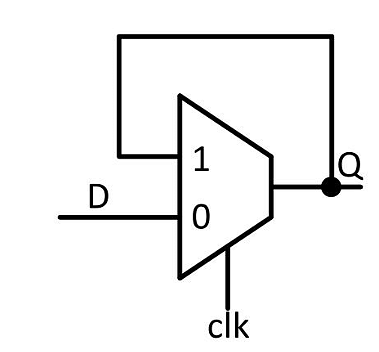
- The circuit shown in the figure functions as which one of the following digital circuit blocks ?
- The measured current through a device is 5 A, the voltage measured across the device is 20 V. The ammeter and the voltmeter used for these measurements have a measurement uncertainty of 1% each. The maximum error in estimation of impedance of the device is ______ mΩ. Give your answer rounded to the nearest integer.
- The Larmor frequency of a Na nucleus when placed in a magnetic field strength of 3 T is _______. (The gyromagnetic ratio of Na is given as γ = 11.26 MHz/T.)
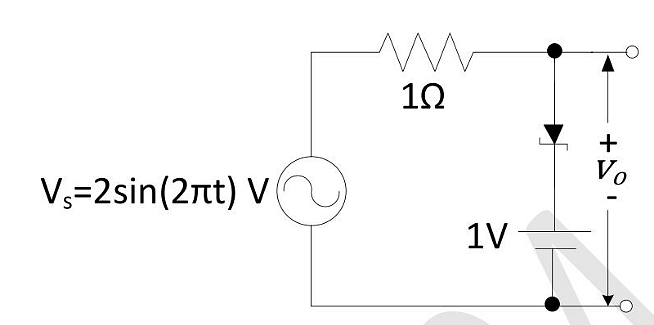
Give your answer in MHz rounded off to the nearest integer. - Which of the following waveforms represents the output V. of the circuit given below? The Zener diode used has a Zener breakdown voltage of 1 V and can be assumed ideal while in forward bias.
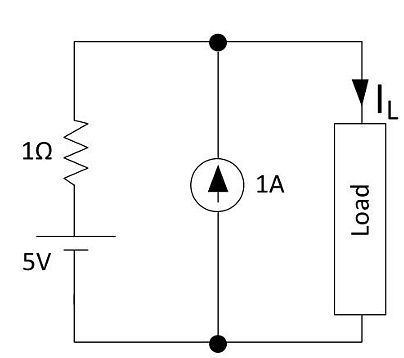
- In the circuit below, what is the value of IL to transfer the maximum power to load ?
View More Questions
Top GATE BM Electrical Circuits Questions
In the circuit shown below, assuming an ideal op-amp, for an input voltage \( V_{in} = 1 \, V \), the output voltage \( V_{out} = ? \, \) (in vol)

In the circuit shown below, \( V_{{in}} = 10 \cos(1000t) \) volts. The magnitude of the input impedance of the circuit is _______k\(\Omega\). (rounded off to one decimal place)

What is the output voltage \( V_{{out}} \) for the circuit shown below?

For the RLC circuit shown below, the root mean square current \( I_{{rms}} \) at the resonance frequency is _______amperes. (rounded off to the nearest integer)

\[ V_{{rms}} = 240 \, {V}, \quad R = 60 \, \Omega, \quad L = 10 \, {mH}, \quad C = 8 \, \mu {F} \]- If the gyromagnetic ratio of proton is 42.58 MHz per Tesla, the resonance frequency for protons in a magnetic field of 1.5 Tesla is _______ MHz. (rounded off to two decimal places)
View More Questions
Top GATE BM Questions
- What is the value of the following complex line integral counter-clockwise ?
\(\oint_{|z|=3}\frac{8}{z(z-2)(z-4)}dz\) - To solve the equation x = 2 cos x using Newton-Raphson's method, which one of the following iterations should be used ?
- During the repolarization phase of a neuron, the cell is brought back to the resting potential by the action of a Sodium-Potassium pump. Which one of the following statements is TRUE for the active transport of Na+ and K+ ions through the cell membrane ?
- The cardiac rhythm in a healthy human heart originates from ______.
- Which one of the following events is NOT typically encountered in diagnostic X-ray projection radiography ?
View More Questions