Two parallel, long wires are kept 0.20 m apart in vacuum, each carrying current of x A in the same direction. If the force of attraction per meter of each wire is 2 × 10⁻⁶ N, then the value of x is approximately:
- 1
- 2.4
- 1.4
- 2

The Correct Option is C
Solution and Explanation
To solve this problem, we need to determine the value of current \( x \) for two long, parallel wires that are 0.20 m apart and carry the same current in the same direction. The force of attraction per meter between the wires is given as \(2 \times 10^{-6} \, \text{N/m}\).
The formula for the force per unit length between two parallel current-carrying wires is given by:
\(F = \frac{\mu_0 \cdot I_1 \cdot I_2}{2\pi \cdot d}\)
where:
- \(\mu_0 = 4\pi \times 10^{-7} \, \text{T m/A}\), is the permeability of free space.
- \(I_1\) and \(I_2\) are the currents through the wires, both are equal to \(x\) A.
- \(d = 0.20 \, \text{m}\), is the distance between the wires.
Since the currents are the same and in the same direction, we can write:
\(F = \frac{4\pi \times 10^{-7} \cdot x^2}{2\pi \cdot 0.20}\)
This simplifies to:
\(F = \frac{2 \times 10^{-7} \cdot x^2}{0.20}\)
Setting this equal to the given force per unit length:
\(\frac{2 \times 10^{-7} \cdot x^2}{0.20} = 2 \times 10^{-6}\)
Simplifying gives:
\(x^2 = \frac{2 \times 10^{-6} \cdot 0.20}{2 \times 10^{-7}}\)
\(x^2 = 2 \end{equation}\)
Solving for \(x\), we get:
\(x = \sqrt{2} = 1.414\ldots\)
Rounding to a single decimal place, the approximate value of \(x\) is \(1.4\). Thus, the correct answer is 1.4.
Top JEE Main Physics Questions
- Two masses $m$ and $\frac{m}{2}$ are connected at the two ends of a massless rigid rod of length $l$. The rod is suspended by a thin wire of torsional constant $k$ at the centre of mass of the rod-mass system(see figure). Because of torsional constant $k$, the restoring torque is $\tau =k\theta$ for angular displacement $\theta$. If the rod is rota ted by $\theta_0$ and released, the tension in it when it passes through its mean position will be:
A black body is at a temperature of 2880 K. The energy of radiation emitted by this body with wavelength between 499 nm and 500 nm is U1, between 999 nm and 1000 nm is U2 and between 1499 nm and 1500 nm is U3. The Wien's constant, b = 2.88×10⁶ nm-K. Then,
- $I _{ CM }$ is the moment of inertia of a circular disc about an axis (CM) passing through its center and perpendicular to the plane of disc $I_{A B}$ is it's moment of inertia about an axis $AB$ perpendicular to plane and parallel to axis $CM$ at a distance $\frac{2}{3} R$ from center Where $R$ is the radius of the dise The ratio of $I _{ AB }$ and $I _{ CM }$ is $x: 9$ The value of $x$ is______

- A nucleus disintegrates into two smaller parts, which have their velocities in the ratio $3: 2$ The ratio of their nuclear sizes will be $\left(\frac{x}{3}\right)^{\frac{1}{3}}$ The value of ' $x$ ' is:-
- A particle starts with an initial velocity of 10.0 m/s along x-direction and accelerates uniformly at the rate of 2.0 m/s$^2$. The time taken by the particle to reach the velocity of 60.0 m/s is
Top JEE Main Magnetic Force Questions
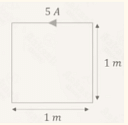
- The current of 5 A flows in a square loop of sides 1 m placed in air. The magnetic field at the center of the loop is \(X\sqrt{2} \times 10^{-7} \, T\). The value of X = _________.
- The electrostatic force (\( \vec{F_1} \)) and magnetic force (\( \vec{F_2} \)) acting on a charge \( q \) moving with velocity \( \vec{v} \) can be written:
- A single turn current loop in the shape of a right angle triangle with sides 5cm, 12cm, 13cm is carrying a current of 2A. The loop is in a uniform magnetic field of magnitude 0.75T whose direction is parallel to the current in the 13 cm side of the loop. The magnitude of the magnetic force on the 5 cm side will be \(\frac{x}{130} N\). The value of x is ________ .
Top JEE Main Questions
- Two masses $m$ and $\frac{m}{2}$ are connected at the two ends of a massless rigid rod of length $l$. The rod is suspended by a thin wire of torsional constant $k$ at the centre of mass of the rod-mass system(see figure). Because of torsional constant $k$, the restoring torque is $\tau =k\theta$ for angular displacement $\theta$. If the rod is rota ted by $\theta_0$ and released, the tension in it when it passes through its mean position will be:
What will be the equilibrium constant of the given reaction carried out in a \(5 \,L\) vessel and having equilibrium amounts of \(A_2\) and \(A\) as \(0.5\) mole and \(2 \times 10^{-6}\) mole respectively?
The reaction : \(A_2 \rightleftharpoons 2A\)- The value of is
- The number of terms of an is even. The sum of the odd terms is and of the even terms is . The last term exceeds the first by . Then the number of terms in the series is ______.
A black body is at a temperature of 2880 K. The energy of radiation emitted by this body with wavelength between 499 nm and 500 nm is U1, between 999 nm and 1000 nm is U2 and between 1499 nm and 1500 nm is U3. The Wien's constant, b = 2.88×10⁶ nm-K. Then,
Concepts Used:
Magnetic Force
Magnetic force is the attraction or repulsion force that results from the motion of electrically charged particles. The magnets are attracted or repellent to one another due to this force. A compass, a motor, the magnets that hold the refrigerator door, train tracks, and modern roller coasters are all examples of magnetic power.
A magnetic field is generated by all moving charges, and the charges that pass through its regions feel a force. Depending on whether the force is attractive or repulsive, it may be positive or negative. The magnetism force is determined by the object's charge, velocity, and magnetic field.
Read More: Magnetic Force and Magnetic Field
The magnitude of the magnetic force depends on how much charge is in how much motion in each of the objects and how far apart they are.
Mathematically, we can write magnetic force as:
A charge will feel a force as it passes through a magnetic field at an angle. This force is given by the equation:

A force acts on the motion of charge q traveling with velocity v in a Magnetism field, and this force is:
- Perpendicular to both v and B.
- Perpendicular to sinθ (where θ is the angle between v and B).
- Proportional to the charge q.
- Proportional to the velocity v.