Two identical metallic spheres A and B when placed at certain distance in air repel each other with a force of F. Another identical uncharged sphere C is first placed in contact with A and then in contact with B and finally placed at midpoint between spheres A and B. The force experienced by sphere C will be
- \(\frac{3}{2}F\)
- \(\frac{3}{4}F\)
- F
- 2F

The Correct Option is B
Approach Solution - 1
To solve the problem, we need to understand the impact of the interactions and the redistribution of charges among the spheres.
- Initially, let's assume that the charge on spheres \(A\) and \(B\) is \(q\) each. Since they repel each other with force \(F\), we know that: \(F = \frac{kq^2}{r^2}\), where \(k\) is Coulomb's constant, and \(r\) is the distance between the spheres.
- Sphere \(C\) is initially uncharged.
- When sphere \(C\) is brought into contact with sphere \(A\), the charge is shared between them. Since both spheres are identical, the charge will redistribute equally: \(q_{\text{after}} = \frac{q}{2}\) for both \(A\) and \(C\).
- Next, sphere \(C\) is brought into contact with sphere \(B\). Again, the charge is shared equally between \(B\) and \(C\). So, the charge on each sphere becomes: \(q_{\text{B final}} = \frac{q + \frac{q}{2}}{2} = \frac{3q}{4}\) and \(q_{\text{C final}} = \frac{3q}{4}\).
- Now, sphere \(C\) is placed at the midpoint between spheres \(A\) and \(B\).
- The net force on sphere \(C\) due to spheres \(A\) and \(B\) must be considered. The force between sphere \(A\) and \(C\) is: \(F_{A \to C} = \frac{k \left(\frac{q}{2}\right) \left(\frac{3q}{4}\right)}{\left(\frac{r}{2}\right)^2} = \frac{3kq^2}{2r^2}\). The force between sphere \(B\) and \(C\) is the same due to symmetry: \(F_{B \to C} = \frac{k \left(\frac{3q}{4}\right)^2}{\left(\frac{r}{2}\right)^2} = \frac{9kq^2}{4r^2}\).
- Adding these forces gives: \(F_{\text{net}} = \frac{3kq^2}{2r^2} - \frac{9kq^2}{4r^2} = \frac{3}{4}F\).
Thus, the force experienced by sphere \(C\) is \(\frac{3}{4}F\). Therefore, the correct answer is \(\frac{3}{4}F\).
Approach Solution -2
When two identical sphere come in contact with each other, the total charge on them is equally distribute.

\(\frac{kQ^2}{d^2}\)=F

F=\(\frac{k9Q^2}{16×\frac{d^2}{4}}−\frac{k3Q^2}{8×\frac{d^2}{4}}\)
=\(\frac{9kQ^2}{4d^2}−\frac{3kQ^2}{2d^2}\)
=\(\frac{kQ^2}{d^2}[\frac{9}{4}−\frac{3}{2}]\)
=\(\frac{6}{8}F\)
=\(\frac{3}{4}F\)
So, the correct option is (B): \(\frac{3}{4}F\)
Top JEE Main Physics Questions
- Two masses $m$ and $\frac{m}{2}$ are connected at the two ends of a massless rigid rod of length $l$. The rod is suspended by a thin wire of torsional constant $k$ at the centre of mass of the rod-mass system(see figure). Because of torsional constant $k$, the restoring torque is $\tau =k\theta$ for angular displacement $\theta$. If the rod is rota ted by $\theta_0$ and released, the tension in it when it passes through its mean position will be:
A black body is at a temperature of 2880 K. The energy of radiation emitted by this body with wavelength between 499 nm and 500 nm is U1, between 999 nm and 1000 nm is U2 and between 1499 nm and 1500 nm is U3. The Wien's constant, b = 2.88×10⁶ nm-K. Then,
- $I _{ CM }$ is the moment of inertia of a circular disc about an axis (CM) passing through its center and perpendicular to the plane of disc $I_{A B}$ is it's moment of inertia about an axis $AB$ perpendicular to plane and parallel to axis $CM$ at a distance $\frac{2}{3} R$ from center Where $R$ is the radius of the dise The ratio of $I _{ AB }$ and $I _{ CM }$ is $x: 9$ The value of $x$ is______

- A nucleus disintegrates into two smaller parts, which have their velocities in the ratio $3: 2$ The ratio of their nuclear sizes will be $\left(\frac{x}{3}\right)^{\frac{1}{3}}$ The value of ' $x$ ' is:-
- A particle starts with an initial velocity of 10.0 m/s along x-direction and accelerates uniformly at the rate of 2.0 m/s$^2$. The time taken by the particle to reach the velocity of 60.0 m/s is
Top JEE Main spherical lenses Questions
- The graph between \(\frac 1u\) and \(\frac 1v\) for a thin convex lens in order to determine its focal length is plotted as shown in the figure. The refractive index of lens is 1.5, and its both the surfaces have the same radius of curvature R. The value of R will be______cm.
(where u = object distance, v = image distance)
- Radius of curvature of equiconvex lens is 20 cm. Material of lens is having refractive index of 1.5. Find image distance from lens if an object is placed 10 cm away from the lens.
- A biconvex lens of refractive index 1.5 has a focal length of 20 cm in air. Its focal length when immersed in a liquid of refractive index 1.6 will be:
- For an object placed at a distance $24\, m$ from a lens, a sharp focused image is observed on a screen placed at a distance $12\, cm$ from the lens A glass plate of refractive index $15$ and thickness $1 \,cm$ is introduced between lens and screen such that the glass plate plane faces parallel to the screen By what distance should the object be shifted so that a sharp focused image is observed again on the screen?
Two objects \(A\) and \(B\)are placed at \(15\, cm\) and \(25\, cm\) from the pole in front of a concave mirros having radius of curvature \(40\, cm\). The distance between images formed by the mirror is:
Top JEE Main Questions
- Two masses $m$ and $\frac{m}{2}$ are connected at the two ends of a massless rigid rod of length $l$. The rod is suspended by a thin wire of torsional constant $k$ at the centre of mass of the rod-mass system(see figure). Because of torsional constant $k$, the restoring torque is $\tau =k\theta$ for angular displacement $\theta$. If the rod is rota ted by $\theta_0$ and released, the tension in it when it passes through its mean position will be:
What will be the equilibrium constant of the given reaction carried out in a \(5 \,L\) vessel and having equilibrium amounts of \(A_2\) and \(A\) as \(0.5\) mole and \(2 \times 10^{-6}\) mole respectively?
The reaction : \(A_2 \rightleftharpoons 2A\)- The value of is
- The number of terms of an is even. The sum of the odd terms is and of the even terms is . The last term exceeds the first by . Then the number of terms in the series is ______.
A black body is at a temperature of 2880 K. The energy of radiation emitted by this body with wavelength between 499 nm and 500 nm is U1, between 999 nm and 1000 nm is U2 and between 1499 nm and 1500 nm is U3. The Wien's constant, b = 2.88×10⁶ nm-K. Then,
Concepts Used:
Spherical Mirrors
A spherical mirror is a mirror which has been cut out of a spherical surface.
There are two kinds of spherical mirrors:
- Convex Mirror
- Concave Mirror
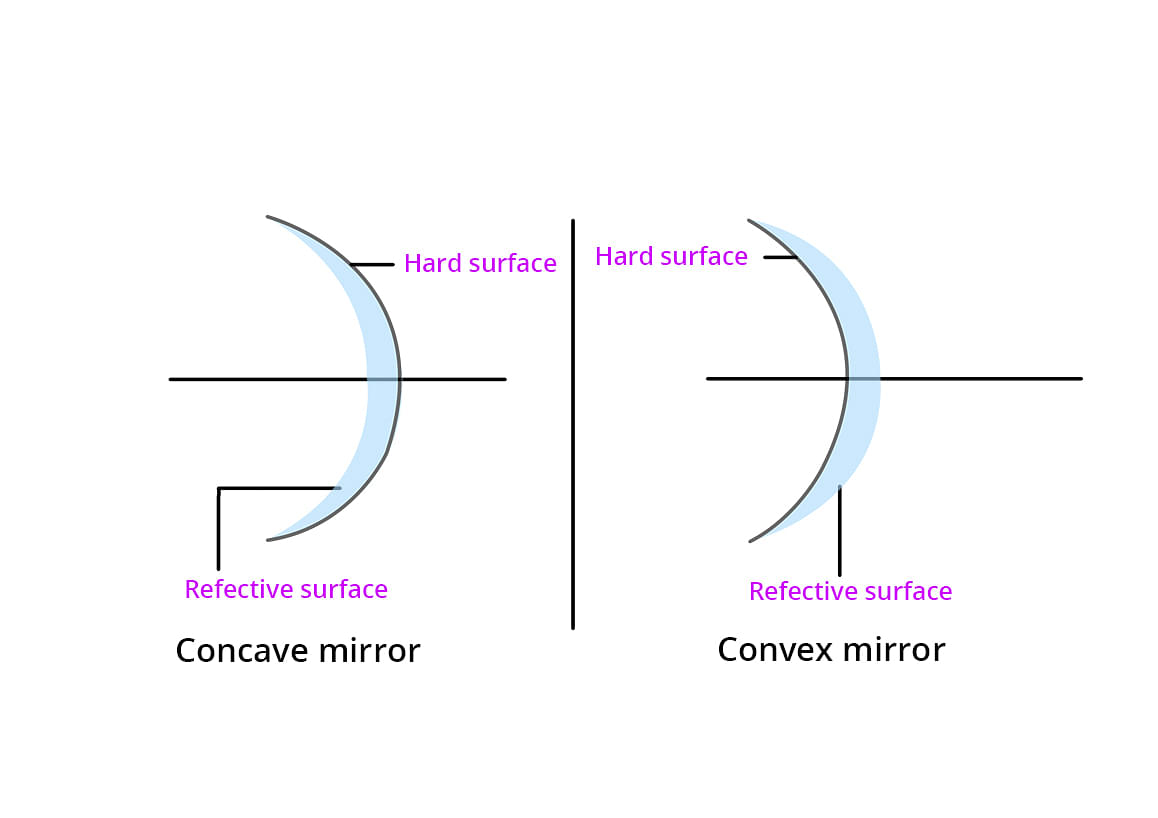
Concave Mirror
Concave mirrors are also called converging mirrors, because in these types of mirrors, light rays converge at a point after impact and reflect back from the reflective surface of the mirror.
Convex Mirror
The convex mirror has a reflective surface that is curved outward. Regardless of the distance between the subject and the mirrors, these mirrors are "always" virtual, upright and reduced.