Two blocks of masses 10 kg and 30 kg are placed on the same straight line with coordinates(0, 0) cm and (x, 0) cm respectively. The block of 10 kg is moved on the same line through a distance of 6 cm towards the other block. The distance through which the block of 30 kg must be moved to keep the position of Centre of mass of the system unchanged is
- 4 cm towards the 10 kg block
- 2 cm away from the 10 kg block
- 2 cm towards the 10 kg block
- 4 cm away from the 10 kg block

The Correct Option is C
Solution and Explanation
For COM to remain unchanged,
\(m_1x_1 = m_2m_2\)
\(⇒ 10 × 6 = 30 × x_2\)
\(⇒ x_2 = 2\) \(cm\) towards \(10\) \(kg\) block.
Therefore, the correct option is (C): \(2\) \(cm\) towards the \(10\) \(kg\) block
Top JEE Main Physics Questions
- Two masses $m$ and $\frac{m}{2}$ are connected at the two ends of a massless rigid rod of length $l$. The rod is suspended by a thin wire of torsional constant $k$ at the centre of mass of the rod-mass system(see figure). Because of torsional constant $k$, the restoring torque is $\tau =k\theta$ for angular displacement $\theta$. If the rod is rota ted by $\theta_0$ and released, the tension in it when it passes through its mean position will be:
A black body is at a temperature of 2880 K. The energy of radiation emitted by this body with wavelength between 499 nm and 500 nm is U1, between 999 nm and 1000 nm is U2 and between 1499 nm and 1500 nm is U3. The Wien's constant, b = 2.88×10⁶ nm-K. Then,
- $I _{ CM }$ is the moment of inertia of a circular disc about an axis (CM) passing through its center and perpendicular to the plane of disc $I_{A B}$ is it's moment of inertia about an axis $AB$ perpendicular to plane and parallel to axis $CM$ at a distance $\frac{2}{3} R$ from center Where $R$ is the radius of the dise The ratio of $I _{ AB }$ and $I _{ CM }$ is $x: 9$ The value of $x$ is______

- A nucleus disintegrates into two smaller parts, which have their velocities in the ratio $3: 2$ The ratio of their nuclear sizes will be $\left(\frac{x}{3}\right)^{\frac{1}{3}}$ The value of ' $x$ ' is:-
- A particle starts with an initial velocity of 10.0 m/s along x-direction and accelerates uniformly at the rate of 2.0 m/s$^2$. The time taken by the particle to reach the velocity of 60.0 m/s is
Top JEE Main Centre of mass Questions
- Two solid spheres each of mass 2 kg and radius 75 cm are arranged as shown. Find MOI of the system about the given axis.
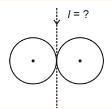
- Three blocks A, B and C are pulled on a horizontal smooth surface by a force of 80 N as shown in figure

The tensions T1 and T2 in the string are respectively: Find the value of m if \(M = 10\) \(kg\). All the surfaces are rough.
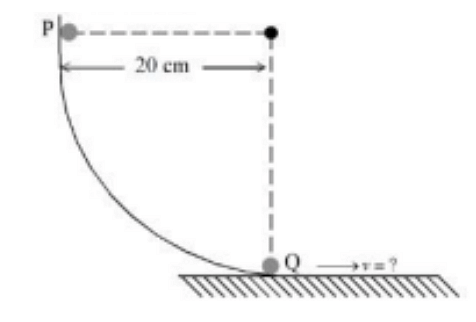
As per the given figure, a small ball $P$ slides down the quadrant of a circle and hits the other ball $Q$ of equal mass which is initially at rest Neglecting the effect of friction and assume the collision to be elastic, the velocity of ball $Q$ after collision will be :$\left( g =10 \,m / s ^2\right)$
- Three identical spheres each of mass $M$ are placed at the corners of a right angled triangle with mutually perpendicular sides equal to $3 m$ each Taking point of intersection of mutually perpendicular sides as origin, the magnitude of position vector of centre of mass of the system will be $\sqrt{ x } m$ The value of $x$ is
Top JEE Main Questions
- Two masses $m$ and $\frac{m}{2}$ are connected at the two ends of a massless rigid rod of length $l$. The rod is suspended by a thin wire of torsional constant $k$ at the centre of mass of the rod-mass system(see figure). Because of torsional constant $k$, the restoring torque is $\tau =k\theta$ for angular displacement $\theta$. If the rod is rota ted by $\theta_0$ and released, the tension in it when it passes through its mean position will be:
What will be the equilibrium constant of the given reaction carried out in a \(5 \,L\) vessel and having equilibrium amounts of \(A_2\) and \(A\) as \(0.5\) mole and \(2 \times 10^{-6}\) mole respectively?
The reaction : \(A_2 \rightleftharpoons 2A\)- The value of is
- The number of terms of an is even. The sum of the odd terms is and of the even terms is . The last term exceeds the first by . Then the number of terms in the series is ______.
A black body is at a temperature of 2880 K. The energy of radiation emitted by this body with wavelength between 499 nm and 500 nm is U1, between 999 nm and 1000 nm is U2 and between 1499 nm and 1500 nm is U3. The Wien's constant, b = 2.88×10⁶ nm-K. Then,
Concepts Used:
Center of Mass
The center of mass of a body or system of a particle is defined as a point where the whole of the mass of the body or all the masses of a set of particles appeared to be concentrated.
The formula for the Centre of Mass:

Center of Gravity
The imaginary point through which on an object or a system, the force of Gravity is acted upon is known as the Centre of Gravity of that system. Usually, it is assumed while doing mechanical problems that the gravitational field is uniform which means that the Centre of Gravity and the Centre of Mass is at the same position.