Question:
Treatment of squamous cell carcinoma of the anal canal is:
Treatment of squamous cell carcinoma of the anal canal is:
Show Hint
Anal canal SCC is cured with combined chemotherapy and radiotherapy, not surgery first; surgery is kept for salvage.
Updated On: Jul 8, 2026
- Cisplatin based chemotherapy followed by radical radiotherapy
- Abdominoperineal resection
- Radical radiotherapy
- Radical radiotherapy followed by mitomycin C based chemotherapy
Show Solution

Verified By Collegedunia
The Correct Option is A
Solution and Explanation
Step 1: Recall how anal canal cancer is treated.
Squamous cell carcinoma of the anal canal is not treated by surgery first. The tumor is treated with combined chemotherapy and radical radiotherapy, a plan often called chemoradiation. This approach cures most patients while keeping the anal sphincter intact, so a colostomy is avoided in most cases.
Step 2: Understand why chemotherapy comes before or with the radiotherapy.
Chemotherapy is started first because it shrinks the tumor and makes the cells more sensitive to the radiation that follows. This is the basis of the combined regimen that replaced surgery as the first line of treatment for this cancer.
Step 3: Rule out abdominoperineal resection.
Abdominoperineal resection removes the anus, rectum, and nearby tissue, leaving a permanent colostomy. It used to be the standard operation, but today it is kept for cases where chemoradiation fails or the cancer comes back, not for a newly diagnosed case.
Step 4: Rule out radiotherapy alone.
Radiotherapy by itself gives poorer local control because it misses the sensitizing effect of chemotherapy. Combined treatment consistently gives better cure rates than radiotherapy alone.
Step 5: Rule out radiotherapy followed by chemotherapy.
Giving the radical radiotherapy first and the chemotherapy afterward reverses the working order of the regimen. The chemotherapy needs to run before or together with the radiotherapy to sensitize the tumor, not after it.
Step 6: Final answer.
The sequence of chemotherapy followed by radical radiotherapy is the one that matches the combined modality plan used for this cancer.
\[ \boxed{\text{Chemotherapy followed by radical radiotherapy}} \]
Note: many current treatment guidelines run the chemotherapy (typically 5-fluorouracil with mitomycin C) at the same time as the radiotherapy rather than strictly before it, and cisplatin based regimens are used as an alternative to mitomycin C in some protocols. Among the four choices given here, chemotherapy paired with radical radiotherapy is still the closest match to the accepted non-surgical, sphincter-sparing approach, so option 1 is kept as the answer.
Squamous cell carcinoma of the anal canal is not treated by surgery first. The tumor is treated with combined chemotherapy and radical radiotherapy, a plan often called chemoradiation. This approach cures most patients while keeping the anal sphincter intact, so a colostomy is avoided in most cases.
Step 2: Understand why chemotherapy comes before or with the radiotherapy.
Chemotherapy is started first because it shrinks the tumor and makes the cells more sensitive to the radiation that follows. This is the basis of the combined regimen that replaced surgery as the first line of treatment for this cancer.
Step 3: Rule out abdominoperineal resection.
Abdominoperineal resection removes the anus, rectum, and nearby tissue, leaving a permanent colostomy. It used to be the standard operation, but today it is kept for cases where chemoradiation fails or the cancer comes back, not for a newly diagnosed case.
Step 4: Rule out radiotherapy alone.
Radiotherapy by itself gives poorer local control because it misses the sensitizing effect of chemotherapy. Combined treatment consistently gives better cure rates than radiotherapy alone.
Step 5: Rule out radiotherapy followed by chemotherapy.
Giving the radical radiotherapy first and the chemotherapy afterward reverses the working order of the regimen. The chemotherapy needs to run before or together with the radiotherapy to sensitize the tumor, not after it.
Step 6: Final answer.
The sequence of chemotherapy followed by radical radiotherapy is the one that matches the combined modality plan used for this cancer.
\[ \boxed{\text{Chemotherapy followed by radical radiotherapy}} \]
Note: many current treatment guidelines run the chemotherapy (typically 5-fluorouracil with mitomycin C) at the same time as the radiotherapy rather than strictly before it, and cisplatin based regimens are used as an alternative to mitomycin C in some protocols. Among the four choices given here, chemotherapy paired with radical radiotherapy is still the closest match to the accepted non-surgical, sphincter-sparing approach, so option 1 is kept as the answer.
Was this answer helpful?
0
0
Top NEET PG Surgery Questions
- A 55-year-old male presented with verrucous carcinoma around the glans of the penis. Examination reveals that the inguinal lymph nodes are not enlarged. What is the appropriate management for this patient?
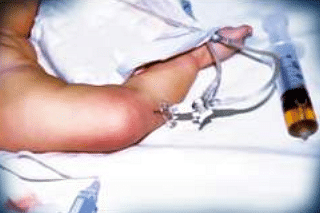
- Identify the procedure being performed in the image given below.
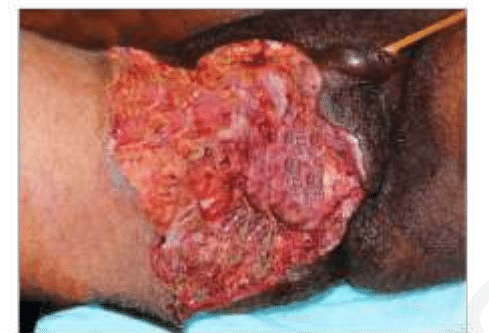
- A diabetic patient presents with sudden-onset perineal pain. On examination, foul-smelling discharge, and necrotic tissue as seen in the image is noted. Which of the following is true about the given condition?
- Which of the following is the most common complication following ligation of the first vessel during abdominoperineal resection for rectal carcinoma?(APR Abdominoperineal resection)
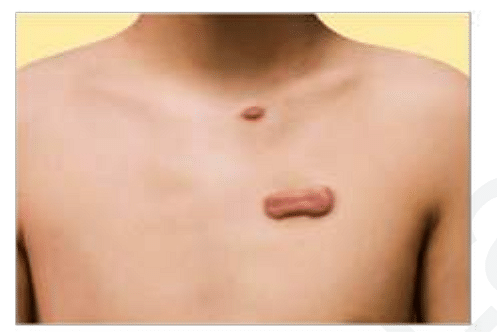
- A patient presents to the clinic with the lesion given in the image. He had a traumatic injury to the chest one year ago. What is the most likely diagnosis?
View More Questions
Top NEET PG Renal cell carcinoma Questions
- Treatment of renal cell carcinoma of less than 4 cm will be:

- A lady who presented with hematuria was, on evaluation, found to have stage 2 (muscle-invasive) transitional cell carcinoma of the bladder. Which of the following is true?
- A 40-year-old patient has a single kidney with an exophytic mass of 4 cm size at its lower pole. Which among the following is the best course of action?
- Which of the following is the most common renal vascular anomaly?
- Most common site of urethral carcinoma in men is:
Top NEET PG Questions
- A patient hailing from Delhi presents with fever, arthralgia, and extensive petechial rash for 3 days. Lab investigations revealed a hemoglobin of 9 g/ dL, a white blood cell count of 9000 cells/mm3, a platelet count of 20000 cells/mm3, and a prolonged bleeding time. The clotting time was normal. What is the most likely diagnosis?
- Which of the following statements is true about Trichomonas vaginalis?
- A lady from West Rajasthan presented with an ulcer surrounded by erythema on the right leg. Microscopy of the biopsy from the edge of the ulcer showed organisms with dark staining nuclei and kinetoplast. What is the most likely causative agent?
- A child presents with a fever and a rash. Urine examination showed cells with owl's eye appearance. What is the most likely diagnosis?
- Infection with Clonorchis sinensis is associated with an increased risk of__?
View More Questions