Question:
The species which follows the 18-electron rule is
(\(en = \mathrm{ethylenediamine}\))
The species which follows the 18-electron rule is
(\(en = \mathrm{ethylenediamine}\))
(\(en = \mathrm{ethylenediamine}\))
Show Hint
Use the ionic method: d-electron count of the metal in its real oxidation state, plus 2 electrons for every 2-electron donor ligand (including bidentate ligands counted twice); look for a total of 18.
Updated On: Aug 10, 2026
- \(\mathrm{[Rh(PPh_3)_3Cl]}\)
- \(\mathrm{[Co(NH_3)_6]^{2+}}\)
- \(\mathrm{[V(CO)_6]^{-}}\)
- \(\mathrm{[Ni(en)_3]^{2+}}\)
Show Solution

Verified By Collegedunia
The Correct Option is C
Solution and Explanation
Step 1: Understanding the Concept.
The 18-electron rule says a stable transition metal complex tends to have a total valence electron count of 18 around the metal, the same count as the next noble gas. Use the ionic method: write the metal in its actual oxidation state, take its d-electron count, then add 2 electrons for every neutral donor (L-type) ligand and 2 electrons for every anionic donor (X-type ligand counted as a 2-electron donor once it is written as an anion).
Step 2: Count option (A), \(\mathrm{[Rh(PPh_3)_3Cl]}\).
The complex is neutral and \(Cl\) is written as \(Cl^-\), so \(Rh\) must be \(Rh(I)\), which is \(d^8\) (8 electrons). Each \(PPh_3\) donates 2 electrons: \(3 \times 2 = 6\). \(Cl^-\) donates 2 electrons.
Total \(= 8 + 6 + 2 = 16\) electrons. This is Wilkinson's catalyst, a well known 16-electron, coordinatively unsaturated square planar complex, not 18.
Step 3: Count option (B), \(\mathrm{[Co(NH_3)_6]^{2+}}\).
\(Co\) here is \(Co(II)\), which is \(d^7\) (7 electrons). Each neutral \(NH_3\) donates 2 electrons: \(6 \times 2 = 12\).
Total \(= 7 + 12 = 19\) electrons, an odd number, so it cannot be 18. This matches the fact that \(\mathrm{[Co(NH_3)_6]^{2+}}\) is a paramagnetic, high spin \(d^7\) complex.
Step 4: Count option (C), \(\mathrm{[V(CO)_6]^{-}}\).
The complex carries a \(-1\) charge and all 6 \(CO\) ligands are neutral, so \(V\) must be in the \(-1\) oxidation state. Neutral \(V\) is a group 5 metal with 5 valence electrons, so \(V(-I)\) has \(5 + 1 = 6\) d-electrons. Each \(CO\) donates 2 electrons: \(6 \times 2 = 12\).
Total \(= 6 + 12 = 18\) electrons. This fits the 18-electron rule exactly, which is why the 17-electron neutral radical \(\mathrm{V(CO)_6}\) is so easily reduced to the stable, closed shell 18-electron anion \(\mathrm{[V(CO)_6]^-}\).
Step 5: Count option (D), \(\mathrm{[Ni(en)_3]^{2+}}\).
\(Ni\) here is \(Ni(II)\), which is \(d^8\) (8 electrons). \(en\) (ethylenediamine) is a bidentate, neutral donor, so each \(en\) contributes 2 donor atoms \(\times\) 2 electrons \(= 4\) electrons; three \(en\) ligands give \(3 \times 4 = 12\) electrons.
Total \(= 8 + 12 = 20\) electrons, above 18, consistent with \(\mathrm{[Ni(en)_3]^{2+}}\) being an octahedral \(d^8\) complex that does not need to obey the 18-electron rule.
Final Answer:
Only \(\mathrm{[V(CO)_6]^{-}}\) has exactly 18 valence electrons at the metal. \[ \boxed{\text{(C) } \mathrm{[V(CO)_6]^{-}}} \]
The 18-electron rule says a stable transition metal complex tends to have a total valence electron count of 18 around the metal, the same count as the next noble gas. Use the ionic method: write the metal in its actual oxidation state, take its d-electron count, then add 2 electrons for every neutral donor (L-type) ligand and 2 electrons for every anionic donor (X-type ligand counted as a 2-electron donor once it is written as an anion).
Step 2: Count option (A), \(\mathrm{[Rh(PPh_3)_3Cl]}\).
The complex is neutral and \(Cl\) is written as \(Cl^-\), so \(Rh\) must be \(Rh(I)\), which is \(d^8\) (8 electrons). Each \(PPh_3\) donates 2 electrons: \(3 \times 2 = 6\). \(Cl^-\) donates 2 electrons.
Total \(= 8 + 6 + 2 = 16\) electrons. This is Wilkinson's catalyst, a well known 16-electron, coordinatively unsaturated square planar complex, not 18.
Step 3: Count option (B), \(\mathrm{[Co(NH_3)_6]^{2+}}\).
\(Co\) here is \(Co(II)\), which is \(d^7\) (7 electrons). Each neutral \(NH_3\) donates 2 electrons: \(6 \times 2 = 12\).
Total \(= 7 + 12 = 19\) electrons, an odd number, so it cannot be 18. This matches the fact that \(\mathrm{[Co(NH_3)_6]^{2+}}\) is a paramagnetic, high spin \(d^7\) complex.
Step 4: Count option (C), \(\mathrm{[V(CO)_6]^{-}}\).
The complex carries a \(-1\) charge and all 6 \(CO\) ligands are neutral, so \(V\) must be in the \(-1\) oxidation state. Neutral \(V\) is a group 5 metal with 5 valence electrons, so \(V(-I)\) has \(5 + 1 = 6\) d-electrons. Each \(CO\) donates 2 electrons: \(6 \times 2 = 12\).
Total \(= 6 + 12 = 18\) electrons. This fits the 18-electron rule exactly, which is why the 17-electron neutral radical \(\mathrm{V(CO)_6}\) is so easily reduced to the stable, closed shell 18-electron anion \(\mathrm{[V(CO)_6]^-}\).
Step 5: Count option (D), \(\mathrm{[Ni(en)_3]^{2+}}\).
\(Ni\) here is \(Ni(II)\), which is \(d^8\) (8 electrons). \(en\) (ethylenediamine) is a bidentate, neutral donor, so each \(en\) contributes 2 donor atoms \(\times\) 2 electrons \(= 4\) electrons; three \(en\) ligands give \(3 \times 4 = 12\) electrons.
Total \(= 8 + 12 = 20\) electrons, above 18, consistent with \(\mathrm{[Ni(en)_3]^{2+}}\) being an octahedral \(d^8\) complex that does not need to obey the 18-electron rule.
Final Answer:
Only \(\mathrm{[V(CO)_6]^{-}}\) has exactly 18 valence electrons at the metal. \[ \boxed{\text{(C) } \mathrm{[V(CO)_6]^{-}}} \]
Was this answer helpful?
0
0
Top GATE CY Inorganic Chemistry Questions
- Which are optically active?
- Among the following, the compound with the lowest CO stretching frequency is
- The ground state of [Cr(H2O)6]2+ is
- The reaction of XeF2 with HN(SO2F)2 at 273 K in CF2Cl2 solvent yields
- The major product in the given reaction sequence is Q. The mass spectrum of Q shows
([M] = molecular ion peak)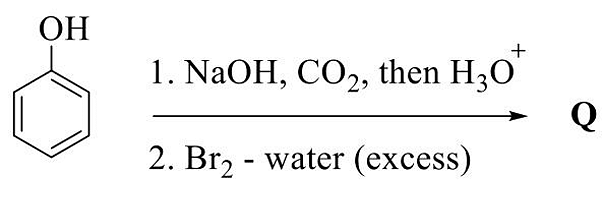
View More Questions
Top GATE CY Organometallic Compounds Questions
The reaction of \(NiBr_2\) with two equivalents of \(PPh_3\) in \(CS_2\) at -78°C gives a red-colored diamagnetic complex, \([NiBr_2 \text{(PPh}_3\text{)}_2]\). This transforms to a green-colored paramagnetic complex with the same molecular formula at 25°C. The geometry and the number of unpaired electrons in the green-colored complex, respectively, are:
- The correct order of increasing intensity (molar absorptivity) of the UV-visible absorption bands for the ions [Ti(H\(_2\)O)\(_6\)]\(^{3+}\), [Mn(H\(_2\)O)\(_6\)]\(^{2+}\), [CrO\(_4\)]\(^{2-}\), and [NiCl\(_4\)]\(^{2-}\) is:
- The species that undergoes \(\beta\)-elimination is
- The interconversion of oxidation states of metal(s) observed in Wacker process is(are)
- The correct electronic configuration of central metal ion in ferrocene with \(z\)-axis passing through the centre of two \(\mathrm{C_5H_5^-}\) rings and the metal ion is:
View More Questions
Top GATE CY Questions
- Ψ(x) = \(\sqrt{\frac{32}{L^3}}\)[sin(\(\frac{\pi x}{L}\)).cos(\(\frac{\pi x}{L}\)).sin(\(\frac{2\pi y}{L}\)).sin(\(\frac{\pi z}{L}\))]Find the value of E221: E111.
 what is the final product
- Which are optically active?
 intensity ratio of final product
- Which among the following is true?
View More Questions