Question:
The interconversion of oxidation states of metal(s) observed in Wacker process is(are)
The interconversion of oxidation states of metal(s) observed in Wacker process is(are)
Show Hint
Trace the Wacker catalytic cycle: palladium activates and releases the alkene product, then copper reoxidises palladium so oxygen can finish the loop.
Updated On: Aug 10, 2026
- \(\mathrm{Pd(II)/Pd(0)}\)
- \(\mathrm{Cu(II)/Cu(I)}\)
- \(\mathrm{Pd(IV)/Pd(II)}\)
- \(\mathrm{Cu(II)/Cu(0)}\)
Show Solution

Verified By Collegedunia
The Correct Option is A, B
Solution and Explanation
Step 1: Recall the overall Wacker process.
The Wacker process converts ethylene into acetaldehyde using a \(\mathrm{PdCl_2}\)/\(\mathrm{CuCl_2}\) catalyst system in water, with \(\mathrm{O_2}\) as the final oxidant.
\[ \mathrm{CH_2=CH_2 + \tfrac{1}{2}O_2 \xrightarrow{PdCl_2,\ CuCl_2} CH_3CHO} \]
Step 2: Follow the palladium cycle.
Ethylene coordinates to \(\mathrm{Pd(II)}\), and after attack by water and beta-hydride steps, acetaldehyde is released and the palladium is reduced from \(\mathrm{Pd(II)}\) to \(\mathrm{Pd(0)}\). So the palladium interconversion is \(\mathrm{Pd(II)/Pd(0)}\), matching option (A).
Step 3: Follow the copper cycle that reoxidises palladium.
\(\mathrm{Pd(0)}\) on its own would stop the catalytic cycle after one turnover. \(\mathrm{Cu(II)}\) chloride reoxidises \(\mathrm{Pd(0)}\) back to \(\mathrm{Pd(II)}\), and in doing so \(\mathrm{Cu(II)}\) itself is reduced to \(\mathrm{Cu(I)}\). So the copper interconversion is \(\mathrm{Cu(II)/Cu(I)}\), matching option (B). The \(\mathrm{Cu(I)}\) formed is then reoxidised back to \(\mathrm{Cu(II)}\) by \(\mathrm{O_2}\), closing the catalytic loop.
Step 4: Rule out options (C) and (D).
\(\mathrm{Pd(IV)/Pd(II)}\) chemistry appears in some C-H activation catalytic cycles, but not in the classic Wacker mechanism, which never forms \(\mathrm{Pd(IV)}\); this rules out (C). Copper never gets reduced all the way to metallic \(\mathrm{Cu(0)}\) in this cycle, it only shuttles between \(\mathrm{Cu(II)}\) and \(\mathrm{Cu(I)}\); this rules out (D).
Final Answer:
The observed interconversions are \(\mathrm{Pd(II)/Pd(0)}\) and \(\mathrm{Cu(II)/Cu(I)}\). \[ \boxed{\text{A, B}} \]
The Wacker process converts ethylene into acetaldehyde using a \(\mathrm{PdCl_2}\)/\(\mathrm{CuCl_2}\) catalyst system in water, with \(\mathrm{O_2}\) as the final oxidant.
\[ \mathrm{CH_2=CH_2 + \tfrac{1}{2}O_2 \xrightarrow{PdCl_2,\ CuCl_2} CH_3CHO} \]
Step 2: Follow the palladium cycle.
Ethylene coordinates to \(\mathrm{Pd(II)}\), and after attack by water and beta-hydride steps, acetaldehyde is released and the palladium is reduced from \(\mathrm{Pd(II)}\) to \(\mathrm{Pd(0)}\). So the palladium interconversion is \(\mathrm{Pd(II)/Pd(0)}\), matching option (A).
Step 3: Follow the copper cycle that reoxidises palladium.
\(\mathrm{Pd(0)}\) on its own would stop the catalytic cycle after one turnover. \(\mathrm{Cu(II)}\) chloride reoxidises \(\mathrm{Pd(0)}\) back to \(\mathrm{Pd(II)}\), and in doing so \(\mathrm{Cu(II)}\) itself is reduced to \(\mathrm{Cu(I)}\). So the copper interconversion is \(\mathrm{Cu(II)/Cu(I)}\), matching option (B). The \(\mathrm{Cu(I)}\) formed is then reoxidised back to \(\mathrm{Cu(II)}\) by \(\mathrm{O_2}\), closing the catalytic loop.
Step 4: Rule out options (C) and (D).
\(\mathrm{Pd(IV)/Pd(II)}\) chemistry appears in some C-H activation catalytic cycles, but not in the classic Wacker mechanism, which never forms \(\mathrm{Pd(IV)}\); this rules out (C). Copper never gets reduced all the way to metallic \(\mathrm{Cu(0)}\) in this cycle, it only shuttles between \(\mathrm{Cu(II)}\) and \(\mathrm{Cu(I)}\); this rules out (D).
Final Answer:
The observed interconversions are \(\mathrm{Pd(II)/Pd(0)}\) and \(\mathrm{Cu(II)/Cu(I)}\). \[ \boxed{\text{A, B}} \]
Was this answer helpful?
0
0
Top GATE CY Inorganic Chemistry Questions
- Which are optically active?
- Among the following, the compound with the lowest CO stretching frequency is
- The ground state of [Cr(H2O)6]2+ is
- The reaction of XeF2 with HN(SO2F)2 at 273 K in CF2Cl2 solvent yields
- The major product in the given reaction sequence is Q. The mass spectrum of Q shows
([M] = molecular ion peak)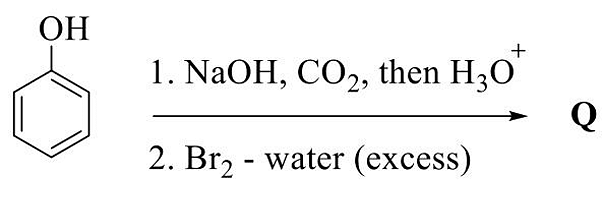
View More Questions
Top GATE CY Organometallic Compounds Questions
The reaction of \(NiBr_2\) with two equivalents of \(PPh_3\) in \(CS_2\) at -78°C gives a red-colored diamagnetic complex, \([NiBr_2 \text{(PPh}_3\text{)}_2]\). This transforms to a green-colored paramagnetic complex with the same molecular formula at 25°C. The geometry and the number of unpaired electrons in the green-colored complex, respectively, are:
- The correct order of increasing intensity (molar absorptivity) of the UV-visible absorption bands for the ions [Ti(H\(_2\)O)\(_6\)]\(^{3+}\), [Mn(H\(_2\)O)\(_6\)]\(^{2+}\), [CrO\(_4\)]\(^{2-}\), and [NiCl\(_4\)]\(^{2-}\) is:
- The species that undergoes \(\beta\)-elimination is
- The species which follows the 18-electron rule is
(\(en = \mathrm{ethylenediamine}\)) - The correct electronic configuration of central metal ion in ferrocene with \(z\)-axis passing through the centre of two \(\mathrm{C_5H_5^-}\) rings and the metal ion is:
View More Questions
Top GATE CY Questions
- Ψ(x) = \(\sqrt{\frac{32}{L^3}}\)[sin(\(\frac{\pi x}{L}\)).cos(\(\frac{\pi x}{L}\)).sin(\(\frac{2\pi y}{L}\)).sin(\(\frac{\pi z}{L}\))]Find the value of E221: E111.
 what is the final product
- Which are optically active?
 intensity ratio of final product
- Which among the following is true?
View More Questions