Question:
The species that undergoes \(\beta\)-elimination is
The species that undergoes \(\beta\)-elimination is
Show Hint
Beta-hydride elimination needs BOTH a hydrogen on the beta carbon AND an open coordination site cis to the alkyl group; check the electron count for a vacant site, and check whether the beta position is even a carbon with an H, phenyl and \(\mathrm{CH_2SiMe_3}\) fail this second test.
Updated On: Aug 10, 2026
- \([\mathrm{Rh(C_5H_5)(P(CH_3)_3)(C_2H_5)}]^{+}\)
- \([\mathrm{Rh(NH_3)_5(C_2H_5)}]^{2+}\)
- \([\mathrm{Pt(P(C_6H_5)_3)_2(C_6H_5)I}]\)
- \([\mathrm{Cr(CH_2Si(CH_3)_3)_4}]\)
Show Solution

Verified By Collegedunia
The Correct Option is A
Solution and Explanation
Step 1: Recall what beta-hydride elimination needs.
\(\beta\)-hydride elimination is the reverse of alkene insertion, a hydrogen on the carbon beta to the metal moves onto the metal, forming a metal hydride and releasing, or coordinating, an alkene. Two things are needed: (1) a hydrogen present on the carbon beta to the metal, in a geometry that can reach the metal, and (2) an open, cis coordination site on the metal for the developing metal-hydride and alkene to occupy, since the transition state needs the alkyl and the vacant site to be cis, going through an agostic interaction. A coordinatively saturated, 18-electron, complex cannot do this even if the beta-hydrogen is present, because there is nowhere for the mechanism to go.
Step 2: Check option (A), \([\mathrm{Rh(C_5H_5)(PMe_3)(C_2H_5)}]^{+}\).
Counting electrons ionically: \(\mathrm{Rh}\) here is \(\mathrm{Rh(III)}\), \(d^6\) (6 electrons), \(\eta^5\text{-}\mathrm{C_5H_5}^{-}\) donates 6 electrons, \(\mathrm{PMe_3}\) donates 2 electrons, and the ethyl group donates 2 electrons: \(6 + 6 + 2 + 2 = 16\) electrons. This is a 16-electron, coordinatively unsaturated complex, so it has an open coordination site cis to the ethyl group. The ethyl group has beta-hydrogens, on its \(\mathrm{CH_3}\) carbon, and the vacant site lets the molecule reach the four-centered agostic transition state needed for \(\beta\)-hydride elimination. This complex readily undergoes \(\beta\)-hydride elimination.
Step 3: Check option (B), \([\mathrm{Rh(NH_3)_5(C_2H_5)}]^{2+}\).
This is an octahedral, six-coordinate \(\mathrm{Rh(III)}\) complex with all six sites occupied by strong \(\sigma\)-donor ligands (five \(\mathrm{NH_3}\) plus the ethyl group), giving an 18-electron, coordinatively saturated center. Even though the ethyl group has beta-hydrogens, there is no open cis site for the elimination pathway, so this complex is stable toward \(\beta\)-hydride elimination, a classic textbook example of a saturated alkyl complex that does not eliminate.
Step 4: Check option (C), \([\mathrm{Pt(PPh_3)_2(C_6H_5)I}]\).
This square-planar \(\mathrm{Pt(II)}\), 16-electron complex does have an accessible open site, square-planar \(d^8\) complexes are coordinatively unsaturated, but the group here is a phenyl, an aromatic ring bonded to the metal through an \(sp^2\) carbon. The carbons "beta" to platinum are the aromatic ring carbons, and removing one of their hydrogens as a beta-hydride would break the aromaticity of the ring, far too costly energetically. Phenyl, and other aryl or vinyl, groups have no accessible \(\beta\)-hydrogens for this pathway, so this complex cannot undergo \(\beta\)-hydride elimination despite being unsaturated.
Step 5: Check option (D), \([\mathrm{Cr(CH_2Si(CH_3)_3)_4}]\).
The ligand here is \(\mathrm{{-}CH_2Si(CH_3)_3}\), trimethylsilylmethyl. The carbon directly bonded to chromium is \(\mathrm{CH_2}\), and the atom beta to the metal is silicon, not carbon. There is no beta carbon-hydrogen bond at all in this ligand, only a beta \(\mathrm{Si{-}C}\) bond, so the whole \(\beta\)-hydride elimination pathway is structurally unavailable. This is exactly why \(\mathrm{CH_2SiMe_3}\), like neopentyl, is a favorite ligand for making stable homoleptic high-oxidation-state alkyl complexes.
Final Answer:
Only the 16-electron, coordinatively unsaturated ethyl complex in option (A) has both a beta-hydrogen and the open site needed to use it. \[ \boxed{\text{(A)}} \]
\(\beta\)-hydride elimination is the reverse of alkene insertion, a hydrogen on the carbon beta to the metal moves onto the metal, forming a metal hydride and releasing, or coordinating, an alkene. Two things are needed: (1) a hydrogen present on the carbon beta to the metal, in a geometry that can reach the metal, and (2) an open, cis coordination site on the metal for the developing metal-hydride and alkene to occupy, since the transition state needs the alkyl and the vacant site to be cis, going through an agostic interaction. A coordinatively saturated, 18-electron, complex cannot do this even if the beta-hydrogen is present, because there is nowhere for the mechanism to go.
Step 2: Check option (A), \([\mathrm{Rh(C_5H_5)(PMe_3)(C_2H_5)}]^{+}\).
Counting electrons ionically: \(\mathrm{Rh}\) here is \(\mathrm{Rh(III)}\), \(d^6\) (6 electrons), \(\eta^5\text{-}\mathrm{C_5H_5}^{-}\) donates 6 electrons, \(\mathrm{PMe_3}\) donates 2 electrons, and the ethyl group donates 2 electrons: \(6 + 6 + 2 + 2 = 16\) electrons. This is a 16-electron, coordinatively unsaturated complex, so it has an open coordination site cis to the ethyl group. The ethyl group has beta-hydrogens, on its \(\mathrm{CH_3}\) carbon, and the vacant site lets the molecule reach the four-centered agostic transition state needed for \(\beta\)-hydride elimination. This complex readily undergoes \(\beta\)-hydride elimination.
Step 3: Check option (B), \([\mathrm{Rh(NH_3)_5(C_2H_5)}]^{2+}\).
This is an octahedral, six-coordinate \(\mathrm{Rh(III)}\) complex with all six sites occupied by strong \(\sigma\)-donor ligands (five \(\mathrm{NH_3}\) plus the ethyl group), giving an 18-electron, coordinatively saturated center. Even though the ethyl group has beta-hydrogens, there is no open cis site for the elimination pathway, so this complex is stable toward \(\beta\)-hydride elimination, a classic textbook example of a saturated alkyl complex that does not eliminate.
Step 4: Check option (C), \([\mathrm{Pt(PPh_3)_2(C_6H_5)I}]\).
This square-planar \(\mathrm{Pt(II)}\), 16-electron complex does have an accessible open site, square-planar \(d^8\) complexes are coordinatively unsaturated, but the group here is a phenyl, an aromatic ring bonded to the metal through an \(sp^2\) carbon. The carbons "beta" to platinum are the aromatic ring carbons, and removing one of their hydrogens as a beta-hydride would break the aromaticity of the ring, far too costly energetically. Phenyl, and other aryl or vinyl, groups have no accessible \(\beta\)-hydrogens for this pathway, so this complex cannot undergo \(\beta\)-hydride elimination despite being unsaturated.
Step 5: Check option (D), \([\mathrm{Cr(CH_2Si(CH_3)_3)_4}]\).
The ligand here is \(\mathrm{{-}CH_2Si(CH_3)_3}\), trimethylsilylmethyl. The carbon directly bonded to chromium is \(\mathrm{CH_2}\), and the atom beta to the metal is silicon, not carbon. There is no beta carbon-hydrogen bond at all in this ligand, only a beta \(\mathrm{Si{-}C}\) bond, so the whole \(\beta\)-hydride elimination pathway is structurally unavailable. This is exactly why \(\mathrm{CH_2SiMe_3}\), like neopentyl, is a favorite ligand for making stable homoleptic high-oxidation-state alkyl complexes.
Final Answer:
Only the 16-electron, coordinatively unsaturated ethyl complex in option (A) has both a beta-hydrogen and the open site needed to use it. \[ \boxed{\text{(A)}} \]
Was this answer helpful?
0
0
Top GATE CY Inorganic Chemistry Questions
- Which are optically active?
- Among the following, the compound with the lowest CO stretching frequency is
- The ground state of [Cr(H2O)6]2+ is
- The reaction of XeF2 with HN(SO2F)2 at 273 K in CF2Cl2 solvent yields
- The major product in the given reaction sequence is Q. The mass spectrum of Q shows
([M] = molecular ion peak)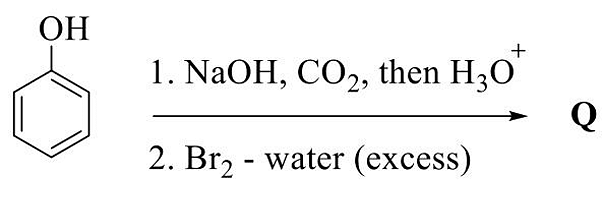
View More Questions
Top GATE CY Organometallic Compounds Questions
The reaction of \(NiBr_2\) with two equivalents of \(PPh_3\) in \(CS_2\) at -78°C gives a red-colored diamagnetic complex, \([NiBr_2 \text{(PPh}_3\text{)}_2]\). This transforms to a green-colored paramagnetic complex with the same molecular formula at 25°C. The geometry and the number of unpaired electrons in the green-colored complex, respectively, are:
- The correct order of increasing intensity (molar absorptivity) of the UV-visible absorption bands for the ions [Ti(H\(_2\)O)\(_6\)]\(^{3+}\), [Mn(H\(_2\)O)\(_6\)]\(^{2+}\), [CrO\(_4\)]\(^{2-}\), and [NiCl\(_4\)]\(^{2-}\) is:
- The species which follows the 18-electron rule is
(\(en = \mathrm{ethylenediamine}\)) - The interconversion of oxidation states of metal(s) observed in Wacker process is(are)
- The correct electronic configuration of central metal ion in ferrocene with \(z\)-axis passing through the centre of two \(\mathrm{C_5H_5^-}\) rings and the metal ion is:
View More Questions
Top GATE CY Questions
- Ψ(x) = \(\sqrt{\frac{32}{L^3}}\)[sin(\(\frac{\pi x}{L}\)).cos(\(\frac{\pi x}{L}\)).sin(\(\frac{2\pi y}{L}\)).sin(\(\frac{\pi z}{L}\))]Find the value of E221: E111.
 what is the final product
- Which are optically active?
 intensity ratio of final product
- Which among the following is true?
View More Questions