Question:
The similarity of bone structure in the forelimbs of many vertebrates is an example of
The similarity of bone structure in the forelimbs of many vertebrates is an example of
Updated On: Apr 24, 2026
- Homology
- Convergent evolution
- Analogy
- Adaptive radiation
Show Solution

Verified By Collegedunia
The Correct Option is A
Solution and Explanation
The question addresses the concept of similarity in bone structures among the forelimbs of different vertebrates. This biological phenomenon is known as homology. To fully understand why homology is the correct answer, let's explore the provided options:
- Homology: Homology refers to similarities resulting from common ancestry. In biological terms, it signifies that certain bones in the forelimbs of vertebrates have a common structural framework due to descent from a common ancestor. Despite the differences in shape and function (such as wings in birds, fins in whales, and arms in humans), the underlying structure reveals a shared evolutionary origin. This is why the similarity in bone structure in the forelimbs of many vertebrates is an example of homology.
- Convergent Evolution: Convergent evolution occurs when different species evolve similar traits independently, often because they adapt to similar environments or niches. However, the traits do not arise from a common ancestor, which distinguishes convergent evolution from homology.
- Analogy: Analogous structures are similar in function but not in origin. They arise due to convergent evolution. For example, the wings of birds and insects serve similar purposes but have dissimilar embryological origins, leading to this functional similarity being labeled an analogy rather than homology.
- Adaptive Radiation: Adaptive radiation involves the diversification of a species into different forms to adapt to various environments. It is a process by which organisms evolve to fill different ecological niches.
Given these definitions, it is evident that the similarity in bone structures such as the forelimbs across various vertebrate species arises from a shared evolutionary ancestry, thus making homology the correct answer.
Was this answer helpful?
0
0
Top NEET Biology Questions
- The chronological order of human evolution from early to the recent is
- Upper part of sea/aquatic ecosystem contains
- Where is respiratory electron transport system (ETS) located in plants ?
- Which among the following are the smallest living cells, known without a definite cell wall, pathogenic to plants as well as animals and can survive without oxygen ?
- Three of the following pairs of the human skeletal parts are correctly matched with their respective inclusive skeletal category and one pair is not matched. Identify the non-matching pair. .
Pair of skeletal parts Category (a)$\,\,$ Sternum and ribs$\,\,$ Axial skeleton (b)$\,\,$ Clavicle and glenoid cavity$\,\,$ Pelvic girdle (c)$\,\,$ Flumerus and ulna$\,\,$ Appendicular skeleton (d)$\,\,$ Malleus and stapes$\,\,$ Ear ossicles
View More Questions
Top NEET Human body Questions
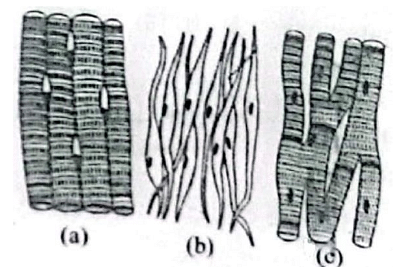
- Three types of muscles are given as a, b and c. Identify the correct matching pair along with their location in human body :
- Given below are two statements:
Statement I: The cerebral hemispheres are connected by nerve tract known as corpus callosum.
Statement II: The brain stem consists of the medulla oblongata, pons and cerebrum.
In the light of the above statements, choose the most appropriate answer from the options given below: - Match the following columns and select the correct option.
Column I
Column II A Floating Ribs I Located between second and seventh ribs B Acromion II Head of the Humerus C Scapula III Clavicle D Glenoid cavity IV Do not connect with the sternum
Top NEET Questions
- A $100.0\, mL$ dilute solution of $Ag ^{+}$is electrolysed for $15.0$ minutes with a current of $1.25 \,mA$ and the silver is removed completely. What was the initial $\left[ Ag ^{+}\right]$?
- The time constant of C-R circuit is
- The chronological order of human evolution from early to the recent is
- The correct Boolean operation represented by the circuit diagram drawn is :
- The driver of a car travelling with speed $30\, m/sec$ towards a hill sounds a horn of frequency $600\, Hz.$ If the velocity of sound in air is $330\, m/s,$ the frequency of reflected sound as heard by driver is
View More Questions