The reaction(s) that produce(s) the following compound is(are)
Show Hint
Ketenes give [2+2], not [4+2], with dienes; look for "masked ketone" dienophiles (nitroalkene reduced by TiCl3, or acetoxynitrile hydrolyzed by NaOH) instead.
Step 1: Identify the target compound.
The target is a bicyclic bridged compound built on a bicyclo[2.2.1]heptene skeleton (a norbornene framework) carrying a ketone on the two-carbon bridge, next to the ring double bond, i.e. bicyclo[2.2.1]hept-5-en-2-one ("5-norbornen-2-one"). This is exactly what a Diels-Alder reaction between cyclopentadiene (the diene) and a dienophile that ultimately delivers a plain \(\mathrm{C{=}O}\) group would give.
Step 2: Check option (A), dichloroketene [2+2].
\(\mathrm{HCCl_2COCl}\) with \(\mathrm{Et_3N}\) and heat eliminates \(\mathrm{HCl}\) in situ to generate dichloroketene, \(\mathrm{Cl_2C{=}C{=}O}\). Ketenes are poor Diels-Alder dienophiles; they react with dienes like cyclopentadiene through a \([2{+}2]\) cycloaddition at the less hindered alkene bond, giving a four-membered ring (cyclobutanone) fused to the cyclopentene ring, i.e. a bicyclo[3.2.0] skeleton. Even after the \(\mathrm{Zn/AcOH}\) dechlorination step, the ring size is wrong (four-membered, not the bridged bicyclo[2.2.1] skeleton of the target), so (A) does NOT give the target.
Step 3: Check option (B), nitroethylene as a formyl-cation equivalent.
Nitroethylene, \(\mathrm{CH_2{=}CHNO_2}\), is an excellent dienophile (the nitro group is strongly electron-withdrawing), so heating it with cyclopentadiene gives a normal Diels-Alder \([4{+}2]\) adduct: 5-nitrobicyclo[2.2.1]hept-2-ene. \(\mathrm{TiCl_3}\) in water is a classic mild one-electron reductant used for the Nef-type conversion of a secondary nitro group directly into a ketone (via the nitronate/nitroso intermediates). Applying it here converts the \(\mathrm{-NO_2}\) group on the bicyclic ring straight into \(\mathrm{C{=}O}\), giving 5-norbornen-2-one, the target. So (B) works.
Step 4: Check option (C), the acetoxy-nitrile ketone equivalent.
2-Acetoxyacrylonitrile, \(\mathrm{CH_2{=}C(OAc)(CN)}\), is a well known "masked ketene" dienophile: it is essentially the acetylated cyanohydrin of a ketene, made because ketenes themselves cannot do clean Diels-Alder chemistry. Heating with cyclopentadiene gives the normal \([4{+}2]\) adduct bearing both the acetoxy and cyano groups on the same bridging carbon. Base hydrolysis (\(\mathrm{NaOH,\ H_2O}\)) removes the acetate and then expels cyanide from the resulting cyanohydrin alkoxide (the reverse of cyanohydrin formation), unmasking the carbonyl. This again gives 5-norbornen-2-one, the target. So (C) works.
Step 5: Check option (D), the acyl chloride dienophile.
The drawn dienophile is a 2,3-dichloroacryloyl chloride type unit, i.e. it carries an acid chloride, not a ketone-equivalent, on the ring after cycloaddition. Base hydrolysis (\(\mathrm{NaOH, H_2O}\)) converts that acid chloride to a carboxylate (\(\mathrm{-COOH}/\mathrm{-COO^-}\)), not a ring ketone; the bridging carbon keeps a carboxylic acid/chloro substituent pattern rather than becoming \(\mathrm{C{=}O}\) IN the ring skeleton shown. So (D) does not give the target either.
Final Answer:
Only the nitroethylene/\(\mathrm{TiCl_3}\) route (B) and the acetoxyacrylonitrile/\(\mathrm{NaOH}\) route (C), both classic "ketone-equivalent" dienophiles used because ketenes cannot do a clean Diels-Alder, give the target norbornenone. \[ \boxed{\text{(B) and (C)}} \]


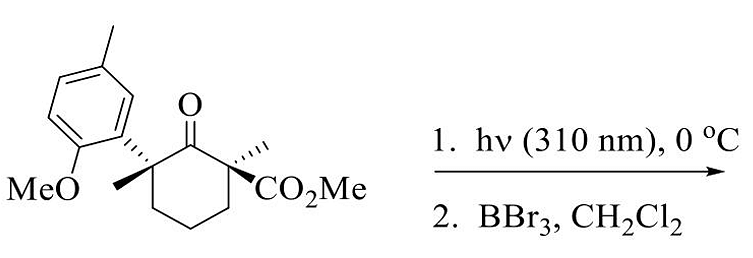
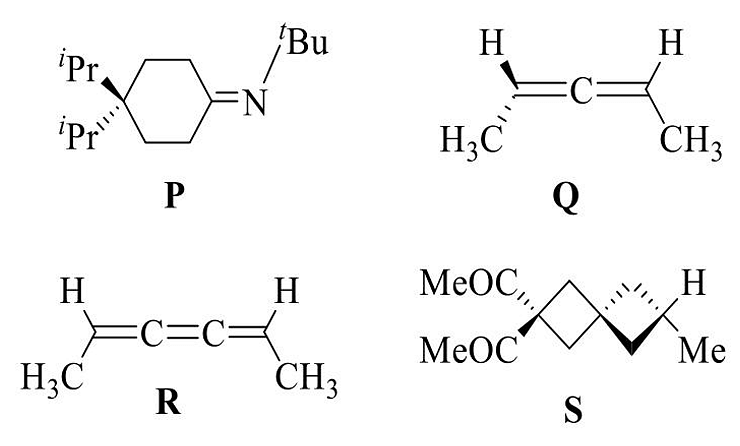
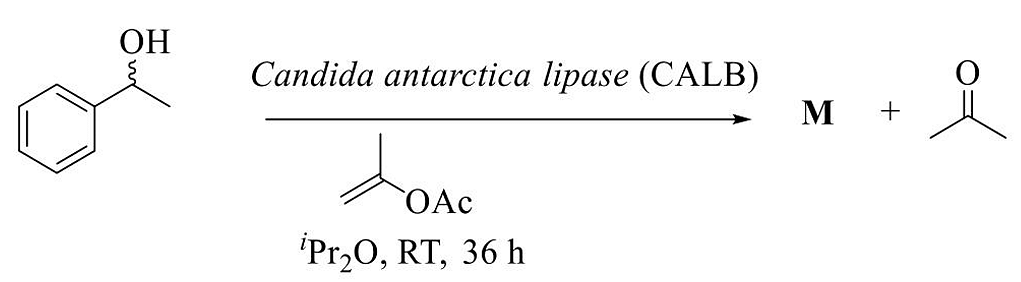
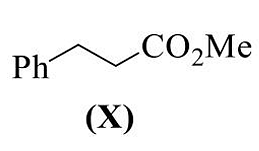


 what is the final product
 intensity ratio of final product