On heating, the compound \(\mathrm{Z}\) undergoes a series of 1,5-H/D shifts to give a mixture of its isomers. The total number of isomers present in the mixture (including \(\mathrm{Z}\)) is (in integer).
Show Hint
Each 1,5-H/D shift moves the sp3 kink of the cyclopentadiene ring to an adjacent carbon, carrying one specific isotope along suprafacially; track every distinct position/label combination reachable this way.
Step 1: Identify \(\mathrm{Z}\) and the rearrangement.
\(\mathrm{Z}\) is a cyclopentadiene carrying an isotopically labelled \(\mathrm{sp^3}\) carbon (bearing one H and one D, with the wedge/dash showing which face each occupies) plus a second D on one of the vinylic ring carbons.
On heating, cyclopentadienes undergo thermal, suprafacial \([1,5]\)-sigmatropic shifts: the H or D on the \(\mathrm{sp^3}\) carbon migrates across the adjacent diene system to the far end of the ring, so the \(\mathrm{sp^3}\) kink effectively walks around the five-membered ring one carbon at a time.
Step 2: See why this walk generates a family of isomers.
Each step of the walk can proceed toward either ring neighbour of the current \(\mathrm{sp^3}\) carbon, and the suprafacial requirement ties a specific face (front or back, i.e. specifically H or D) to each direction.
As the \(\mathrm{sp^3}\) centre visits each of the five ring carbons in turn, it also picks up or leaves behind the second, fixed ring-D whenever the walk passes through the carbon that originally carried it, and it carries the mobile H/D pair along in a way fixed by the ring geometry.
Step 3: Enumerate the distinguishable outcomes.
Tracking every combination of (i) which ring carbon is currently \(\mathrm{sp^3}\), (ii) which isotope sits on that \(\mathrm{sp^3}\) carbon's two faces, and (iii) where the second, originally-fixed D ends up as the walk proceeds, while removing any duplicate structure produced by the ring's own symmetry, gives 9 distinct labelled cyclopentadienes overall, one of which is \(\mathrm{Z}\) itself.
Final Answer:
The mixture formed by the full sequence of 1,5-H/D shifts contains 9 distinct isomers, including \(\mathrm{Z}\).
\[ \boxed{9} \]


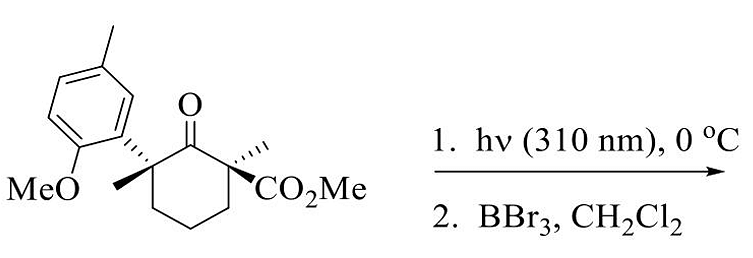
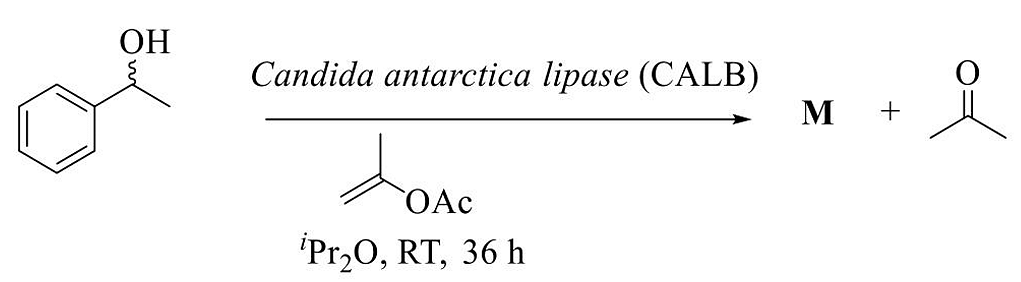


 what is the final product
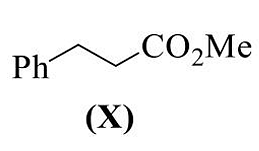
 intensity ratio of final product