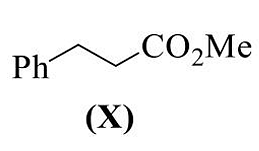
The correct statement about the intermediate formed in the following reaction is
Show Hint
Aziridine ring-opening to an azomethine ylide is a 4\(\pi\)-electron electrocyclic process; under thermal conditions the Woodward-Hoffmann rules require conrotatory ring-opening, and the resulting ylide geometry follows from that rotation sense.
is formed through conrotatory opening of \(\mathrm{X}\)
is formed through disrotatory opening of \(\mathrm{X}\)
is formed through conrotatory opening of \(\mathrm{X}\)
is formed through disrotatory opening of \(\mathrm{X}\)
Show Solution
Verified By Collegedunia
The Correct Option isA
Solution and Explanation
Step 1: Recognise the overall transformation.
Aziridine \(\mathrm{X}\) (a three-membered ring with \(\mathrm{N}\)-\(\mathrm{Ph}\) and two \(\mathrm{CO_2Me}\) groups on the ring carbons) is heated with diethyl acetylenedicarboxylate (\(\mathrm{EtO_2C}{-}\mathrm{C}{\equiv}\mathrm{C}{-}\mathrm{CO_2Et}\)) and gives a pyrrole. A three-membered N-heterocycle plus an alkyne giving a five-membered N-heterocycle is the classic signature of thermal aziridine-to-azomethine-ylide ring-opening followed by a 1,3-dipolar cycloaddition with the alkyne as dipolarophile.
Step 2: Identify the ring-opening step and count electrons.
The first step, breaking the \(\mathrm{C-C}\) bond of the aziridine to generate the 1,3-dipole (azomethine ylide), is a thermal electrocyclic ring-opening. The ylide is a 3-atom, 4-\(\pi\)-electron system (the anionic lone pair on one carbon plus the \(\mathrm{C=N^+}\) unit), so this is a 4\(\pi\) electrocyclic process.
Step 3: Apply the Woodward-Hoffmann rule.
For a 4\(\pi\)-electron electrocyclic reaction, the Woodward-Hoffmann selection rules require conrotatory ring-opening under thermal conditions (the two termini rotate the same way); disrotatory opening is only allowed photochemically. Since this reaction runs simply under heat, the ring must open conrotatory, which rules out options (B) and (D), both claiming disrotatory opening.
Step 4: Fix the geometry of the resulting ylide.
Conrotatory opening, with the two ester-bearing carbons rotating in the same direction, carries the two \(\mathrm{CO_2Me}\)-bearing termini into the extended, zig-zag arrangement about the newly formed \(\mathrm{C=N^+}{-}\mathrm{C^-}\) 2-azaallyl system shown in option (A), rather than the folded arrangement in option (C). This extended geometry is also set up correctly to react with the linear alkyne dipolarophile in the subsequent cycloaddition that builds the pyrrole product.
Final Answer:
The intermediate is the one drawn in option (A), formed through conrotatory (thermal, 4\(\pi\)) opening of \(\mathrm{X}\).
\[ \boxed{\text{Option (A)}} \]




 what is the final product
 intensity ratio of final product