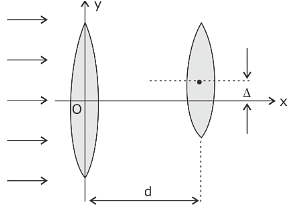
Let us assume that the focal length is denoted by \( f \), the object distance by \( u \), and the image distance by \( v \) (measured from the lens).
Step 1: Applying the lens formula
The lens formula to be used is:
\[
\frac{1}{f} = \frac{1}{v} - \frac{1}{u}
\]
Given for the first lens:
\[
f_1 = +10 \, \text{cm}, \quad u_1 = -30 \, \text{cm}
\]
Using the lens formula:
\[
\frac{1}{v_1} = \frac{1}{f_1} + \frac{1}{u_1}
\]
Substituting the values:
\[
\frac{1}{v_1} = \frac{1}{10} + \frac{1}{(-30)} = \frac{1}{15}
\]
Hence,
\[
v_1 = +15 \, \text{cm}
\]
As shown in the figure, the image of the first lens is formed at a distance of 15 cm, and this image will serve as the object for the second lens, placed to the right of the first lens.
Step 2: Considering the second lens
For the second lens:
\[
f_2 = -10 \, \text{cm}
\]
The object distance for this lens will be:
\[
u_2 = (15 - 5) = +10 \, \text{cm}
\]
Using the lens formula again:
\[
\frac{1}{v_2} = \frac{1}{f_2} + \frac{1}{u_2}
\]
Substituting the values:
\[
\frac{1}{v_2} = \frac{1}{(-10)} + \frac{1}{10} = 0
\]
Hence,
\[
v_2 = \infty
\]
The image formed by the second lens is at infinity. This image will now act as the object for the third lens placed to the right of the second lens.
Step 3: Calculating for the third lens
Given for the third lens:
\[
f_3 = +30 \, \text{cm}
\]
and since the image from the second lens is at infinity:
\[
u_3 = \infty
\]
Applying the lens formula:
\[
\frac{1}{v_3} = \frac{1}{f_3} + \frac{1}{u_3}
\]
\[
\frac{1}{v_3} = \frac{1}{30} + 0 \Rightarrow v_3 = +30 \, \text{cm}
\]
Final Result:
Thus, the final position of the image formed by this combination is:
\[
v_3 = +30 \, \text{cm}
\]
to the right of the third lens.
Was this answer helpful?
0
0
Show Solution
Verified By Collegedunia
Approach Solution -2
The image positions are calculated lens by lens using the lens formula: \[\frac{1}{f} = \frac{1}{v} - \frac{1}{u} \implies v = \frac{uf}{u + f}.\] For lens 1 (\(f_1 = 10 \, \text{cm}, u = -30 \, \text{cm}\)): \[v = \frac{(-30) \times 10}{-30 + 10} = \frac{-300}{-20} = 15 \, \text{cm}.\] The image forms 15 cm to the right of the first lens. For lens 2 (\(f_2 = -10 \, \text{cm}, u = 10 \, \text{cm}\)): \[v = \frac{10 \times (-10)}{10 - 10} = \infty.\] The image is formed at infinity due to parallel rays after the second lens. For lens 3 (\(f_3 = 30 \, \text{cm}, u = -\infty\)): \[v = f_3 = 30 \, \text{cm}.\] Thus, the final image is formed 30 cm to the right of the third lens.