Question:
The Municipality of a town increases water tax by 20% and water consumption decreased by 20%. Then the percentage of increase or decrease in the monthly expenditure is:
The Municipality of a town increases water tax by 20% and water consumption decreased by 20%. Then the percentage of increase or decrease in the monthly expenditure is:
Updated On: Jul 11, 2024
- 4% increase
- 4% decrease
- 5% increase
- 5% decrease
Show Solution

Verified By Collegedunia
The Correct Option is B
Solution and Explanation
The correct option is (B): 4% decrease.
Was this answer helpful?
0
0
Top CLAT Quantitative Aptitude Questions
- Automobiles are the most preferred mode of transport because they allow us to cover large distance quickly. Resultantly, vehicles have been developed that run on diesel, petrol and even on electricity, which is a remarkable innovative development. During a survey about the percentage wise distribution of cars in four different states, the information regarding ratio between the diesel engine cars, petrol engine cars and electric cars was collected. Total number of cars for which data was collected was 8000. Of these, State 1 had 15% of the total cars in the ratio of 3:4:1 (diesel, petrol and electric); State 2 had 20% of the total cars in the ratio of 5:3:2 (diesel, petrol and electric); State 3 had 30% of the total cars in the ratio of 4:5:3 (diesel, petrol and electric), and; State 4 had 35% of the total cars in the ratio of 7:5:2 (diesel, petrol and electric).
Based on the above information, answer the following questions. - A survey was conducted about the population of a particular region having working population of three lacs and information was collected about self-employed persons, casual wage workers, regular salaries employees of both urban and rural areas of the region. Self-employment is a key source of income in both rural and urban areas but it is more prevalent in rural areas (56% of the rural population) than in urban areas (40% of the urban population). Rural population was 48% of the total population. Regular salaried workers in urban areas were 48% of the urban population whereas in rural areas, regular salaried workers constituted 12% of the rural population. During the survey, the casual wage workers were found to be more common in rural areas than in urban areas. Casual wage workers in rural areas were 32% of the rural population whereas it was 12% of the urban population in urban areas.
Based on the above information, answer the following questions - The findings of Oxfam India’s latest ‘India Discrimination Report 2022’ indicate that there is a significant gap in the earnings between men and women in the case of regular and self-employment in urban areas. The lower wages for salaried women are due to 67 percent of discrimination and 33 percent due to lack of education and work experience. The average earning is ₹ 16,000 for men and merely ₹ 6,600 for women in urban areas in self-employment. The average earning of men is ₹ 19,800 as against ₹ 15,600 for women in regular/salaried employment in urban areas. Also, in urban areas the average earnings of men (₹ 9,000) are significantly higher than women (₹ 5,700) even in casual employment. Apart from women, historically oppressed communities along with religious minorities also continue to face discrimination in accessing jobs, livelihoods, and agricultural credit. The mean income for Scheduled Castes or Scheduled Tribes (“SC/ST”) persons in urban areas who are in regular employment is ₹ 15,300 as against ₹ 20,300 for persons belonging to the non-SC/ST category. The average earning of self-employed workers is ₹ 15,900 for non-SC/STs and ₹ 10,500 for SC/STs. The average monthly earning for the SC/ST workers in casual work is ₹ 8,000 below the corresponding figure of ₹ 8,600 for the non-SC/ST.
[Data Source: Oxfam India]
[Note: Values have been approximated to the nearest hundred] - World fruit production went up 54 percent between 2000 and 2019, to 883 million tonnes. Five fruit species accounted for 57 percent of the total production in 2019, down from 63 percent in 2000. Use the data in the passage to answer the following questions.
[Data source: fao] - Players are selected for Judo based on their body weights from the following 10 weight groups:
1. (48 kg - 52 kg)
2. (52 kg - 56 kg)
3. (56 kg - 60 kg)
4. (60 kg - 64 kg)
5. (64 kg - 68 kg)
6. (68 kg - 72 kg)
7. (72 kg - 76 kg)
8. (76 kg - 80 kg)
9. (80 kg - 84 kg)
10. (84 kg - 88 kg)
The average weight of the players after selecting one player from each group is 68 kg. If one of the players (named S) leaves the team, their average weight comes down to 66.5 kg
View More Questions
Top CLAT Percentage Questions
- Automobiles are the most preferred mode of transport because they allow us to cover large distance quickly. Resultantly, vehicles have been developed that run on diesel, petrol and even on electricity, which is a remarkable innovative development. During a survey about the percentage wise distribution of cars in four different states, the information regarding ratio between the diesel engine cars, petrol engine cars and electric cars was collected. Total number of cars for which data was collected was 8000. Of these, State 1 had 15% of the total cars in the ratio of 3:4:1 (diesel, petrol and electric); State 2 had 20% of the total cars in the ratio of 5:3:2 (diesel, petrol and electric); State 3 had 30% of the total cars in the ratio of 4:5:3 (diesel, petrol and electric), and; State 4 had 35% of the total cars in the ratio of 7:5:2 (diesel, petrol and electric).
Based on the above information, answer the following questions. - A survey was conducted about the population of a particular region having working population of three lacs and information was collected about self-employed persons, casual wage workers, regular salaries employees of both urban and rural areas of the region. Self-employment is a key source of income in both rural and urban areas but it is more prevalent in rural areas (56% of the rural population) than in urban areas (40% of the urban population). Rural population was 48% of the total population. Regular salaried workers in urban areas were 48% of the urban population whereas in rural areas, regular salaried workers constituted 12% of the rural population. During the survey, the casual wage workers were found to be more common in rural areas than in urban areas. Casual wage workers in rural areas were 32% of the rural population whereas it was 12% of the urban population in urban areas.
Based on the above information, answer the following questions - The findings of Oxfam India’s latest ‘India Discrimination Report 2022’ indicate that there is a significant gap in the earnings between men and women in the case of regular and self-employment in urban areas. The lower wages for salaried women are due to 67 percent of discrimination and 33 percent due to lack of education and work experience. The average earning is ₹ 16,000 for men and merely ₹ 6,600 for women in urban areas in self-employment. The average earning of men is ₹ 19,800 as against ₹ 15,600 for women in regular/salaried employment in urban areas. Also, in urban areas the average earnings of men (₹ 9,000) are significantly higher than women (₹ 5,700) even in casual employment. Apart from women, historically oppressed communities along with religious minorities also continue to face discrimination in accessing jobs, livelihoods, and agricultural credit. The mean income for Scheduled Castes or Scheduled Tribes (“SC/ST”) persons in urban areas who are in regular employment is ₹ 15,300 as against ₹ 20,300 for persons belonging to the non-SC/ST category. The average earning of self-employed workers is ₹ 15,900 for non-SC/STs and ₹ 10,500 for SC/STs. The average monthly earning for the SC/ST workers in casual work is ₹ 8,000 below the corresponding figure of ₹ 8,600 for the non-SC/ST.
[Data Source: Oxfam India]
[Note: Values have been approximated to the nearest hundred] - World fruit production went up 54 percent between 2000 and 2019, to 883 million tonnes. Five fruit species accounted for 57 percent of the total production in 2019, down from 63 percent in 2000. Use the data in the passage to answer the following questions.
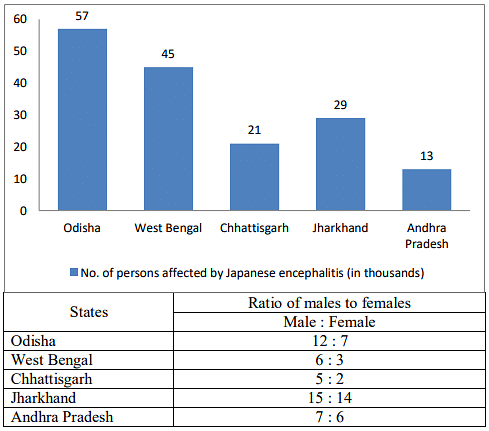
[Data source: fao] - The following data presents the cases of Japanese Encephalitis in five states of India
View More Questions
Top CLAT Questions
- In the realm of contemporary literature, the interplay between character and setting is a nuanced dance that shapes the narrative’s essence. The setting, often described with painstaking detail, becomes more than a backdrop; it becomes a character, influencing the plot and character development.
Consider, for instance, the barren expanse of the desert in Jhumpa Lahiri’s The Namesake. The arid landscape mirrors the sense of isolation felt by the protagonist, Gogol, as he navigates his identity crisis in a foreign land. The relentless sun and vast sands are not mere descriptions; they are the silent witnesses to his inner turmoil.
On the other end of the literary spectrum, there is Arundhati Roy’s The God of Small Things. The lush, vibrant Kerala backwaters are not just the setting; they are a character woven into the fabric of the story. The teeming, humid landscape reflects the complex web of human relationships and secrets that unravel in the narrative. This interplay is not confined to contemporary literature alone. In Shakespeare’s timeless tragedy Macbeth, the eerie and foreboding setting of the Scottish moors casts a dark shadow over the characters’ actions. The moors, shrouded in mist and mystery, serve as an ever-present omen of the impending tragedy. - The crisis of justice that is the subject matter of discussion in the media today is in fact the crisis of “justice for the middle class”. The main difference between India and the OECD (Organisation for Economic Cooperation and Development) countries is that whereas the middle class in these countries has reasonable access to justice, in India it does not. A vocal and powerful middle class has emerged in India since 1991. It is demanding reasonable access to justice. Much of the judicial reform effort will help meet this demand…
The question of justice for the poor is, however, an altogether different challenge. No country in the world has been able to secure justice for the poor. Most of the jails of the richest countries are filled with the poorest. The “masses” are more often victims of the criminal justice system than of crime. In India as well, jails are almost exclusively filled with the poor. The civil justice system is hardly accessible to them. They are often victimised by lawyers, touts and court staff. They are docket-excluded, a new type of untouchability. The language and the logic—and the colonial and feudal culture—of the judicial system are alien to them. It rarely takes cognisance of their needs and interests.
Their main concern, therefore, is to escape the attention of the justice system, criminal and civil. A landless Dalit person in the interior of Madhya Pradesh once gave me an insightful definition of a court from the perspective of the masses: “A court is a place where you are forcibly taken by the police to be punished; no one goes to a court.” In contrast, many lawyers and judges colloquially define a court as “a temple of justice where rights are protected”.
These sharply divergent visions mean that justice for one section is often injustice for another. Protecting the livelihood of traditional taxi and auto drivers from predatory pricing by corporate app-based taxi providers by imaginatively using the available tools of law to delay their incursion would be seen by the rich and by sections of the middle class as a failure of the judicial system, and possibly as also resulting in a downgrading of the “ease of doing business” measure. However, the masses would see such a judicial intervention as strong evidence of a good justice system. Although the conflict over competing visions of the nation and conflicting demands from social and economic segments have confined judicial reform of judicial administration mainly to “neutral” areas such as process reform, procedural law, technology, planning and court and case management, judge strength, and the workload of judges, there has been considerable improvement in these areas, and the judicial system has improved its performance.
[Extracted, with edits, from “Justice and the Two Ideas of India”, by G. Mohan Gopal, Frontline] - Everything she wanted was here, at Carignano, in Kasauli. Here, on the ridge of the mountain, in this quiet house. It was the place, and the time of life, that she had wanted and prepared for all her life-as she realized on the first day at Carignano, with a great, cool flowering of relief - and at last she had it. She wanted no one and nothing else. Whatever else came, or happened here, would be an unwelcome intrusion and distraction. This she tried to convey to the plodding postman with a cold and piercing stare from the height of the ridge onto his honest bull back. Unfortunately, he did not look up at her on the hilltop but stared stolidly down at the dust piling onto his shoes as he plodded on. A bullock-man, an oafish ox, she thought bitterly. She stepped backwards into the garden and the wind suddenly billowed up and threw the pine branches about as though to curtain her. She was grey, tall and thin and her silk sari made a sweeping, shivering sound and she fancied she could merge with the pine trees and be mistaken for one. To be a tree, no more and no less, was all she was prepared to undertake.
What pleased and satisfied her so, here at Carignano, was its barrenness. This was the chief virtue of all Kasauli of course-its starkness. It had rocks, it had pines, it had light and air. In every direction there was a sweeping view - to the north, of the mountains, to the south, of the plains. Occasionally an eagle swam through this clear unobstructed mass of light and air, that was all. And Carignano, her home on the ridge, had no more than that. Why should it? The sun shone on its white walls. Its windows were open the ones facing north opened on to the blue waves of the Himalayas flowing out and up to the line of ice and snow sketched upon the sky, while those that faced south looked down the plunging cliff to the plain stretching out, flat and sere to the blurred horizon.
Yes, there were some apricot trees close to the house. There were clumps of iris that had finished blooming. There was the kitchen with a wing of smoke lifting out of its chimney and a stack of wood outside its door. But these were incidental, almost unimportant.
[Extracted, with edits and revisions, from “Fire on the Mountain” by Anita Desai] - English literature is a vast and diverse field that has left an indelible mark on the world of letters. From the eloquent plays of William Shakespeare to the complex novels of Jane Austen and the profound poetry of William Wordsworth, English literature offers a window into the human experience. One of the luminaries of English literature is William Shakespeare, often hailed as the greatest playwright in the history of English language. His works, including Hamlet, Macbeth, and Romeo and Juliet, are celebrated for their exploration of human nature, love, ambition, and tragedy. His characters, such as the tormented Hamlet and the star-crossed lovers Romeo and Juliet, continue to captivate readers and audiences worldwide.
The 19th century ushered in a new era of literary giants. Jane Austen’s novels, such as Pride and Prejudice and Sense and Sensibility, provide incisive social commentary through the lens of wit and romance. Austen’s heroines, like Elizabeth Bennet and Elinor Dashwood, remain beloved literary figures known for their intelligence and resilience. The Romantic era brought forth poets like William Wordsworth and Samuel Taylor Coleridge, who celebrated * 8 UG the beauty of nature and the emotional intensity of the individual. Wordsworth’s ‘‘I Wandered Lonely as a Cloud’’ and Coleridge’s ‘‘The Rime of the Ancient Mariner’’ are testament to the power of the written words to evoke profound emotions and imagery. Moving towards 20th century, English literature continued to evolve. Virginia Woolf’s ground-breaking novel Mrs. Dalloway explored the inner thoughts and lives of its characters with a modernist narrative style. Dystopian visions, as seen in George Orwell’s Nineteen Eighty-Four provided stark warnings about the dangers of totalitarianism and the erosion of individual freedom.
Today, English literature is a global phenomenon, transcending borders and languages. Indian authors like Arundhati Roy, with her novel The God of Small Things, have won prestigious international literary awards. The book not only explores intricate family dynamics but also delves into the broader socio-political landscape of India. In summary, English literature is a testament to the enduring power of storytelling and the written word. It encompasses an array of authors, themes, and styles that continue to captivate and inspire readers across the world. - On the evening of the 10th, General Dyer arrived at Amritsar, and the Deputy-Commissioner handed over the civil power to him. He issued a proclamation by word of mouth that no meetings should be held. Two days later, after there had been no sort of riot, nor murder, General Dyer heard that a meeting was to be held at the Jallianwala Bagh. He proceeded there with about fifty troops, half British, half Indian, and a certain number of Ghurkas, armed with their kukris. The Jallianwala Bagh is an open space, half a mile square, which has one entry wide enough for three persons. The troops got in and lined up on a mound of debris. The walls, seven feet high, and the surrounding houses enclosed the people. There were, too, three alleys through which the people might have been able to pass. Within thirty seconds of the troops getting in, General Dyer gave orders to fire, and the crowd of people, estimated at anything from 5,000 to 20,000, who were sitting on the ground peacefully listening to the mob oratory, were fired on. The result of the troops’ fire into the mass of people we do not know. But we do know that Dyer’s own estimate of the casualties resulting from ten minutes continual individual firing, was 400 to 500 killed and 1,500 wounded. The people were not able to escape. They were people who had not offered any violence and who had not been warned. These people were shot down. After ten minutes, the ammunition was exhausted and the troops marched off, and they left 1,500 wounded there. There were men lying there for two days, dying of thirst, eating the ground, bleeding to death and nobody to look after them. Those who lived nearby came and carried away some of the wounded from the heap of dead and dying, but the unfortunate country people died there miserably of their wounds. This is what is done in 1919 in British India…
Centuries hence you will find Indian children brought up to this spot, just as they visit now the Cawnpore Well, and you can imagine the feelings of these Indians for generations over this terrible business.
[Col. Wedgwood, MP, speaking in the British Parliament, 22 December 1919]
View More Questions