Question:
The magnetic moment of lanthanide ions is determined from which one of the following relation?
The magnetic moment of lanthanide ions is determined from which one of the following relation?
Updated On: Apr 30, 2026
- $\mu \, \, = \, \sqrt{n(n+2)} $
- $\mu \, = g \sqrt{J(J+1)}$
- $\mu=g\sqrt{n(n+1)}$
- $\mu = 2 \sqrt{n(n+1)}$
Show Solution

Verified By Collegedunia
The Correct Option is B
Solution and Explanation
In lanthanoids, the \(4f\) orbitals are deeply buried and shielded by outer orbitals. As a result, the orbital motion of electrons is not quenched, and both spin (\(S\)) and orbital (\(L\)) angular momenta contribute to the magnetic moment.
These combine to give the total angular momentum quantum number \(J\):
\[
J = |L - S| \quad \text{(less than half-filled shell)}, \qquad
J = L + S \quad \text{(more than half-filled shell)}
\]
The magnetic moment is given by:
\[
\mu = g \sqrt{J(J+1)}
\]
where the Landé \(g\)-factor is:
\[
g = 1 + \frac{J(J+1) + S(S+1) - L(L+1)}{2J(J+1)}
\]
Was this answer helpful?
0
0
Top VITEEE Chemistry Questions
- Which of the following is not a characteristic of transition elements ?
- Most crystals show good cleavage because their atoms, ions or molecules are
- Which of the following sets consists only of essential amino acids ?
- The chemical composition of slag formed during the smelting process in the extraction of copper is
- The reaction,Zn(s) + CuSO4(aq) $\rightarrow$ZnSO4(aq) + Cu(s) is an example of a
View More Questions
Top VITEEE The Lanthanoids Questions
Top VITEEE Questions
- A motor of power $P_0$ is used to deliver water at a certain rate through a given horizontal pipe. To increase the rate of flow of water through the same pipe $n$ times, the power of the motor is increased to $P_1$. The ratio of $P_1 $ to $P_0$ is
- A $30\,V-90\,W$ lamp is operated on a $120\,V$ DC line. A resistor is connected in series with the lamp in order to glow it properly. The value of resistance is
- Which of the following is not a characteristic of transition elements ?
- Most crystals show good cleavage because their atoms, ions or molecules are
- Which of the following sets consists only of essential amino acids ?
View More Questions
Concepts Used:
Lanthanoids
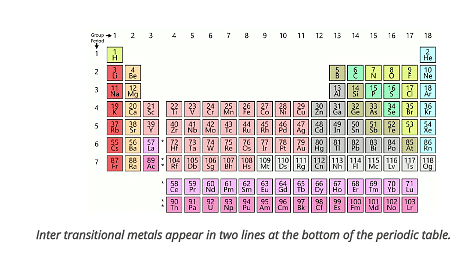
Lanthanoids are at the top of these two-row, while actinoids are at the bottom row.
Properties of Lanthanoids
Lanthanoids are inclusive of 14 elements, with atomic numbers 58-71:
- Cerium - Xe 4f1 5d1 6s2
- Praseodymium - Xe 4f3 6s2
- Neodymium - Xe 4f4 6s2
- Promethium - Xe 4f5 6s2
- Samarium - Xe 4f6 6s2
- Europium - Xe 4f7 6s2
- Gadolinium - Xe 4f7 5d1 6s2
- Terbium - Xe 4f9 6s2
- Dysprosium - Xe 4f10 6s2
- Holmium - Xe 4f11 6s2
- Erbium - Xe 4f12 6s2
- Thulium - Xe 4f13 6s2
- Ytterbium - Xe 4f14 6s2
- Lutetium - Xe 4f14 5d1 6s2
These elements are also called rare earth elements. They are found naturally on the earth, and they're all radioactively stable except promethium, which is radioactive. A trend is one of the interesting properties of the lanthanoid elements, called lanthanide contraction.