The equlibrium constant for the reaction $ 2N{{O}_{2}}(g) \rightleftharpoons 2NO(g)+{{O}_{2}}(g) $ is $ 2\times {{10}^{-6}} $ at $ 185{}^\circ C $ . Then the equilibrium constant for the reaction, $ 4NO(g)+2{{O}_{2}}(g) \rightleftharpoons $ $ 2N{{O}_{2}}(g) $ at the same temperature would be
- $ 2.5\times {{10}^{-5}} $
- $ 4\times {{10}^{-12}} $
- $ 2.5\times {{11}^{11}} $
- $ 2\times {{10}^{6}} $

The Correct Option is C
Solution and Explanation
Top KEAM Chemistry Questions
- The pH of a solution obtained by mixing 60 mL of 0.1 M BaOH solution at 40m of 0.15m HCI solution is
- $4\, g$ of copper was dissolved in concentrated nitric acid. The copper nitrate solution on strong heating gave $5\, g$ of its oxide. The equivalent weight of copper is :
- Green chemistry deals with
- Neopentyl bromide undergoes dehydrohalogenation to give alkenes even though it has no $\beta$- hydrogen. This is due to
- Plot of $ log\text{ }x/m $ against log $p$ is a straight line inclined at an angle of $ 45{}^\circ $ . When the pressure is $ 0.5 \,arm $ and Freundlich parameter. $ k $ is $ 10 $ , the amount of solute adsorbed per gram of adsorbent will be $ (log\text{ }5=0.6990) $
Top KEAM Law Of Chemical Equilibrium And Equilibrium Constant Questions
- Some of the reactions and their equilibrium constants Kc are given. Choose the reaction which proceeds rarely at the given temperature.
- The equilibrium constants for the following two reactions at 298k are given below:
2A ⇋ B+C; K1 =16
2B + C ⇋ 2X; K2 = 25
What is the value of k for the reaction, \(A+\frac{1}{2}B \rightleftharpoons X\) at 298K? - Which of the following is added to commercial salt to control hypothyroidism?
- For the gas phase homogeneous equilibrium:
\[ 2X(g) \rightleftharpoons 2Y(g) + Z(g) \]
$K_C$ at 400K is $1 \times 10^{-3}$ mol L-1. What is the value of $K_P$ for the equilibrium at 400K?\[ R = 0.082 \, \text{L atm K}^{-1} \, \text{mol}^{-1} \]
- For the equilibrium at 500 K, \( \text{N}_2 (\text{g}) + 3\text{H}_2 (\text{g}) \rightleftharpoons 2\text{NH}_3 (\text{g}) \), the equilibrium concentrations of \(\text{N}_2 (\text{g})\), \(\text{H}_2 (\text{g})\) and \(\text{NH}_3 (\text{g})\) are respectively 4.0 M, 2.0 M, and 2.0 M. The \(K_c\) for the formation of \(\text{NH}_3\) at 500 K is:
Top KEAM Questions
- i.$\quad$ They help in respiration ii.$\quad$ They help in cell wall formation iii.$\quad$ They help in DNA replication iv. $\quad$They increase surface area of plasma membrane Which of the following prokaryotic structures has all the above roles?
- A body oscillates with SHM according to the equation (in SI units), $x = 5 cos \left(2\pi t +\frac{\pi}{4}\right) .$ Its instantaneous displacement at $t = 1$ second is
- The pH of a solution obtained by mixing 60 mL of 0.1 M BaOH solution at 40m of 0.15m HCI solution is
Kepler's second law (law of areas) of planetary motion leads to law of conservation of
- If $\int e^{2x}f' \left(x\right)dx =g \left(x\right)$, then $ \int\left(e^{2x}f\left(x\right) + e^{2x} f' \left(x\right)\right)dx =$
Concepts Used:
Law of Chemical Equilibrium
Law of Chemical Equilibrium states that at a constant temperature, the rate of a chemical reaction is directly proportional to the product of the molar concentrations of the reactants each raised to a power equal to the corresponding stoichiometric coefficients as represented by the balanced chemical equation.
Let us consider a general reversible reaction;
A+B ↔ C+D
After some time, there is a reduction in reactants A and B and an accumulation of the products C and D. As a result, the rate of the forward reaction decreases and that of backward reaction increases.
Eventually, the two reactions occur at the same rate and a state of equilibrium is attained.
By applying the Law of Mass Action;
The rate of forward reaction;
Rf = Kf [A]a [B]b
The rate of backward reaction;
Rb = Kb [C]c [D]d
Where,
[A], [B], [C] and [D] are the concentrations of A, B, C and D at equilibrium respectively.
a, b, c, and d are the stoichiometric coefficients of A, B, C and D respectively.
Kf and Kb are the rate constants of forward and backward reactions.
However, at equilibrium,
Rate of forward reaction = Rate of backward reaction.
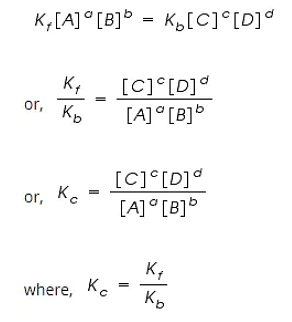
Kc is called the equilibrium constant expressed in terms of molar concentrations.
The above equation is known as the equation of Law of Chemical Equilibrium.