The equilibrium constant for the reaction $N_{2} +3H_{2} {\rightleftharpoons} 2NH_{3}$ is ?K?. Then, the equilibrium constant for the reaction
$2N_{2}+6H_{2} {\rightleftharpoons} 4NH_{3}$ will be
- K
- $K^{2}$
- $\sqrt{K}$
- 2K

The Correct Option is B
Solution and Explanation
$N_{2}+3H_{2} {\rightleftharpoons} \,2NH_{3},$ equilibrium constant = K. $\therefore K=\frac{\left[NH_{3}\right]^{2}}{\left[N_{2}\right]\left[H_{2}\right]^{3}}$ Now, for $2N_{2}+6H_{2} {\rightleftharpoons}\,4NH_{3},\, K^{'}=\frac{\left[NH_{3}\right]^{4}}{\left[N_{2}\right]^{2}\left[H_{2}\right]^{6}}=K^{2}$
Top WBJEE Chemistry Questions
- $20\, mL$ of $0.2\, M \,NaOH$ is added to $50\, mL$ of $0.2\, M$ acetic acid. The pH of this solution after mixing is $(Ka = 1.8 \times 10^{-5})$
- If molecular weight of $ KMn{{O}_{4}} $ is $M$, then its equivalent weight in acidic medium would be
- Which of the following has the smallest number of molecules?
- $ 4.6\times {{10}^{22}} $ atoms of an element weigh $13.8\,g$. The atomic weight of that element is
- The decomposition of hydrogen peroxide can be slowed by the addition of acetamide. The latter acts as a
Top WBJEE Law Of Chemical Equilibrium And Equilibrium Constant Questions
Consider the following gas phase dissociation, PCl$_5$(g) $\rightleftharpoons$ PCl$_3$(g) + Cl$_2$(g) with equilibrium constant K$_p$ at a particular temperature and at pressure P. The degree of dissociation ($\alpha$) for PCl$_5$(g) is
PCl$_5$(g) $\rightleftharpoons$ PCl$_3$(g) + Cl$_2$(g)- Consider the gas phase dissociation, PCl$_5$(g) $\rightleftharpoons$ PCl$_3$(g) + Cl$_2$(g) with equilibrium constant $K_p$ at a particular temperature and pressure $P$. The degree of dissociation ($\alpha$) for PCl$_5$(g) is
- For the reaction \(\text{A} \rightleftharpoons \text{B}\), variation of concentration is plotted against time as shown below.

Top WBJEE Questions
- Let $\vec{\alpha } = \hat{i} + \hat{j} + \hat{k} , \vec{\beta} = \hat{i} - \hat{j} - \hat{k}$ and $\vec{\gamma} = - \hat{i} + \hat{j} - \hat{k}$ be three vectors. A vector $\vec{\delta} $, in the plane of $\vec{\alpha}$ and $\vec{\beta}$, whose projection on $\vec{\gamma}$ is $\frac{1}{\sqrt{3}}$, is given by
- Let a, b, c be real numbers such that $a + b + c < 0$ and the quadratic equation $ax^2 + bx + c = 0$ has imaginary roots. Then
- If the radius of a spherical balloon increases by 0.1%, then its volume increases approximately by
- The velocity of a particle executing a simple harmonic motion is $13\, ms^{-1}$, when its distance from the equilibrium position (Q) is 3 m and its velocity is $12 \, ms^{-1}$, when it is 5 m away from The frequency of the simple harmonic motion is
- By which of the following methods, new and better varieties of plants can be formed?
Concepts Used:
Law of Chemical Equilibrium
Law of Chemical Equilibrium states that at a constant temperature, the rate of a chemical reaction is directly proportional to the product of the molar concentrations of the reactants each raised to a power equal to the corresponding stoichiometric coefficients as represented by the balanced chemical equation.
Let us consider a general reversible reaction;
A+B ↔ C+D
After some time, there is a reduction in reactants A and B and an accumulation of the products C and D. As a result, the rate of the forward reaction decreases and that of backward reaction increases.
Eventually, the two reactions occur at the same rate and a state of equilibrium is attained.
By applying the Law of Mass Action;
The rate of forward reaction;
Rf = Kf [A]a [B]b
The rate of backward reaction;
Rb = Kb [C]c [D]d
Where,
[A], [B], [C] and [D] are the concentrations of A, B, C and D at equilibrium respectively.
a, b, c, and d are the stoichiometric coefficients of A, B, C and D respectively.
Kf and Kb are the rate constants of forward and backward reactions.
However, at equilibrium,
Rate of forward reaction = Rate of backward reaction.
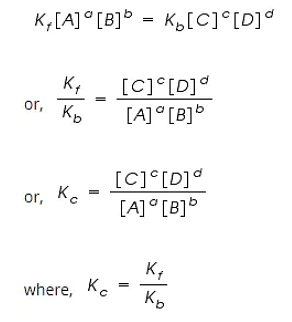
Kc is called the equilibrium constant expressed in terms of molar concentrations.
The above equation is known as the equation of Law of Chemical Equilibrium.