Question:
The correct order of $C-O $ bond length among $CO,CO_3^{2-}$, $CO_2$ is
The correct order of $C-O $ bond length among $CO,CO_3^{2-}$, $CO_2$ is
Updated On: May 26, 2026
- $CO_2 < CO_3^{2-} < CO$
- $CO < CO_3^{2-} < CO_2$
- $CO_3^{2-} < CO_2 < CO$
- $CO < CO_2 < CO_3^{2-}$
Show Solution

Verified By Collegedunia
The Correct Option is D
Solution and Explanation
A bond length is the average distance between the centres of nuclei of two bonded atoms.
A multiple bond (double or triple bonds) is always shorter than the corresponding single bond.
The C-atom in $CO_3^{2-}$ is $sp^2$ hybridised as shown:
The C-atom in $CO_2$ is $sp$ hybridised with bond distance carbon-oxygen is $122\, pm$.
$O = C = O \leftrightarrow ^+ O \equiv C - _O^- \leftrightarrow $
$ \hspace37mm$ $_O^- - C \equiv _O^+$
The C-atom in CO is sp hybridised with C-O bond distance is 110 pm.
$ \, \, \, \, \, \, \, :C \equiv O^+ :$
So, the correct order is
$ \, \, \, \, \, \, CO < CO_2 < CO_3^{2-}$
A multiple bond (double or triple bonds) is always shorter than the corresponding single bond.
The C-atom in $CO_3^{2-}$ is $sp^2$ hybridised as shown:
The C-atom in $CO_2$ is $sp$ hybridised with bond distance carbon-oxygen is $122\, pm$.
$O = C = O \leftrightarrow ^+ O \equiv C - _O^- \leftrightarrow $
$ \hspace37mm$ $_O^- - C \equiv _O^+$
The C-atom in CO is sp hybridised with C-O bond distance is 110 pm.
$ \, \, \, \, \, \, \, :C \equiv O^+ :$
So, the correct order is
$ \, \, \, \, \, \, CO < CO_2 < CO_3^{2-}$
Was this answer helpful?
0
0
Top NEET Chemistry Questions
- A $100.0\, mL$ dilute solution of $Ag ^{+}$is electrolysed for $15.0$ minutes with a current of $1.25 \,mA$ and the silver is removed completely. What was the initial $\left[ Ag ^{+}\right]$?
- Under isothermal condition, a gas at 300 K expands from 0.1 L to 0.25 L against a constant externalpressureof2bar Theworkdonebythe gas i s : [Given that 1Lbar= 100J)
- Unit of entropy is : -
- For a reaction, activation energy E$_a$=0 and the rate constant at 200K is 1.6×10$^6$s$^{-1}$. The rate constant at 400K will be- [Given that gas constant] R= 8.314 J K$^{-1}$ mol$^{-1}$
- Half-life period of a first order reaction is $1386\, s.$ The specific rate constant of the reaction is
View More Questions
Top NEET Molecular Orbital Theory Questions

Top NEET Questions
- A $100.0\, mL$ dilute solution of $Ag ^{+}$is electrolysed for $15.0$ minutes with a current of $1.25 \,mA$ and the silver is removed completely. What was the initial $\left[ Ag ^{+}\right]$?
- The time constant of C-R circuit is
- The chronological order of human evolution from early to the recent is
- The correct Boolean operation represented by the circuit diagram drawn is :
- The driver of a car travelling with speed $30\, m/sec$ towards a hill sounds a horn of frequency $600\, Hz.$ If the velocity of sound in air is $330\, m/s,$ the frequency of reflected sound as heard by driver is
View More Questions
Concepts Used:
Molecular Orbital Theory
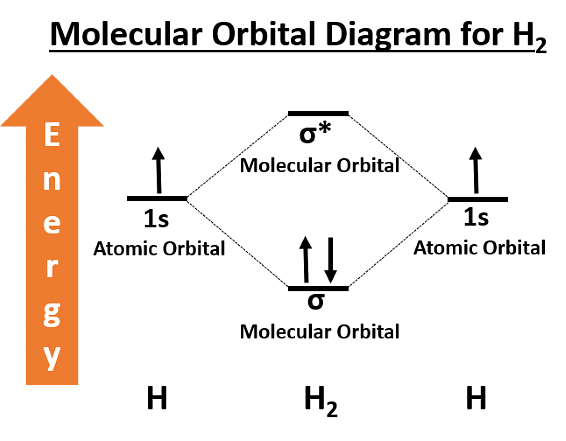
The Molecular Orbital Theory is a more sophisticated model of chemical bonding where new molecular orbitals are generated using a mathematical process called Linear Combination of Atomic Orbitals (LCAO).
Molecular Orbital theory is a chemical bonding theory that states that individual atoms combine together to form molecular orbitals. Due to this arrangement in MOT Theory, electrons associated with different nuclei can be found in different atomic orbitals. In molecular orbital theory, the electrons present in a molecule are not assigned to individual chemical bonds between the atoms. Rather, they are treated as moving under the influence of the atomic nuclei in the entire molecule.