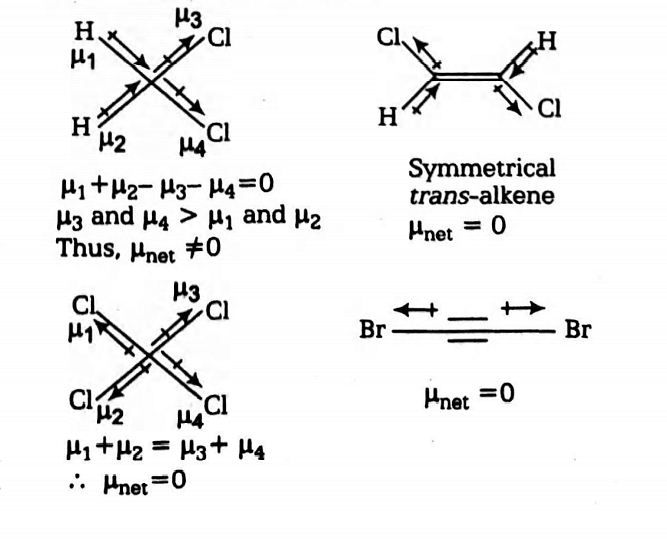
The compound that will have a permanent dipole moment among the following is
- $I$
- $II$
- $III$
- $IV$

The Correct Option is A
Solution and Explanation
$CH _{2} Cl _{2}$ is not a symmetrical molecule, thus it will have a permanent dipole.
Top WBJEE Chemistry Questions
- $20\, mL$ of $0.2\, M \,NaOH$ is added to $50\, mL$ of $0.2\, M$ acetic acid. The pH of this solution after mixing is $(Ka = 1.8 \times 10^{-5})$
- If molecular weight of $ KMn{{O}_{4}} $ is $M$, then its equivalent weight in acidic medium would be
- Which of the following has the smallest number of molecules?
- $ 4.6\times {{10}^{22}} $ atoms of an element weigh $13.8\,g$. The atomic weight of that element is
- The decomposition of hydrogen peroxide can be slowed by the addition of acetamide. The latter acts as a
Top WBJEE Questions
- Let $\vec{\alpha } = \hat{i} + \hat{j} + \hat{k} , \vec{\beta} = \hat{i} - \hat{j} - \hat{k}$ and $\vec{\gamma} = - \hat{i} + \hat{j} - \hat{k}$ be three vectors. A vector $\vec{\delta} $, in the plane of $\vec{\alpha}$ and $\vec{\beta}$, whose projection on $\vec{\gamma}$ is $\frac{1}{\sqrt{3}}$, is given by
- Let a, b, c be real numbers such that $a + b + c < 0$ and the quadratic equation $ax^2 + bx + c = 0$ has imaginary roots. Then
- If the radius of a spherical balloon increases by 0.1%, then its volume increases approximately by
- The velocity of a particle executing a simple harmonic motion is $13\, ms^{-1}$, when its distance from the equilibrium position (Q) is 3 m and its velocity is $12 \, ms^{-1}$, when it is 5 m away from The frequency of the simple harmonic motion is
- By which of the following methods, new and better varieties of plants can be formed?
Concepts Used:
Polarity of bonds
Polarity, in chemical bonding, distribution of electrical charge over the atoms joined by the bond. Specifically, while bonds between identical atoms, as in H2, are electrically uniform in the sense that both hydrogen atoms are electrically neutral, bonds between atoms of different elements are electrically inequivalent.
Non-polar Covalent Bond:
A non-polar covalent bond is a type of chemical bond that is formed when electrons are shared equally between two atoms. Thus, in an atom, the number of electrons shared by the adjacent atoms will be the same.
The covalent bond is also termed as nonpolar because the difference in electronegativity is mostly negligible.
Polar Covalent Bond:
A polar covalent bond exists when atoms with different electronegativities share electrons in a covalent bond. Consider the hydrogen chloride (HCl) molecule. Each atom in HCl requires one more electron to form an inert gas electron configuration.
Dipole Moment
Dipole moment is defined as the product of the magnitude of charge and the distance of separation between the centres of positive and negative charge.
Dipole moment is a vector quantity and it is denoted by µ.
µ = charge (Q) * Distance of separation(r)
The dipole moment is expressed in Debye units (D).