Question:
The capacitance of a capacitor with charge q and a potential difference V depends on :
The capacitance of a capacitor with charge q and a potential difference V depends on :
Updated On: May 1, 2026
- both q and V
- the geometry of the capacitor
- q only
- V only
Show Solution

Verified By Collegedunia
The Correct Option is B
Solution and Explanation
The capacitance of a capacitor is a measure of its ability to store charge per unit voltage. The relationship between these quantities can be summarized by the formula:
\(C = \frac{q}{V}\)
where:
- \(C\) is the capacitance,
- \(q\) is the charge stored on the capacitor,
- \(V\) is the potential difference across the capacitor.
To understand what determines the capacitance, let's explore the factors:
- The capacitance is independent of both the charge \((q)\) and the voltage \((V)\). It depends on the physical characteristics of the capacitor like:
- The area \((A)\) of the plates: Larger plate areas increase capacitance because there is more room to store charge.
- The distance \((d)\) between the plates: Smaller distances increase capacitance because the charge is more concentrated.
- The dielectric material between the plates: A material with higher permittivity increases capacitance.
- Option: 'Both \(q\) and \(V\)': This is incorrect because, although capacitance relates these values, it is not determined by them.
- Option: '\(q\) only': Incorrect because only variating charge \(q\) does not determine capacitance but adjusts with respect to capacitance and voltage.
- Option: '\(V\) only': Incorrect because the voltage does not independently determine capacitance.
Therefore, the correct answer is that the capacitance depends on the geometry of the capacitor and the material used, which fundamentally define the capacitor's ability to store charge for a given potential difference.
Was this answer helpful?
2
0
Top NEET Physics Questions
- The time constant of C-R circuit is
- The correct Boolean operation represented by the circuit diagram drawn is :
- The driver of a car travelling with speed $30\, m/sec$ towards a hill sounds a horn of frequency $600\, Hz.$ If the velocity of sound in air is $330\, m/s,$ the frequency of reflected sound as heard by driver is
- Two simple harmonic motions of angular frequency 100 and 1000 rad $s^1$ have the same displacement amplitude. The ratio of their maximum acceleration is
- In an ac circuit , an alternating voltage $e = 200 \sqrt2 \,sin \,100\, t$ volts is connected to a capacitor of capacitance $1 \,\mu \,F$. The rms value of the current in the circuit is :
View More Questions
Top NEET Capacitors and Capacitance Questions
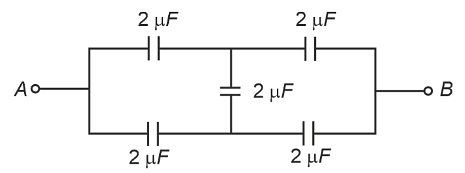
- In the following circuit, the equivalent capacitance between terminal A and terminal B is :
- A parallel plate capacitor is charged by connecting it to a battery through a resistor. If I is the current in the circuit, then in the gap between the plates :
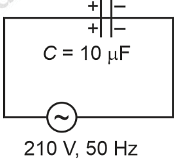
- A 10 µF capacitor is connected to a 210 V, 50 Hz source as shown in figure. The peak current in the circuit is nearly (π = 3.14) :
 :
: - The plates of a parallel plate capacitor are separated by d. Two slabs of different dielectric constant \(K_1\) and \(K_2\) with thickness \(d/2\) and \(d/2\) respectively are inserted in the capacitor. Due to this, the capacitance becomes two times larger than when there is nothing between the plates. If \(K_1 = 1.25 K_2\), the value of \(K_2\) is :
- The capacitance of a parallel plate capacitor with air as medium is $6\, \mu F$. With the introduction of a dielectric medium, the capacitance becomes 30 $\mu F.$ The permittivity of the medium is : $(\epsilon_0 = 8.85 \times 10^{-12} C^2N^{-1}m^{-2}$)
View More Questions
Top NEET Questions
- A $100.0\, mL$ dilute solution of $Ag ^{+}$is electrolysed for $15.0$ minutes with a current of $1.25 \,mA$ and the silver is removed completely. What was the initial $\left[ Ag ^{+}\right]$?
- The time constant of C-R circuit is
- The chronological order of human evolution from early to the recent is
- The correct Boolean operation represented by the circuit diagram drawn is :
- The driver of a car travelling with speed $30\, m/sec$ towards a hill sounds a horn of frequency $600\, Hz.$ If the velocity of sound in air is $330\, m/s,$ the frequency of reflected sound as heard by driver is
View More Questions