Pick the wrong answer in the context with rainbow.
- When the light rays undergo two internal reflections in a water drop, a secondary rainbow is formed.
- The order of colours is reversed in the secondary rainbow.
- An observer can see a rainbow when his front is towards the sun.
- Rainbow is a combined effect of dispersion, refraction and reflection of sunlight.

The Correct Option is C
Solution and Explanation
To determine which statement regarding rainbows is incorrect, let's evaluate each option:
- When the light rays undergo two internal reflections in a water drop, a secondary rainbow is formed.
This statement is correct. A secondary rainbow occurs when light is reflected twice inside the water droplets before coming out, resulting in a pattern with reversed colors compared to the primary rainbow.
- The order of colours is reversed in the secondary rainbow.
This statement is also correct. In a secondary rainbow, the order of colors is indeed reversed because the light is reflected an additional time inside the droplets, which alters the sequence of colors.
- An observer can see a rainbow when his front is towards the sun.
This statement is incorrect. Rainbows are typically seen with the observer's back to the sun because they form due to the refraction, dispersion, and reflection of sunlight in water droplets which occurs opposite to the sun. Therefore, the correct answer to this question is that this statement is the wrong one.
- Rainbow is a combined effect of dispersion, refraction and reflection of sunlight.
This statement is correct. Rainbows result from the dispersion (splitting of light into colors), refraction (bending of light as it enters water droplets), and reflection (bouncing of light inside the droplets), ultimately creating the colorful arc seen by observers.
The concept of rainbows involves understanding that they are created when sunlight disperses upon entering and exiting raindrops, causing a spectrum of light to appear in a circular arc. Observing a rainbow requires having the sun at the observer's back, casting light into the droplets ahead.
Top NEET Physics Questions
- The time constant of C-R circuit is
- The correct Boolean operation represented by the circuit diagram drawn is :
- The driver of a car travelling with speed $30\, m/sec$ towards a hill sounds a horn of frequency $600\, Hz.$ If the velocity of sound in air is $330\, m/s,$ the frequency of reflected sound as heard by driver is
- Two simple harmonic motions of angular frequency 100 and 1000 rad $s^1$ have the same displacement amplitude. The ratio of their maximum acceleration is
- In an ac circuit , an alternating voltage $e = 200 \sqrt2 \,sin \,100\, t$ volts is connected to a capacitor of capacitance $1 \,\mu \,F$. The rms value of the current in the circuit is :
Top NEET Refraction Through A Prism Questions
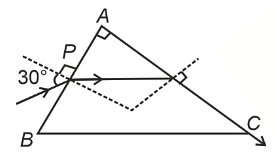
- A light ray enters through a right angled prism at point P with the angle of incidence 30° as shown in figure. It travels through the prism parallel to its base BC and emerges along the face AC. The refractive index of the prism is :
- A ray of monochromatic light is passing through an equilateral prism (ABC) as shown in the figure. The refracted ray (QR) is parallel to its base (BC) and the angle of incidence (i) is 50°. Then the angle of deviation ($\delta$) is: ____.

एकवर्णी प्रकाश की एक किरण, एक समबाहु प्रिज्म (ABC) से गुज़र रही है, जैसा कि चित्र में दर्शाया गया है। अपवर्तित किरण (QR) आधार (BC) के समांतर है और आपतन कोण (i) 50° है। तो विचलन कोण (\(\delta\)) है :

Top NEET Questions
- A $100.0\, mL$ dilute solution of $Ag ^{+}$is electrolysed for $15.0$ minutes with a current of $1.25 \,mA$ and the silver is removed completely. What was the initial $\left[ Ag ^{+}\right]$?
- The time constant of C-R circuit is
- The chronological order of human evolution from early to the recent is
- The correct Boolean operation represented by the circuit diagram drawn is :
- The driver of a car travelling with speed $30\, m/sec$ towards a hill sounds a horn of frequency $600\, Hz.$ If the velocity of sound in air is $330\, m/s,$ the frequency of reflected sound as heard by driver is