An aromatic compound ‘A’ on treatment with aqueous ammonia and heating forms compound ‘B’ which on heating with Br2 and KOH forms a compound ‘C’ of molecular formula C6H7N. Write the structures and IUPAC names of compounds A, B and C
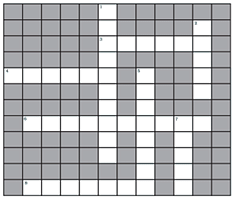
Here is a crossword puzzle: Good luck!
Across 3. Liquid waste products4. Solid waste extracted in sewage treatment6. A word related to hygiene8. Waste matter discharged from human bodyDown1. Used water2. A pipe carrying sewage5. Micro-organisms which causes cholera7. A chemical to disinfect water
In the circuit shown in Fig.
(i) Would any of the bulb glow when the switch is in the ‘OFF’ position?(ii) What will be the order in which the bulbs A, B and C will glow when the switch is moved to the ‘ON’ position?
Will the compass needle show deflection when the switch in the circuit shown by Fig. is closed?
Fig. shows four cells fixed on a board. Draw lines to indicate how you will connect their terminals with wires to make a battery of four cells.
The decomposition of A into product has value of k as \(4.5 \times 10^3 s^{-1}\) at \(10°C\) and energy of activation \(60\ kJ mol^{-1 }\). At what temperature would k be \(1.5 \times 10^4 s^{-1}\)?
Draw the circuit diagram to represent the circuit shown in Fig.
Fig. shows the distance-time graph for the motion of two vehicles A and B. Which one of them is moving faster?
For the decomposition of azoisopropane to hexane and nitrogen at 543 K, the following data are obtained.
Calculate the rate constant.
During nuclear explosion, one of the products is \(^{90}Sr\) with half-life of 28.1 years. If 1µg of \(^{90}Sr\) was absorbed in the bones of a newly born baby instead of calcium, how much of it will remain after 10 years and 60 years if it is not lost metabolically.
The rate constant for a first order reaction is 60 s-1. How much time will it take to reduce the initial concentration of the reactant to its \(\frac {1}{16}^{th}\) value?
The experimental data for decomposition of \(N_2O_5\)\([2N_2O_5→4NO_2+O_2]\)in gas phase at \(318 \ K\) are given below:
The half-life for radioactive decay of \(^{14}C\) is 5730 years. An archaeological artifact containing wood had only 80% of the \(^{14}C\) found in a living tree. Estimate the age of the sample.
The following results have been obtained during the kinetic studies of the reaction:\(2A+B→C+D\)
Determine the rate law and the rate constant for the reaction.
In a reaction between A and B the initial rate of reaction (r0) was measured for different initial concentrations of A and B as given below:
A/mol L-1
0.20
0.40
B/mol L-1
0.30
0.10
0.05
ro/mol L-1 s-1
5.07x10⁻⁵
1.43x10⁻⁴
What is the order of the reaction with respect to A and B?
In a pseudo first order hydrolysis of ester in water, the following results were obtained: