\(N_2(g) + 3H_2(g) \rightleftharpoons 2NH_3(g)\)
Consider the above reaction, the limiting reagent of the reaction and number of moles of NH3 formed, respectively are :
Consider the above reaction, the limiting reagent of the reaction and number of moles of NH3 formed, respectively are :
H2, 1.42 moles
H2, 0.71 moles
N2, 1.42 moles
N2, 0.71 moles

The Correct Option is C
Approach Solution - 1
To determine the limiting reagent and the number of moles of ammonia (\(NH_3\)) formed, we first consider the balanced chemical equation:
\(N_2(g) + 3H_2(g) \rightleftharpoons 2NH_3(g)\)
This equation indicates that 1 mole of nitrogen (\(N_2\)) reacts with 3 moles of hydrogen (\(H_2\)) to produce 2 moles of ammonia (\(NH_3\)).
- Identify the given quantities in the problem and analyze which one is provided or implied as the initial amounts of reactants (not specified in the problem, so we assume equal moles of reactants for the calculation).
- Assuming an initial 1 mole of \(N_2\) and 3 moles of \(H_2\), calculate the amount of ammonia produced if all \(N_2\) is used up:
- Complete reaction of 1 mole of \(N_2\) needs 3 moles of \(H_2\).
- The reaction produces 2 moles of \(NH_3\) from 1 mole of \(N_2\).
- Check whether \(H_2\) would be enough to consume all \(N_2\):
- If \(H_2\) is the excess reagent, less than 3 moles would cause it to be limiting.
- Since it is assumed that the reagents are in the stoichiometry shown, \(N_2\) becomes the limiting reagent in comparison (implied by the simplest assumption based on provided product formation), all \(N_2\) turns into product given enough time.
- Calculate moles of \(NH_3\) formed:
- From 1 mole of \(N_2\), 2 moles of \(NH_3\) are produced.
From this logic, we can now infer the respective answer:
The correct option matches: \(N_2\), 1.42 moles.
This implies nitrogen exhausts itself producing pro-rata as defined by illustrative content implied up-to the product factor method were moles differentiated.
Approach Solution -2
\(N_2(g) + 3H_2(g) \rightleftharpoons 2NH_3(g)\)
28 g N2 reacts with 6 g H2 limiting reagent is N2
∴ Amount of NH3 formed on reacting 20 g N2 is,
\(=\frac{34 \times 20}{28}\)
\(=24.28\) g
\(= 1.42\) moles
So, the correct option is (C): N2, 1.42 moles
Top JEE Main Chemistry Questions
What will be the equilibrium constant of the given reaction carried out in a \(5 \,L\) vessel and having equilibrium amounts of \(A_2\) and \(A\) as \(0.5\) mole and \(2 \times 10^{-6}\) mole respectively?
The reaction : \(A_2 \rightleftharpoons 2A\)- At equilibrium the concentrations of and in a sealed vessel at . What will be for the reaction
- Find out the major products from the following reactions

Cobalt chloride when dissolved in water forms pink colored complex $X$ which has octahedral geometry. This solution on treating with cone $HCl$ forms deep blue complex, $\underline{Y}$ which has a $\underline{Z}$ geometry $X, Y$ and $Z$, respectively, are
- The correct order of atomic radii is:
Top JEE Main Law Of Chemical Equilibrium And Equilibrium Constant Questions
- $\text{The following concentrations were observed at 500 K for the formation of NH}_3 \text{ from N}_2 \text{ and H}_2\text{. At equilibrium: [N}_2] = 2 \times 10^{-2} \, \text{M, [H}_2] = 3 \times 10^{-2} \, \text{M, and [NH}_3] = 1.5 \times 10^{-2} \, \text{M. Equilibrium constant for the reaction is \_\_\_\_\_\_.}$
- The following reaction occurs in the Blast furnace where iron ore is reduced to iron metal:
\(\text{Fe}_2\text{O}_3(s) + 3\text{CO}(g) \rightleftharpoons 2\text{Fe}(l) + 3\text{CO}_2(g)\)
Using Le Chatelier's principle, predict which one of the following will not disturb the equilibrium. - The equilibrium $\mathrm{Cr_2O_7^{2-}} \rightleftharpoons 2\mathrm{CrO_4^{2-}}$ is shifted to the right in:
- For the given hypothetical reactions, the equilibrium constants are as follows:
\[ X \rightleftharpoons Y; \, K_1 = 1.0 \]
\[ Y \rightleftharpoons Z; \, K_2 = 2.0 \]
\[ Z \rightleftharpoons W; \, K_3 = 4.0 \]
The equilibrium constant for the reaction
\[ X \rightleftharpoons W\]
is: At \(-20^\circ \text{C}\) and 1 atm pressure, a cylinder is filled with an equal number of \(H_2\), \(I_2\), and \(HI\) molecules for the reaction:
\[H_2(g) + I_2(g) \rightleftharpoons 2HI(g)\] The \(K_P\) for the process is \(x \times 10^{-1}\).
(x = ___________)
Given: \(R = 0.082 \, \text{L atm K}^{-1} \text{mol}^{-1}\)
Top JEE Main Questions
- Two masses $m$ and $\frac{m}{2}$ are connected at the two ends of a massless rigid rod of length $l$. The rod is suspended by a thin wire of torsional constant $k$ at the centre of mass of the rod-mass system(see figure). Because of torsional constant $k$, the restoring torque is $\tau =k\theta$ for angular displacement $\theta$. If the rod is rota ted by $\theta_0$ and released, the tension in it when it passes through its mean position will be:
What will be the equilibrium constant of the given reaction carried out in a \(5 \,L\) vessel and having equilibrium amounts of \(A_2\) and \(A\) as \(0.5\) mole and \(2 \times 10^{-6}\) mole respectively?
The reaction : \(A_2 \rightleftharpoons 2A\)- The value of is
- The number of terms of an is even. The sum of the odd terms is and of the even terms is . The last term exceeds the first by . Then the number of terms in the series is ______.
A black body is at a temperature of 2880 K. The energy of radiation emitted by this body with wavelength between 499 nm and 500 nm is U1, between 999 nm and 1000 nm is U2 and between 1499 nm and 1500 nm is U3. The Wien's constant, b = 2.88×10⁶ nm-K. Then,
Concepts Used:
Law of Chemical Equilibrium
Law of Chemical Equilibrium states that at a constant temperature, the rate of a chemical reaction is directly proportional to the product of the molar concentrations of the reactants each raised to a power equal to the corresponding stoichiometric coefficients as represented by the balanced chemical equation.
Let us consider a general reversible reaction;
A+B ↔ C+D
After some time, there is a reduction in reactants A and B and an accumulation of the products C and D. As a result, the rate of the forward reaction decreases and that of backward reaction increases.
Eventually, the two reactions occur at the same rate and a state of equilibrium is attained.
By applying the Law of Mass Action;
The rate of forward reaction;
Rf = Kf [A]a [B]b
The rate of backward reaction;
Rb = Kb [C]c [D]d
Where,
[A], [B], [C] and [D] are the concentrations of A, B, C and D at equilibrium respectively.
a, b, c, and d are the stoichiometric coefficients of A, B, C and D respectively.
Kf and Kb are the rate constants of forward and backward reactions.
However, at equilibrium,
Rate of forward reaction = Rate of backward reaction.
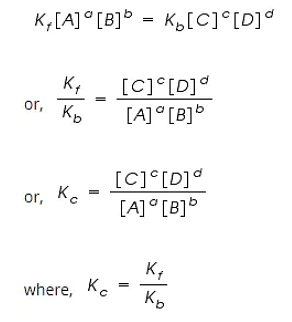
Kc is called the equilibrium constant expressed in terms of molar concentrations.
The above equation is known as the equation of Law of Chemical Equilibrium.