Munna is the jigri of:

Munna is the jigri of:
Show Hint
- Sastry and Ritesh
- Niran and Praveen
- Lucky and Rahul
- Jassi and Lucky

The Correct Option is B
Solution and Explanation
Step 1: Identify Munna’s pattern
Munna got exactly 9 out of 10 answers correct. From the final answer key (last row — Sastry), we compare Munna’s row: Sastry:b , d , d , c , b , d , a , c , a , b
Munna: b , d , d , c , b , d , a , c , b , b] Only mismatch is at Q9 ⇒ Munna changed this intentionally (as per passage).
Step 2: Find two students who can be jigri to Munna
A student’s answer key is copied from either one or two jigri(s). If two: identical ⇒ copied, else blank. Let’s check whose answers closely match Munna except Q9.
Niran: b d d c b d a c b b (Only Q9 differs from Sastry) ✔️
Praveen: b d d c b d a c b b ✔️ These match Munna exactly ⇒ Both could be jigri.
Therefore, Munna is the jigri of Niran and Praveen.
Top CAT Data Interpretation & Logical Reasoning (DILR) Questions
- 1000 patients currently suffering from a disease were selected to study the effectiveness of treatment of four types of medicines — A, B, C and D. These patients were first randomly assigned into two groups of equal size, called treatment group and control group. The patients in the control group were not treated with any of these medicines; instead they were given a dummy medicine, called placebo, containing only sugar and starch. The following information is known about the patients in the treatment group.
a. A total of 250 patients were treated with type A medicine and a total of 210 patients were treated with type C medicine.
b. 25 patients were treated with type A medicine only. 20 patients were treated with type C medicine only. 10 patients were treated with type D medicine only.
c. 35 patients were treated with type A and type D medicines only. 20 patients were treated with type A and type B medicines only. 30 patients were treated with type A and type C medicines only. 20 patients were treated with type C and type D medicines only.
d. 100 patients were treated with exactly three types of medicines.
e. 40 patients were treated with medicines of types A, B and C, but not with medicines of type D. 20 patients were treated with medicines of types A, C and D, but not with medicines of type B.
f. 50 patients were given all the four types of medicines. 75 patients were treated with exactly one type of medicine. - A new game show on TV has 100 boxes numbered 1, 2, . . . , 100 in a row, each containing a mystery prize. The prizes are items of different types, a, b, c, . . . , in decreasing order of value. The most expensive item is of type a, a diamond ring, and there is exactly one of these. You are told that the number of items at least doubles as you move to the next type. For example, there would be at least twice as many items of type b as of type a, at least twice as many items of type c as of type b and so on. There is no particular order in which the prizes are placed in the boxes.
- The figure below shows the street map for a certain region with the street intersections marked from a through l. A person standing at an intersection can see along straight lines to other intersections that are in her line of sight and all other people standing at these intersections. For example, a person standing at intersection g can see all people standing at intersections b, c, e, f, h, and k. In particular, the person standing at intersection g can see the person standing at intersection e irrespective of whether there is a person standing at intersection f.

Six people U, V, W, X, Y, and Z, are standing at different intersections. No two people are standing at the same intersection.
The following additional facts are known.
1. X, U, and Z are standing at the three corners of a triangle formed by three street segments.
2. X can see only U and Z.
3. Y can see only U and W.
4. U sees V standing in the next intersection behind Z.
5. W cannot see V or Z.
6. No one among the six is standing at intersection d. - The Ministry of Home Affairs is analysing crimes committed by foreigners in different states and union territories (UT) of India. All cases refer to the ones registered against foreigners in 2016. The number of cases – classified into three categories: IPC crimes, SLL crimes and other crimes – for nine states/UTs are shown in the figure below. These nine belong to the top ten states/UTs in terms of the total number of cases registered. The remaining state (among top ten) is West Bengal, where all the 520 cases registered were SLL crimes.

The table below shows the ranks of the ten states/UTs mentioned above among ALL states/UTs of India in terms of the number of cases registered in each of the three category of crimes. A state/UT is given rank r for a category of crimes if there are (r―1) states/UTs having a larger number of cases registered in that category of crimes. For example, if two states have the same number of cases in a category, and exactly three other states/UTs have larger numbers of cases registered in the same category, then both the states are given rank 4 in that category. Missing ranks in the table are denoted by *.IPC crimes SLL crimes Other crimes Delhi * * * Goa * 4 * Haryana 8 6 * Karnataka 3 2 * Kerala * 9 * Maharashtra 3 4 8 Puducherry 13 29 * Tamil Nadu 11 7 * Telangana 6 9 8 West Bengal 17 * 16 - Five vendors are being considered for a service. The evaluation committee evaluated each vendor on six aspects – Cost, Customer Service, Features, Quality, Reach, and Reliability. Each of these evaluations are on a scale of 0 (worst) to 100 (perfect). The evaluation scores on these aspects are shown in the radar chart. For example, Vendor 1 obtains a score of 52 on Reliability, Vendor 2 obtains a score of 45 on Features and Vendor 3 obtains a score of 90 on Cost.

Top CAT Data Interpretation Questions
- Amudha, Bharatan, Chandran, Dhinesh, Ezhil, Fani and Gowtham are seven people in a town. Any pair of them could either be strangers, acquaintances, or friends. All relationships are mutual. For example, if Amudha is a friend of Bharatan, then Bharatan is also a friend of Amudha. Similarly, if Amudha is a stranger to Bharatan, then Bharatan is also a stranger to Amudha.
Partial information about the number of friends, acquaintances, and strangers of each of these people among them is given in the table below.No. of Friends No. of Acquaintances No. of Strangers Amudha 1 4 Bharatan Chandran 1 Dhinesh 2 Ezhil 1 Fani 1 Gowtham 3 2 The following additional facts are also known.
1. Amudha, Bharatan, and Chandran are mutual strangers.
2. Amudha, Dhinesh, and Fani are Ezil's friends.
3. Chandran and Gowtham are friends.
4. Every friend of Amudha is an acquaintance of Bharatan, and every acquaintance of Bharatan is a friend of Amudha.
5. Every friend of Bharatan is an acquaintance of Amudha, and every acquaintance of Amudha is a friend of Bharatan. - In a recent comprehensive survey of 500 employees, a company examined commuting preferences and the factors influencing transportation choices to work. The survey identified four main modes of transportation: Car, Bus, Bicycle, and Walking. Each mode revealed distinct reasons cited by employees for their preferences.
Among respondents, 40% favored commuting by Car. Key reasons included convenience and speed (60%), comfort (30%), and flexibility (10%). 25% of employees preferred the Bus. Reasons for choosing this mode included cost-effectiveness (50%), environmental concerns (30%), and availability (20%). Bicycle commuting was preferred by 20% of the surveyed employees. Reasons included health benefits (40%), environmental concerns (30%), and cost-effectiveness (30%). The remaining employees chose Walking as their preferred mode. They cited proximity to work (50%), health benefits (30%), and environmental concerns (20%) as their primary reasons. - A multinational corporation is planning to establish new offices in five cities: A, B, C, D, and E, with a total budget of 150 million USD allocated for this expansion. To determine the fund allocation for each city, a composite score is calculated based on three key factors: Market Potential, Infrastructure, and Cost of Living. These factors are weighted at 40%, 35%, and 25%, respectively. City A has the highest market potential among the cities but scores lowest in infrastructure quality. City B ranks highest in infrastructure quality but has the highest cost of living. City C, despite having the lowest market potential, offers the lowest cost of living among the cities under consideration.
The composite score for each city is computed as a weighted average of its ratings on these factors, where ratings range from 1 to 10. The fund allocation for each city will be directly proportional to its composite score, reflecting its overall attractiveness for establishing new offices based on market potential, infrastructure quality, and cost of living considerations. - A vast interplanetary transport network has been established within our solar system to facilitate efficient movement between celestial bodies. This network comprises two primary transit routes: the inner route connecting Mercury, Venus, Earth, and Mars, and the outer route connecting Jupiter, Saturn, Uranus, and Neptune. These routes intersect at several asteroid belts designated as transfer hubs, crucial for transferring cargo, passengers, and refueling spacecraft.
The infrastructure of the network includes terminal stations located on the outermost planets of each route, represented as squares on the map. Key asteroid belts where the inner and outer routes intersect serve as transfer hubs, depicted as diamonds. Additionally, there are smaller waystations positioned between terminal stations and transfer hubs, marked as dots on the map. Spacecraft within this network operate exclusively on either the inner or outer route and never switch between the two. Travel times between adjacent waystations vary significantly between the inner and outer routes: the average travel time on the inner route is approximately 30 Earth hours, while on the outer route, it averages around 72 Earth hours. At transfer hubs, spacecraft typically spend about 6 Earth hours for operations such as cargo and passenger transfers, as well as refueling. - Answer the questions based on the information given below.
There are four sellers namely Ram, Mohan, Lakhan and Raghav. Each of them has three types of articles (pen, pencil and erasers). The given table shows the sum of the cost prices (in Rs.) of each pen and pencil, difference between total cost prices (in Rs.) of all the pencils and erasers and sum of cost prices (in Rs.) of all the pens and erasers, with the respective sellers.The given bar graph shows the difference between number of pens and pencils and sum of numerical value of cost price of each pencil and number of pencils, with the respective sellers.Sellers Sum of the cost price (in Rs.) of each pen and pencil Cost price (in Rs.) of all pencils - Cost price (in Rs.) of all erasers Sum of cost price (in Rs.) of all pens and erasers Ram 15 100 2100 Mohan 13 480 2050 Lakhan 27 600 3000 Raghav 19 300 3300 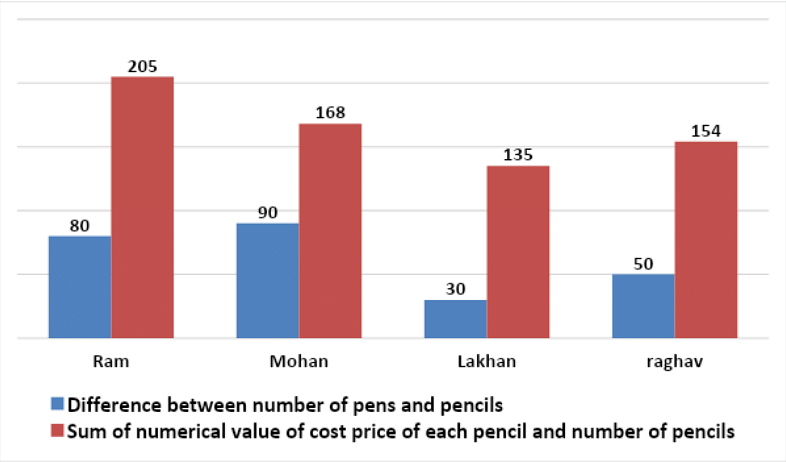
Note : Number of pens/pencils/erasers sold by each of the given sellers is an integer.
Top CAT Questions
- Compare and contrast between Portia and Jessica characters in Merchant of Venice.
- In a triangle ABC,AB=AC=8cm. A circle drawn with BC as diameter passes through A. Another circle drawn with center at A passes through B and C. Then the area,in sq.cm,of the overlapping region between the two circles is
- The simple interest accrued on an amount of Rs.25,000 at the end of three years is Rs.7,500. What would be the compound interest accrued on the same amount at the same rate in the same period?
- What is the sum of all roots of the equation \(|x+4|^2–10|x+4|=24\)?
- A solid metal sphere is melted and smaller spheres of equal radii are formed. 10% of the volume of the sphere is lost in the process. The smaller spheres have a radius which is \(\frac{1}{9}\text{th}\) the larger sphere. If 10 litres of paint were needed to paint the larger sphere,how many litres are needed to paint all the smaller spheres?