Equilibrium constants K1 and K2 for the following equilibria: NO(g)+\(\bigg(\frac{1}{2}\bigg)\)O2 \(^{K_1}_\rightleftharpoons\) NO2(g) and 2NO2(g) \(^{K_2}_\rightleftharpoons\) 2NO(g)+O2(g) are related as:
\(K_2\) = \(\frac{1}{K_1}\)
K2 = \(K^2_1\)
K2 = \(K^1_2\)
K2 = \(\frac{1}{K^2_1}\)

The Correct Option is D
Solution and Explanation
By changing the first reaction in reverse order and multiplying it by 2 we will get the equation similar to second equation.
Thus, K1 and K2 can be related in the above equations as:
K2 = \(\frac{1}{K^2_1}\)
\(\Rightarrow\) K1 = \(\frac{1}{\sqrt K_2}\)
Therefore, the correct option is (D): K2 = \(\frac{1}{K^2_1}\)
Top NEET Chemistry Questions
- A $100.0\, mL$ dilute solution of $Ag ^{+}$is electrolysed for $15.0$ minutes with a current of $1.25 \,mA$ and the silver is removed completely. What was the initial $\left[ Ag ^{+}\right]$?
- Under isothermal condition, a gas at 300 K expands from 0.1 L to 0.25 L against a constant externalpressureof2bar Theworkdonebythe gas i s : [Given that 1Lbar= 100J)
- Unit of entropy is : -
- For a reaction, activation energy E$_a$=0 and the rate constant at 200K is 1.6×10$^6$s$^{-1}$. The rate constant at 400K will be- [Given that gas constant] R= 8.314 J K$^{-1}$ mol$^{-1}$
- Half-life period of a first order reaction is $1386\, s.$ The specific rate constant of the reaction is
Top NEET Equilibrium Questions
Solubility of a \(M_2S\) salt is \(3.5 \times 10^{–6}\) , then find out solubility product.
- Consider the following reaction in a sealed vessel at equilibrium with concentrations of
N2 = 3.0 × 10⁻³ M, O2 = 4.2 × 10⁻³ M and NO = 2.8 × 10⁻³ M.
2NO(g)⇋N2(g) + O2(g)
If 0.1 mol L–1 of NO(g) is taken in a closed vessel, what will be degree of dissociation (a) of NO(g) at equilibrium? निम्नलिखित अभिक्रिया पर विचार कीजिए:
2A(g) + B(g) \(\rightarrow\) 2D(g)
298 K पर \(\Delta\)U\(^\circ\) = -10.0 kJ mol\(^{-1}\) और \(\Delta\)S\(^\circ\) = -44.0 J K\(^{-1}\) mol\(^{-1}\)
298 K पर, अभिक्रिया के \(\Delta\)G\(^\circ\) और अभिक्रिया की स्वतः प्रवर्तिता के लिए सही विकल्प पहचानिए।
(दिया गया है : R = 8.314 J mol\(^{-1}\) K\(^{-1}\))
Top NEET Questions
- A $100.0\, mL$ dilute solution of $Ag ^{+}$is electrolysed for $15.0$ minutes with a current of $1.25 \,mA$ and the silver is removed completely. What was the initial $\left[ Ag ^{+}\right]$?
- The time constant of C-R circuit is
- The chronological order of human evolution from early to the recent is
- The correct Boolean operation represented by the circuit diagram drawn is :
- The driver of a car travelling with speed $30\, m/sec$ towards a hill sounds a horn of frequency $600\, Hz.$ If the velocity of sound in air is $330\, m/s,$ the frequency of reflected sound as heard by driver is
Concepts Used:
Law of Chemical Equilibrium
Law of Chemical Equilibrium states that at a constant temperature, the rate of a chemical reaction is directly proportional to the product of the molar concentrations of the reactants each raised to a power equal to the corresponding stoichiometric coefficients as represented by the balanced chemical equation.
Let us consider a general reversible reaction;
A+B ↔ C+D
After some time, there is a reduction in reactants A and B and an accumulation of the products C and D. As a result, the rate of the forward reaction decreases and that of backward reaction increases.
Eventually, the two reactions occur at the same rate and a state of equilibrium is attained.
By applying the Law of Mass Action;
The rate of forward reaction;
Rf = Kf [A]a [B]b
The rate of backward reaction;
Rb = Kb [C]c [D]d
Where,
[A], [B], [C] and [D] are the concentrations of A, B, C and D at equilibrium respectively.
a, b, c, and d are the stoichiometric coefficients of A, B, C and D respectively.
Kf and Kb are the rate constants of forward and backward reactions.
However, at equilibrium,
Rate of forward reaction = Rate of backward reaction.
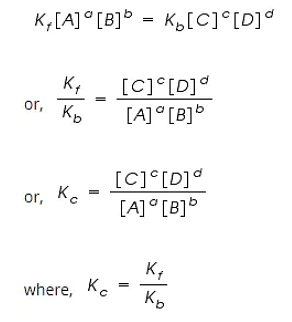
Kc is called the equilibrium constant expressed in terms of molar concentrations.
The above equation is known as the equation of Law of Chemical Equilibrium.