Question:
In free space, an electromagnetic wave is travelling whose wavevector is \(\vec{k} = 10(\hat{x} + \sqrt{3}\hat{y})\) m\(^{-1}\). The electric field component of this electromagnetic wave is given by \(\vec{E}(\vec{r},t) = \hat{z}\, 600\cos(\vec{k}\cdot\vec{r} - \omega t)\) V.m\(^{-1}\). The speed of light in free space is \(c = 3.0 \times 10^{8}\) m.s\(^{-1}\). The corresponding magnetic field \(\vec{B}(\vec{r},t)\) is
In free space, an electromagnetic wave is travelling whose wavevector is \(\vec{k} = 10(\hat{x} + \sqrt{3}\hat{y})\) m\(^{-1}\). The electric field component of this electromagnetic wave is given by \(\vec{E}(\vec{r},t) = \hat{z}\, 600\cos(\vec{k}\cdot\vec{r} - \omega t)\) V.m\(^{-1}\). The speed of light in free space is \(c = 3.0 \times 10^{8}\) m.s\(^{-1}\). The corresponding magnetic field \(\vec{B}(\vec{r},t)\) is
Show Hint
Use \(\vec{B} = \frac{1}{c}\hat{k}\times\vec{E}\) with \(\hat{k}\) the unit vector along \(\vec{k} = 10(\hat{x}+\sqrt3\hat{y})\), whose magnitude is 20 m\(^{-1}\).
Updated On: Aug 17, 2026
- \(\vec{B}(\vec{r},t) = 2\times10^{-6}(\sqrt{3}\hat{x} - \hat{y})\cos(\vec{k}\cdot\vec{r}-\omega t)\) V.m\(^{-2}\).s
- \(\vec{B}(\vec{r},t) = 10^{-6}(\sqrt{3}\hat{x} - \hat{y})\cos(\vec{k}\cdot\vec{r}-\omega t)\) V.m\(^{-2}\).s
- \(\vec{B}(\vec{r},t) = 2\times10^{-5}(-\sqrt{3}\hat{x} + \hat{y})\cos(\vec{k}\cdot\vec{r}-\omega t)\) V.m\(^{-2}\).s
- \(\vec{B}(\vec{r},t) = 10^{-5}(\sqrt{3}\hat{x} - \hat{y})\cos(\vec{k}\cdot\vec{r}-\omega t)\) V.m\(^{-2}\).s
Show Solution

Verified By Collegedunia
The Correct Option is B
Solution and Explanation
Step 1: Understanding the Concept:
An electromagnetic plane wave in free space has its electric field, magnetic field, and direction of travel mutually perpendicular. Once we know the wave's direction (given by the wavevector \(\vec{k}\)) and the electric field \(\vec{E}\), the magnetic field is fixed by the relation \(\vec{B} = \frac{1}{c}\hat{k}\times \vec{E}\), where \(\hat{k}\) is the unit vector along the direction of propagation.
Step 2: Key Formula or Approach:
1. Find the unit vector \(\hat{k} = \vec{k}/|\vec{k}|\).
2. Use \(\vec{B}(\vec{r},t) = \frac{1}{c}\,\hat{k}\times \vec{E}(\vec{r},t)\), since \(\vec{B}\) carries the same phase \(\cos(\vec{k}\cdot\vec{r}-\omega t)\) as \(\vec{E}\) for a wave travelling in a single direction.
Step 3: Detailed Explanation:
The wavevector is \(\vec{k} = 10(\hat{x}+\sqrt{3}\hat{y})\) m\(^{-1}\), so its magnitude is \(|\vec{k}| = 10\sqrt{1^2+(\sqrt3)^2} = 10\sqrt{4} = 20\) m\(^{-1}\).
The unit vector along propagation is \(\hat{k} = \frac{10(\hat{x}+\sqrt{3}\hat{y})}{20} = \frac{1}{2}(\hat{x}+\sqrt{3}\hat{y})\).
The electric field amplitude vector is \(600\hat{z}\) V.m\(^{-1}\). Cross it with \(\hat{k}\):
\[ \hat{k}\times(600\hat{z}) = \frac{600}{2}\left[(\hat{x}\times\hat{z}) + \sqrt{3}(\hat{y}\times\hat{z})\right] \]
Using \(\hat{x}\times\hat{z} = -\hat{y}\) and \(\hat{y}\times\hat{z} = \hat{x}\):
\[ \hat{k}\times(600\hat{z}) = 300\left[-\hat{y}+\sqrt{3}\hat{x}\right] = 300(\sqrt{3}\hat{x}-\hat{y}) \]
Divide by \(c = 3.0\times10^{8}\) m.s\(^{-1}\):
\[ \vec{B}_0 = \frac{300(\sqrt{3}\hat{x}-\hat{y})}{3.0\times10^{8}} = 10^{-6}(\sqrt{3}\hat{x}-\hat{y}) \]
Since \(\vec{B}\) tracks the same phase as \(\vec{E}\):
\[ \vec{B}(\vec{r},t) = 10^{-6}(\sqrt{3}\hat{x}-\hat{y})\cos(\vec{k}\cdot\vec{r}-\omega t) \text{ V.m}^{-2}\text{.s} \]
Step 4: Why the other options are wrong.
Option (A) has the right direction \((\sqrt3\hat{x}-\hat{y})\) but a magnitude twice too large. Option (C) reverses the direction, using \(-\sqrt3\hat{x}+\hat{y}\) instead, and is off by a further factor of 10 in size, the kind of mistake you get from crossing the vectors in the wrong order and misplacing a power of ten. Option (D) has the correct direction but is 10 times too large.
Final Answer:
The magnetic field is \(10^{-6}(\sqrt{3}\hat{x}-\hat{y})\cos(\vec{k}\cdot\vec{r}-\omega t)\) V.m\(^{-2}\).s, which is option (B). \[ \boxed{\vec{B}(\vec{r},t) = 10^{-6}(\sqrt{3}\hat{x}-\hat{y})\cos(\vec{k}\cdot\vec{r}-\omega t)\ \text{V.m}^{-2}\text{.s}} \]
An electromagnetic plane wave in free space has its electric field, magnetic field, and direction of travel mutually perpendicular. Once we know the wave's direction (given by the wavevector \(\vec{k}\)) and the electric field \(\vec{E}\), the magnetic field is fixed by the relation \(\vec{B} = \frac{1}{c}\hat{k}\times \vec{E}\), where \(\hat{k}\) is the unit vector along the direction of propagation.
Step 2: Key Formula or Approach:
1. Find the unit vector \(\hat{k} = \vec{k}/|\vec{k}|\).
2. Use \(\vec{B}(\vec{r},t) = \frac{1}{c}\,\hat{k}\times \vec{E}(\vec{r},t)\), since \(\vec{B}\) carries the same phase \(\cos(\vec{k}\cdot\vec{r}-\omega t)\) as \(\vec{E}\) for a wave travelling in a single direction.
Step 3: Detailed Explanation:
The wavevector is \(\vec{k} = 10(\hat{x}+\sqrt{3}\hat{y})\) m\(^{-1}\), so its magnitude is \(|\vec{k}| = 10\sqrt{1^2+(\sqrt3)^2} = 10\sqrt{4} = 20\) m\(^{-1}\).
The unit vector along propagation is \(\hat{k} = \frac{10(\hat{x}+\sqrt{3}\hat{y})}{20} = \frac{1}{2}(\hat{x}+\sqrt{3}\hat{y})\).
The electric field amplitude vector is \(600\hat{z}\) V.m\(^{-1}\). Cross it with \(\hat{k}\):
\[ \hat{k}\times(600\hat{z}) = \frac{600}{2}\left[(\hat{x}\times\hat{z}) + \sqrt{3}(\hat{y}\times\hat{z})\right] \]
Using \(\hat{x}\times\hat{z} = -\hat{y}\) and \(\hat{y}\times\hat{z} = \hat{x}\):
\[ \hat{k}\times(600\hat{z}) = 300\left[-\hat{y}+\sqrt{3}\hat{x}\right] = 300(\sqrt{3}\hat{x}-\hat{y}) \]
Divide by \(c = 3.0\times10^{8}\) m.s\(^{-1}\):
\[ \vec{B}_0 = \frac{300(\sqrt{3}\hat{x}-\hat{y})}{3.0\times10^{8}} = 10^{-6}(\sqrt{3}\hat{x}-\hat{y}) \]
Since \(\vec{B}\) tracks the same phase as \(\vec{E}\):
\[ \vec{B}(\vec{r},t) = 10^{-6}(\sqrt{3}\hat{x}-\hat{y})\cos(\vec{k}\cdot\vec{r}-\omega t) \text{ V.m}^{-2}\text{.s} \]
Step 4: Why the other options are wrong.
Option (A) has the right direction \((\sqrt3\hat{x}-\hat{y})\) but a magnitude twice too large. Option (C) reverses the direction, using \(-\sqrt3\hat{x}+\hat{y}\) instead, and is off by a further factor of 10 in size, the kind of mistake you get from crossing the vectors in the wrong order and misplacing a power of ten. Option (D) has the correct direction but is 10 times too large.
Final Answer:
The magnetic field is \(10^{-6}(\sqrt{3}\hat{x}-\hat{y})\cos(\vec{k}\cdot\vec{r}-\omega t)\) V.m\(^{-2}\).s, which is option (B). \[ \boxed{\vec{B}(\vec{r},t) = 10^{-6}(\sqrt{3}\hat{x}-\hat{y})\cos(\vec{k}\cdot\vec{r}-\omega t)\ \text{V.m}^{-2}\text{.s}} \]
Was this answer helpful?
0
0
Top GATE PH Physics Questions
- An infinite one-dimensional lattice extends along the x-axis. At each lattice site, there exists an ion with spin 1/2. The spin can point either in the +z or -z direction only. Let \( S_P \), \( S_F \), and \( S_A \) denote the entropies of paramagnetic, ferromagnetic, and antiferromagnetic configurations, respectively. Which of the following relations is/are true?
- Two point charges of charge \( +q \) each are placed a distance \( 2d \) apart. A grounded solid conducting sphere of radius \( a \) is placed midway between them. Assume \( a^2 \ll d^2 \). Which of the following statements is/are true?
- A particle of mass $m$ is moving in the potential
\[ V(x) = \begin{cases} V_0 + \frac{1}{2} m \omega_{0P}^2 x^2 & \quad \text{if } x > 0 \\ \infty & \quad \text{if } x \leq 0 \end{cases} \]
Figures P, Q, R, and S show different combinations of the values of $ \omega_0 $ and $ V_0 $. - Decays of mesons and baryons can be categorized as weak, strong and electromagnetic decays depending upon the interactions involved in the processes. Which of the following option is/are true?
- The temperature \( T \) dependence of magnetic susceptibility \( \chi \) (Column I) of certain magnetic materials (Column II) are given below. Which of the following options is/are correct?
Column I Column II (1) 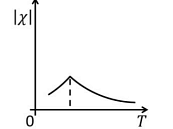
(P) Diamagnetic (2) 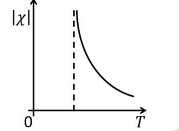
(Q) Paramagnetic (3) 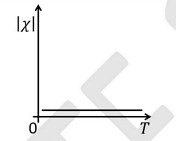
(R) Ferromagnetic (4) 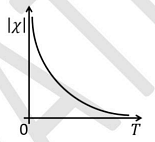
(S) Antiferromagnetic
View More Questions
Top GATE PH Electromagnetism Questions
- An infinitely large non-conducting thin sheet in the \(xy\) plane (\(z=0\)) carries a uniform surface charge density \(\sigma = 17.70\times10^{-12}\) C.m\(^{-2}\). The electric field in the region \(z < 0\) is \(\vec{E}_2 = \hat{x}+2\hat{y}+3\hat{z}\). Then, the electric field \(\vec{E}_1\) in the region \(z > 0\) will be (\(\epsilon_0 = 8.85\times10^{-12}\) C\(^2\).N\(^{-1}\).m\(^{-2}\))
- Which of the following options is correct for transformation of electric field \(\vec{E}\) and magnetic field \(\vec{B}\) under time reversal, i.e., \(t \to -t\)?
- For the electric field of an electromagnetic wave given below, which of the following statements is correct?
\[ \vec{E} = \hat{x}\, E_0 \cos(\omega t) + \hat{y}\, 2E_0 \cos\left(\omega t + \frac{\pi}{2}\right) \] - An infinitely large thin sheet in the \(xy\)-plane carries uniform positive charge density and is moving with constant velocity \(\vec{v}\) in the \(+x\) direction (see figure below). The direction of the corresponding Poynting vector is

- A positive point charge is fixed at the origin. At some distance from it on the \(x\) axis, a point dipole is kept pointing in the \(+y\) direction. The force on the dipole is
View More Questions
Top GATE PH Questions
- If \( F_1(Q, q) = Qq \) is the generating function of a canonical transformation from \((p, q)\) to \((P, Q)\), then which one of the following relations is correct?
- When an unpolarized plane electromagnetic wave in a dielectric medium with refractive index \( n_1 \) is incident on a plane interface separating it from another dielectric medium with refractive index \( n_2 \) (where \( n_2 > n_1 \)), and the angle of incidence is \(\tan^{-1} \left( \frac{n_2}{n_1} \right) \), the following statement is true:
- The wavefunction of a particle in an infinite one-dimensional potential well at time \( t \) is
\[ \Psi(x, t) = \sqrt{\frac{2}{3}} e^{-iE_1 t/\hbar}\psi_1(x) + \frac{1}{\sqrt{6}} e^{i\pi/6} e^{-iE_2 t/\hbar} \psi_2(x) + \frac{1}{\sqrt{6}} e^{i\pi/4} e^{-iE_3 t/\hbar} \psi_3(x) \]where \(\psi_1\), \(\psi_2\), and \(\psi_3\) are the normalized ground state, the normalized first excited state, and the normalized second excited state, respectively. \(E_1\), \(E_2\), and \(E_3\) are the eigen-energies corresponding to \(\psi_1\), \(\psi_2\), and \(\psi_3\), respectively. The expectation value of energy of the particle in state \(\Psi(x,t)\) is - If a thermodynamical system is adiabatically isolated and experiences a change in volume under an externally applied constant pressure, then the thermodynamical potential minimized at equilibrium is the
- The mean distance between the two atoms of an HD molecule is \( r \), where H and D denote hydrogen and deuterium, respectively. The mass of the hydrogen atom is \( m_H \). The energy difference between the two lowest lying rotational states of HD in multiples of \(\frac{h^2}{m_H r^2}\) is:
View More Questions