Question:
A positive point charge is fixed at the origin. At some distance from it on the \(x\) axis, a point dipole is kept pointing in the \(+y\) direction. The force on the dipole is
A positive point charge is fixed at the origin. At some distance from it on the \(x\) axis, a point dipole is kept pointing in the \(+y\) direction. The force on the dipole is
Show Hint
Use \(\vec F = (\vec p \cdot \nabla)\vec E\) for a dipole in an external field; since \(\vec p = p\hat y\), only \(\partial E_y/\partial y\) at the dipole's location matters, and for a point charge this comes out positive on the \(x\)-axis.
Updated On: Aug 17, 2026
- 0
- in the \(+y\) direction
- in the \(-y\) direction
- in the \(+x\) direction
Show Solution

Verified By Collegedunia
The Correct Option is B
Solution and Explanation
Step 1: Understanding the Concept:
A point dipole with dipole moment \(\vec p\) sitting in a non-uniform external field \(\vec E\) feels a net force even though the total charge is zero, because the field is slightly different at its two ends. The force is given by \(\vec F = (\vec p \cdot \nabla)\vec E\), evaluated at the location of the dipole. Here the field is that of the point charge \(q\) fixed at the origin, and \(\vec p = p\hat y\) sits at a point \((d,0,0)\) on the \(x\)-axis.
Step 2: Key Formula or Approach:
1. Field of a point charge: \(\vec E(x,y,z) = \dfrac{kq}{r^3}(x,y,z)\), with \(r=\sqrt{x^2+y^2+z^2}\) and \(k=1/4\pi\epsilon_0\).
2. Since \(\vec p\) only has a \(y\)-component, the force reduces to \(\vec F = p\,\dfrac{\partial \vec E}{\partial y}\), evaluated at \((d,0,0)\).
Step 3: Detailed Explanation:
Differentiate each component of \(\vec E\) with respect to \(y\):
\[ \frac{\partial E_x}{\partial y} = kq\,\frac{\partial}{\partial y}\left(\frac{x}{r^3}\right) = -\frac{3kqxy}{r^5} \]
\[ \frac{\partial E_y}{\partial y} = kq\,\frac{\partial}{\partial y}\left(\frac{y}{r^3}\right) = kq\left(\frac{1}{r^3} - \frac{3y^2}{r^5}\right) \]
\[ \frac{\partial E_z}{\partial y} = kq\,\frac{\partial}{\partial y}\left(\frac{z}{r^3}\right) = -\frac{3kqzy}{r^5} \]
Now put in the dipole's location \((x,y,z)=(d,0,0)\), so \(r=d\) and \(y=z=0\). The first and third derivatives both carry a factor of \(y\) or \(z\), so they vanish at this point. Only the middle one survives:
\[ \left.\frac{\partial E_y}{\partial y}\right|_{(d,0,0)} = \frac{kq}{d^3} \]
So the gradient of \(\vec E\) at the dipole's location is nonzero only in the \(y\) direction, and:
\[ \vec F = p\left(0,\ \frac{kq}{d^3},\ 0\right) = \frac{kqp}{d^3}\hat y \]
Since \(q\), \(p\) and \(d^3\) are all positive, this force is a positive multiple of \(\hat y\).
Step 4: Why the other options are wrong.
The force is not zero (A), because the field of a point charge is genuinely non-uniform, so a dipole placed in it always feels some net pull unless its moment happens to be perpendicular to the local field gradient in just the right way, which is not the case here. It is not along \(-\hat y\) (C), because the sign of \(\partial E_y/\partial y\) at this point came out positive, not negative. It is not along \(\hat x\) (D), because both the \(x\) and \(z\) derivatives of \(\vec E\) vanish exactly at this symmetric point on the axis.
Step 5: Final Answer:
The dipole is pulled further along the \(y\)-direction it is already pointing in.\[ \boxed{\text{in the } +y \text{ direction}} \]
A point dipole with dipole moment \(\vec p\) sitting in a non-uniform external field \(\vec E\) feels a net force even though the total charge is zero, because the field is slightly different at its two ends. The force is given by \(\vec F = (\vec p \cdot \nabla)\vec E\), evaluated at the location of the dipole. Here the field is that of the point charge \(q\) fixed at the origin, and \(\vec p = p\hat y\) sits at a point \((d,0,0)\) on the \(x\)-axis.
Step 2: Key Formula or Approach:
1. Field of a point charge: \(\vec E(x,y,z) = \dfrac{kq}{r^3}(x,y,z)\), with \(r=\sqrt{x^2+y^2+z^2}\) and \(k=1/4\pi\epsilon_0\).
2. Since \(\vec p\) only has a \(y\)-component, the force reduces to \(\vec F = p\,\dfrac{\partial \vec E}{\partial y}\), evaluated at \((d,0,0)\).
Step 3: Detailed Explanation:
Differentiate each component of \(\vec E\) with respect to \(y\):
\[ \frac{\partial E_x}{\partial y} = kq\,\frac{\partial}{\partial y}\left(\frac{x}{r^3}\right) = -\frac{3kqxy}{r^5} \]
\[ \frac{\partial E_y}{\partial y} = kq\,\frac{\partial}{\partial y}\left(\frac{y}{r^3}\right) = kq\left(\frac{1}{r^3} - \frac{3y^2}{r^5}\right) \]
\[ \frac{\partial E_z}{\partial y} = kq\,\frac{\partial}{\partial y}\left(\frac{z}{r^3}\right) = -\frac{3kqzy}{r^5} \]
Now put in the dipole's location \((x,y,z)=(d,0,0)\), so \(r=d\) and \(y=z=0\). The first and third derivatives both carry a factor of \(y\) or \(z\), so they vanish at this point. Only the middle one survives:
\[ \left.\frac{\partial E_y}{\partial y}\right|_{(d,0,0)} = \frac{kq}{d^3} \]
So the gradient of \(\vec E\) at the dipole's location is nonzero only in the \(y\) direction, and:
\[ \vec F = p\left(0,\ \frac{kq}{d^3},\ 0\right) = \frac{kqp}{d^3}\hat y \]
Since \(q\), \(p\) and \(d^3\) are all positive, this force is a positive multiple of \(\hat y\).
Step 4: Why the other options are wrong.
The force is not zero (A), because the field of a point charge is genuinely non-uniform, so a dipole placed in it always feels some net pull unless its moment happens to be perpendicular to the local field gradient in just the right way, which is not the case here. It is not along \(-\hat y\) (C), because the sign of \(\partial E_y/\partial y\) at this point came out positive, not negative. It is not along \(\hat x\) (D), because both the \(x\) and \(z\) derivatives of \(\vec E\) vanish exactly at this symmetric point on the axis.
Step 5: Final Answer:
The dipole is pulled further along the \(y\)-direction it is already pointing in.\[ \boxed{\text{in the } +y \text{ direction}} \]
Was this answer helpful?
0
0
Top GATE PH Physics Questions
- An infinite one-dimensional lattice extends along the x-axis. At each lattice site, there exists an ion with spin 1/2. The spin can point either in the +z or -z direction only. Let \( S_P \), \( S_F \), and \( S_A \) denote the entropies of paramagnetic, ferromagnetic, and antiferromagnetic configurations, respectively. Which of the following relations is/are true?
- Two point charges of charge \( +q \) each are placed a distance \( 2d \) apart. A grounded solid conducting sphere of radius \( a \) is placed midway between them. Assume \( a^2 \ll d^2 \). Which of the following statements is/are true?
- A particle of mass $m$ is moving in the potential
\[ V(x) = \begin{cases} V_0 + \frac{1}{2} m \omega_{0P}^2 x^2 & \quad \text{if } x > 0 \\ \infty & \quad \text{if } x \leq 0 \end{cases} \]
Figures P, Q, R, and S show different combinations of the values of $ \omega_0 $ and $ V_0 $. - Decays of mesons and baryons can be categorized as weak, strong and electromagnetic decays depending upon the interactions involved in the processes. Which of the following option is/are true?
- The temperature \( T \) dependence of magnetic susceptibility \( \chi \) (Column I) of certain magnetic materials (Column II) are given below. Which of the following options is/are correct?
Column I Column II (1) 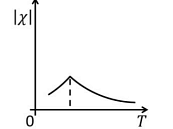
(P) Diamagnetic (2) 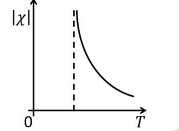
(Q) Paramagnetic (3) 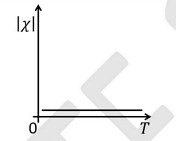
(R) Ferromagnetic (4) 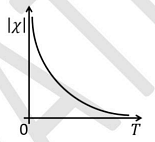
(S) Antiferromagnetic
View More Questions
Top GATE PH Electromagnetism Questions
- In free space, an electromagnetic wave is travelling whose wavevector is \(\vec{k} = 10(\hat{x} + \sqrt{3}\hat{y})\) m\(^{-1}\). The electric field component of this electromagnetic wave is given by \(\vec{E}(\vec{r},t) = \hat{z}\, 600\cos(\vec{k}\cdot\vec{r} - \omega t)\) V.m\(^{-1}\). The speed of light in free space is \(c = 3.0 \times 10^{8}\) m.s\(^{-1}\). The corresponding magnetic field \(\vec{B}(\vec{r},t)\) is
- An infinitely large non-conducting thin sheet in the \(xy\) plane (\(z=0\)) carries a uniform surface charge density \(\sigma = 17.70\times10^{-12}\) C.m\(^{-2}\). The electric field in the region \(z < 0\) is \(\vec{E}_2 = \hat{x}+2\hat{y}+3\hat{z}\). Then, the electric field \(\vec{E}_1\) in the region \(z > 0\) will be (\(\epsilon_0 = 8.85\times10^{-12}\) C\(^2\).N\(^{-1}\).m\(^{-2}\))
- Which of the following options is correct for transformation of electric field \(\vec{E}\) and magnetic field \(\vec{B}\) under time reversal, i.e., \(t \to -t\)?
- For the electric field of an electromagnetic wave given below, which of the following statements is correct?
\[ \vec{E} = \hat{x}\, E_0 \cos(\omega t) + \hat{y}\, 2E_0 \cos\left(\omega t + \frac{\pi}{2}\right) \] - An infinitely large thin sheet in the \(xy\)-plane carries uniform positive charge density and is moving with constant velocity \(\vec{v}\) in the \(+x\) direction (see figure below). The direction of the corresponding Poynting vector is

View More Questions
Top GATE PH Questions
- If \( F_1(Q, q) = Qq \) is the generating function of a canonical transformation from \((p, q)\) to \((P, Q)\), then which one of the following relations is correct?
- When an unpolarized plane electromagnetic wave in a dielectric medium with refractive index \( n_1 \) is incident on a plane interface separating it from another dielectric medium with refractive index \( n_2 \) (where \( n_2 > n_1 \)), and the angle of incidence is \(\tan^{-1} \left( \frac{n_2}{n_1} \right) \), the following statement is true:
- The wavefunction of a particle in an infinite one-dimensional potential well at time \( t \) is
\[ \Psi(x, t) = \sqrt{\frac{2}{3}} e^{-iE_1 t/\hbar}\psi_1(x) + \frac{1}{\sqrt{6}} e^{i\pi/6} e^{-iE_2 t/\hbar} \psi_2(x) + \frac{1}{\sqrt{6}} e^{i\pi/4} e^{-iE_3 t/\hbar} \psi_3(x) \]where \(\psi_1\), \(\psi_2\), and \(\psi_3\) are the normalized ground state, the normalized first excited state, and the normalized second excited state, respectively. \(E_1\), \(E_2\), and \(E_3\) are the eigen-energies corresponding to \(\psi_1\), \(\psi_2\), and \(\psi_3\), respectively. The expectation value of energy of the particle in state \(\Psi(x,t)\) is - If a thermodynamical system is adiabatically isolated and experiences a change in volume under an externally applied constant pressure, then the thermodynamical potential minimized at equilibrium is the
- The mean distance between the two atoms of an HD molecule is \( r \), where H and D denote hydrogen and deuterium, respectively. The mass of the hydrogen atom is \( m_H \). The energy difference between the two lowest lying rotational states of HD in multiples of \(\frac{h^2}{m_H r^2}\) is:
View More Questions