Question:
For the electric field of an electromagnetic wave given below, which of the following statements is correct?
\[ \vec{E} = \hat{x}\, E_0 \cos(\omega t) + \hat{y}\, 2E_0 \cos\left(\omega t + \frac{\pi}{2}\right) \]
For the electric field of an electromagnetic wave given below, which of the following statements is correct?
\[ \vec{E} = \hat{x}\, E_0 \cos(\omega t) + \hat{y}\, 2E_0 \cos\left(\omega t + \frac{\pi}{2}\right) \]
\[ \vec{E} = \hat{x}\, E_0 \cos(\omega t) + \hat{y}\, 2E_0 \cos\left(\omega t + \frac{\pi}{2}\right) \]
Show Hint
Write \(E_y=2E_0\cos(\omega t+\pi/2)=-2E_0\sin\omega t\) and eliminate \(t\) between \(E_x\) and \(E_y\).
The result is an ellipse equation with semi-axes \(E_0\) and \(2E_0\).
The result is an ellipse equation with semi-axes \(E_0\) and \(2E_0\).
Updated On: Aug 17, 2026
- The electric field is linearly polarised with slope 2.
- The electric field is circularly polarised with radius \(E_0\).
- The electric field is elliptically polarised with a ratio of major to minor axis being 2.
- The electric field is unpolarised with the two components being phase shifted by \(\pi/2\).
Show Solution

Verified By Collegedunia
The Correct Option is C
Solution and Explanation
Step 1: Understanding the Concept:
The polarisation state of a wave is fixed by how its two transverse field components compare in amplitude and in phase. Two components in phase (or exactly out of phase by \(\pi\)) give linear polarisation. Two components with equal amplitude and a \(\pi/2\) phase difference give circular polarisation. Two components with unequal amplitude and a \(\pi/2\) phase difference give elliptical polarisation, with the ellipse's axes lined up with the coordinate axes.
Step 2: Key Formula or Approach:
Write out both components explicitly as functions of time and use \(\cos(\omega t + \pi/2) = -\sin(\omega t)\):
\[ E_x = E_0\cos(\omega t), \qquad E_y = 2E_0\cos\left(\omega t + \frac{\pi}{2}\right) = -2E_0\sin(\omega t) \]
Step 3: Detailed Explanation:
From these, \(E_x/E_0 = \cos\omega t\) and \(E_y/(2E_0) = -\sin\omega t\). Squaring both and adding removes the time dependence:
\[ \left(\frac{E_x}{E_0}\right)^2 + \left(\frac{E_y}{2E_0}\right)^2 = \cos^2\omega t + \sin^2\omega t = 1 \]
This is the equation of an ellipse in the \(E_x\)-\(E_y\) plane, with semi-axis \(E_0\) along \(x\) and semi-axis \(2E_0\) along \(y\). As time goes on, the tip of the electric field vector traces this ellipse once every period, so the wave is elliptically polarised.
Step 4: Get the axis ratio and rule out the other options.
The ratio of the major axis to the minor axis is \(2E_0 : E_0 = 2\), matching option (C). Option (A) is wrong because the phase difference here is \(\pi/2\), not \(0\) or \(\pi\), so the field does not oscillate along a single fixed line. Option (B) needs the two amplitudes to be equal so the ellipse becomes a circle, but here they are \(E_0\) and \(2E_0\), not equal, so it cannot be circular. Option (D) is wrong because unpolarised describes an incoherent mix of many independent waves with randomly varying phase, not a single coherent wave like this one, which has one fixed, well defined amplitude and phase relationship at all times.
Final Answer:
The wave traces an ellipse with major to minor axis ratio 2, so the field is elliptically polarised. \[ \boxed{\text{Option (C): axis ratio } = 2} \]
The polarisation state of a wave is fixed by how its two transverse field components compare in amplitude and in phase. Two components in phase (or exactly out of phase by \(\pi\)) give linear polarisation. Two components with equal amplitude and a \(\pi/2\) phase difference give circular polarisation. Two components with unequal amplitude and a \(\pi/2\) phase difference give elliptical polarisation, with the ellipse's axes lined up with the coordinate axes.
Step 2: Key Formula or Approach:
Write out both components explicitly as functions of time and use \(\cos(\omega t + \pi/2) = -\sin(\omega t)\):
\[ E_x = E_0\cos(\omega t), \qquad E_y = 2E_0\cos\left(\omega t + \frac{\pi}{2}\right) = -2E_0\sin(\omega t) \]
Step 3: Detailed Explanation:
From these, \(E_x/E_0 = \cos\omega t\) and \(E_y/(2E_0) = -\sin\omega t\). Squaring both and adding removes the time dependence:
\[ \left(\frac{E_x}{E_0}\right)^2 + \left(\frac{E_y}{2E_0}\right)^2 = \cos^2\omega t + \sin^2\omega t = 1 \]
This is the equation of an ellipse in the \(E_x\)-\(E_y\) plane, with semi-axis \(E_0\) along \(x\) and semi-axis \(2E_0\) along \(y\). As time goes on, the tip of the electric field vector traces this ellipse once every period, so the wave is elliptically polarised.
Step 4: Get the axis ratio and rule out the other options.
The ratio of the major axis to the minor axis is \(2E_0 : E_0 = 2\), matching option (C). Option (A) is wrong because the phase difference here is \(\pi/2\), not \(0\) or \(\pi\), so the field does not oscillate along a single fixed line. Option (B) needs the two amplitudes to be equal so the ellipse becomes a circle, but here they are \(E_0\) and \(2E_0\), not equal, so it cannot be circular. Option (D) is wrong because unpolarised describes an incoherent mix of many independent waves with randomly varying phase, not a single coherent wave like this one, which has one fixed, well defined amplitude and phase relationship at all times.
Final Answer:
The wave traces an ellipse with major to minor axis ratio 2, so the field is elliptically polarised. \[ \boxed{\text{Option (C): axis ratio } = 2} \]
Was this answer helpful?
0
0
Top GATE PH Physics Questions
- An infinite one-dimensional lattice extends along the x-axis. At each lattice site, there exists an ion with spin 1/2. The spin can point either in the +z or -z direction only. Let \( S_P \), \( S_F \), and \( S_A \) denote the entropies of paramagnetic, ferromagnetic, and antiferromagnetic configurations, respectively. Which of the following relations is/are true?
- Two point charges of charge \( +q \) each are placed a distance \( 2d \) apart. A grounded solid conducting sphere of radius \( a \) is placed midway between them. Assume \( a^2 \ll d^2 \). Which of the following statements is/are true?
- A particle of mass $m$ is moving in the potential
\[ V(x) = \begin{cases} V_0 + \frac{1}{2} m \omega_{0P}^2 x^2 & \quad \text{if } x > 0 \\ \infty & \quad \text{if } x \leq 0 \end{cases} \]
Figures P, Q, R, and S show different combinations of the values of $ \omega_0 $ and $ V_0 $. - Decays of mesons and baryons can be categorized as weak, strong and electromagnetic decays depending upon the interactions involved in the processes. Which of the following option is/are true?
- The temperature \( T \) dependence of magnetic susceptibility \( \chi \) (Column I) of certain magnetic materials (Column II) are given below. Which of the following options is/are correct?
Column I Column II (1) 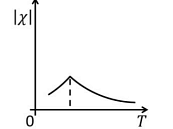
(P) Diamagnetic (2) 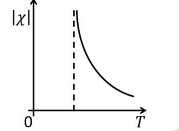
(Q) Paramagnetic (3) 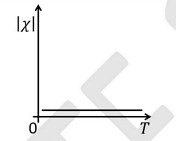
(R) Ferromagnetic (4) 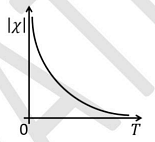
(S) Antiferromagnetic
View More Questions
Top GATE PH Electromagnetism Questions
- In free space, an electromagnetic wave is travelling whose wavevector is \(\vec{k} = 10(\hat{x} + \sqrt{3}\hat{y})\) m\(^{-1}\). The electric field component of this electromagnetic wave is given by \(\vec{E}(\vec{r},t) = \hat{z}\, 600\cos(\vec{k}\cdot\vec{r} - \omega t)\) V.m\(^{-1}\). The speed of light in free space is \(c = 3.0 \times 10^{8}\) m.s\(^{-1}\). The corresponding magnetic field \(\vec{B}(\vec{r},t)\) is
- An infinitely large non-conducting thin sheet in the \(xy\) plane (\(z=0\)) carries a uniform surface charge density \(\sigma = 17.70\times10^{-12}\) C.m\(^{-2}\). The electric field in the region \(z < 0\) is \(\vec{E}_2 = \hat{x}+2\hat{y}+3\hat{z}\). Then, the electric field \(\vec{E}_1\) in the region \(z > 0\) will be (\(\epsilon_0 = 8.85\times10^{-12}\) C\(^2\).N\(^{-1}\).m\(^{-2}\))
- Which of the following options is correct for transformation of electric field \(\vec{E}\) and magnetic field \(\vec{B}\) under time reversal, i.e., \(t \to -t\)?
- An infinitely large thin sheet in the \(xy\)-plane carries uniform positive charge density and is moving with constant velocity \(\vec{v}\) in the \(+x\) direction (see figure below). The direction of the corresponding Poynting vector is

- A positive point charge is fixed at the origin. At some distance from it on the \(x\) axis, a point dipole is kept pointing in the \(+y\) direction. The force on the dipole is
View More Questions
Top GATE PH Questions
- If \( F_1(Q, q) = Qq \) is the generating function of a canonical transformation from \((p, q)\) to \((P, Q)\), then which one of the following relations is correct?
- When an unpolarized plane electromagnetic wave in a dielectric medium with refractive index \( n_1 \) is incident on a plane interface separating it from another dielectric medium with refractive index \( n_2 \) (where \( n_2 > n_1 \)), and the angle of incidence is \(\tan^{-1} \left( \frac{n_2}{n_1} \right) \), the following statement is true:
- The wavefunction of a particle in an infinite one-dimensional potential well at time \( t \) is
\[ \Psi(x, t) = \sqrt{\frac{2}{3}} e^{-iE_1 t/\hbar}\psi_1(x) + \frac{1}{\sqrt{6}} e^{i\pi/6} e^{-iE_2 t/\hbar} \psi_2(x) + \frac{1}{\sqrt{6}} e^{i\pi/4} e^{-iE_3 t/\hbar} \psi_3(x) \]where \(\psi_1\), \(\psi_2\), and \(\psi_3\) are the normalized ground state, the normalized first excited state, and the normalized second excited state, respectively. \(E_1\), \(E_2\), and \(E_3\) are the eigen-energies corresponding to \(\psi_1\), \(\psi_2\), and \(\psi_3\), respectively. The expectation value of energy of the particle in state \(\Psi(x,t)\) is - If a thermodynamical system is adiabatically isolated and experiences a change in volume under an externally applied constant pressure, then the thermodynamical potential minimized at equilibrium is the
- The mean distance between the two atoms of an HD molecule is \( r \), where H and D denote hydrogen and deuterium, respectively. The mass of the hydrogen atom is \( m_H \). The energy difference between the two lowest lying rotational states of HD in multiples of \(\frac{h^2}{m_H r^2}\) is:
View More Questions