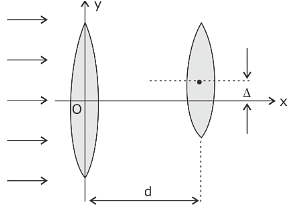
In an experiment a convex lens of focal length $15\, cm$ is placed coaxially on an optical bench in front of a convex mirror at a distance of $5 \,cm$ from it. It is found that an object and its image coincide, if the object is placed at a distance of $20 \,cm $ from the lens. The focal length of the convex mirror is :
The correct answer is (A) : 27.5 cm Given: u= -20cm f= 15 cm distance (d) of convex lens= 5cm
By substituting the values in equation (1) we get, \(\frac{1}{v}+\frac{1}{20}=\frac{1}{15}\) \(⇒\frac{1}{v}=\frac{1}{15}-\frac{1}{20}\) \(⇒\frac{1}{v}=\frac{5}{300}\) \(⇒v=\frac{300}{5}\) \(⇒v=60\ cm\) Thus, the image will be formed at 60cm to the right of the lens and it will be inverted. Therefore, distance between lens and mirror will be d = image distance – radius of curvature of convex mirror \(d = v -2f\) By substituting the values in above equation we get, \(5 = 60 - R\) \(⇒ R = 55\) But, the radius of curvature (R) is given by, \(R=2f\) \(⇒f=\frac{55}{2}\) \(⇒f=27.5\) Hence , the focal length of the convex mirror is 27.5cm.
Optics, deals with the determination of behaviour and the properties of light, along with its interactions with the matter and also with the instruments that are used to detect it.
Ray optics is also known as the geometrical optics and it is a branch of science which describes light propagation.
Reflection is the change in direction of light at an interface in-between two different media so that the wave-front returns into a medium from which it was originated.
Speed of light is the rate at which the light travels in free space.
A phenomenal change in image formed when the light is passed from one medium to another which is called Refraction.
Total Internal Reflection is the reflection of light when the light ray enters into a rarer medium from a denser medium and the angle of incidence is higher than the critical angle of incidence then that light ray will be reflected back to the denser medium.