Given below are two statements :
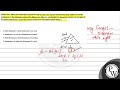
Statement I : When the white light passed through a prism, the red light bends lesser than yellow and violet.
Statement II : The refractive indices are different for different wavelengths in dispersive medium.
In the light of the above statements, choose the correct answer from the options given below :
Statement I : When the white light passed through a prism, the red light bends lesser than yellow and violet.
Statement II : The refractive indices are different for different wavelengths in dispersive medium.
In the light of the above statements, choose the correct answer from the options given below :
- Both Statement I and Statement II are true.
- Statement I is true but Statement II is false.
- Both Statement I and Statement II are false.
- Statement I is false but Statement II is true.

The Correct Option is A
Solution and Explanation
When white light passes through a prism, it undergoes dispersion due to varying refractive indices for different wavelengths. Among the colors in the visible spectrum, red light has the longest wavelength, while violet has the shortest. Since the refractive index is inversely proportional to the wavelength, red light bends the least, while violet light bends the most.
This phenomenon occurs because a higher refractive index results in greater bending, and shorter wavelengths correspond to higher refractive indices. Thus, red light deviates less compared to yellow and violet.
As \( \lambda_{\text{red}} > \lambda_{\text{yellow}} > \lambda_{\text{violet}} \), light rays with longer wavelengths bend less.
Therefore, both Statement I and Statement II are true.
Learn with videos:
Top JEE Main Physics Questions
- Two masses $m$ and $\frac{m}{2}$ are connected at the two ends of a massless rigid rod of length $l$. The rod is suspended by a thin wire of torsional constant $k$ at the centre of mass of the rod-mass system(see figure). Because of torsional constant $k$, the restoring torque is $\tau =k\theta$ for angular displacement $\theta$. If the rod is rota ted by $\theta_0$ and released, the tension in it when it passes through its mean position will be:
A black body is at a temperature of 2880 K. The energy of radiation emitted by this body with wavelength between 499 nm and 500 nm is U1, between 999 nm and 1000 nm is U2 and between 1499 nm and 1500 nm is U3. The Wien's constant, b = 2.88×10⁶ nm-K. Then,
- $I _{ CM }$ is the moment of inertia of a circular disc about an axis (CM) passing through its center and perpendicular to the plane of disc $I_{A B}$ is it's moment of inertia about an axis $AB$ perpendicular to plane and parallel to axis $CM$ at a distance $\frac{2}{3} R$ from center Where $R$ is the radius of the dise The ratio of $I _{ AB }$ and $I _{ CM }$ is $x: 9$ The value of $x$ is______

- A nucleus disintegrates into two smaller parts, which have their velocities in the ratio $3: 2$ The ratio of their nuclear sizes will be $\left(\frac{x}{3}\right)^{\frac{1}{3}}$ The value of ' $x$ ' is:-
- A particle starts with an initial velocity of 10.0 m/s along x-direction and accelerates uniformly at the rate of 2.0 m/s$^2$. The time taken by the particle to reach the velocity of 60.0 m/s is
Top JEE Main Optics Questions
- The diffraction pattern of a light of wavelength 400 nm diffracting from a slit of width 0.2 mm is focused on the focal plane of a convex lens of focal length 100 cm. The width of the 1st secondary maxima will be :
- A parallel beam of monochromatic light of wavelength 5000 •Å is incident normally on a single narrow slit of width 0.001 mm. The light is focused by convex lens on screen, placed on its focal plane. The first minima will be formed for the angle of diffraction of ________ (degree).
In an experiment to measure the focal length (f) of a convex lens, the magnitude of object distance (x) and the image distance (y) are measured with reference to the focal point of the lens. The y-x plot is shown in figure.
The focal length of the lens is_____cm.
- Two immiscible liquids of refractive indices \( \frac{8}{5} \) and \( \frac{3}{2} \) respectively are put in a beaker as shown in the figure. The height of each column is 6 cm. A coin is placed at the bottom of the beaker. For near-normal vision, the apparent depth of the coin is \( \frac{\alpha}{4} \) cm. The value of \( \alpha \) is ______.
- The refractive index of a prism with apex angle \( A \) is \( \cot \frac{A}{2} \). The angle of minimum deviation is:
Top JEE Main Questions
- Two masses $m$ and $\frac{m}{2}$ are connected at the two ends of a massless rigid rod of length $l$. The rod is suspended by a thin wire of torsional constant $k$ at the centre of mass of the rod-mass system(see figure). Because of torsional constant $k$, the restoring torque is $\tau =k\theta$ for angular displacement $\theta$. If the rod is rota ted by $\theta_0$ and released, the tension in it when it passes through its mean position will be:
What will be the equilibrium constant of the given reaction carried out in a \(5 \,L\) vessel and having equilibrium amounts of \(A_2\) and \(A\) as \(0.5\) mole and \(2 \times 10^{-6}\) mole respectively?
The reaction : \(A_2 \rightleftharpoons 2A\)- The value of is
- The number of terms of an is even. The sum of the odd terms is and of the even terms is . The last term exceeds the first by . Then the number of terms in the series is ______.
A black body is at a temperature of 2880 K. The energy of radiation emitted by this body with wavelength between 499 nm and 500 nm is U1, between 999 nm and 1000 nm is U2 and between 1499 nm and 1500 nm is U3. The Wien's constant, b = 2.88×10⁶ nm-K. Then,