Question:
Calculate the λmax of the following molecule:
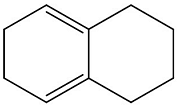
Calculate the λmax of the following molecule:
Updated On: Jul 14, 2026
- 283 nm
- 273 nm
- 234 nm
- 244 nm
Show Solution

Verified By Collegedunia
The Correct Option is B
Approach Solution - 1
The correct option is (B): 273 nm.
Was this answer helpful?
1
6
Show Solution
Verified By Collegedunia
Approach Solution -2
The structure shown is a bicyclic ring system carrying two double bonds that sit next to each other inside the same six-membered ring, forming a locked, homoannular (ring-held) diene. To find its \(\lambda_{max}\) we apply the Woodward-Fieser rules for dienes. Let's check what each answer choice would mean.
- 283 nm: This value would only come out if we mistakenly added an extra +30 nm increment for a further conjugated double bond that this molecule does not have. The diene here has just two double bonds in conjugation, so this overshoots the true value.
- 273 nm: Because the two double bonds are held in one ring, the base value used is that of a homoannular diene, 253 nm. The four sp2 carbons of the diene each carry a ring-residue (the rest of the fused bicyclic skeleton acts as an alkyl substituent at each end), and each ring residue adds +5 nm. With four such ring residues, we add \(4 \times 5 = 20\) nm to the base, giving \(253 + 20 = 273\) nm. There is no exocyclic double bond in this system, so no further increment applies.
- 234 nm: This lower figure would follow only if the heteroannular (open-chain type) base value of 217 nm were used instead of the correct homoannular base of 253 nm. Since the diene here is locked inside one ring, not spread across two separate rings, the heteroannular base does not apply.
- 244 nm: This would result from combining the heteroannular base with extra increments that do not belong to this structure, or from missing one of the four ring-residue contributions. Either way it does not reflect the actual substitution pattern.
Using the correct homoannular base of 253 nm with four ring-residue increments of 5 nm each gives \(253 + 20 = 273\) nm, matching the true diene system in the molecule.
So the correct answer is 273 nm.
Was this answer helpful?
0
0
Top GPAT Biochemistry Questions
- Which one of the following is NOT a phospholipid?
- Given below are two statements
Statement I: Sequencing of DNA is much easier than RNA sequencing due to greater stability
Statement II: The chemical method of DNA sequencing (Maxam & Gilbert) works for only single stranded DNA
In light of the above statements, choose the correct answer from the options given below - Which of the following is false about HMP shunt?
- How many molecules of acyl-CoA are produced in beta-oxidation of palmitic acid
- p-gp (p-glycoprotein) is highly expressed on the
View More Questions
Top GPAT Nucleic acid: replication, transcription, splicing, translation Questions
- Given below are two statements
Statement I: Sequencing of DNA is much easier than RNA sequencing due to greater stability
Statement II: The chemical method of DNA sequencing (Maxam & Gilbert) works for only single stranded DNA
In light of the above statements, choose the correct answer from the options given below - For protein detection most commonly used probe is:
- ELISA is based upon
- One of the following is a most commonly used protecting group for amines :
- RNA molecules having intrinsic catalytic activity are called as___
View More Questions
Top GPAT Questions
- Match the symbols in the List I with the terms used in the List II of conductance measurements, and
List I
SymbolsList II
TermsA \(\Omega^{-1}\) I Specific conductance B \(∧\) II Electrical conductance C k III Specific resistance D \(\rho\) IV Equivalent conductance
Choose the correct answer from the options given below: - Cottrell’s method is used for the measurement of:
- Match the statements in List I with their correct answers in List II, respectively, in respect to modified 1st law of thermodynamics, and
List I
List II
A Constant heat (q = 0) I Isothermal B Reversible process at constant temperature (dT = 0) II Isometric C Constant volume (dV = 0) III Adiabatic D Constant pressure (dP = 0) IV Isobar
Choose the correct answer from the options given below: - Boric acid with molecular weight 61.83 was partitioned between water and amyl alcohol at 25 °C. The amount of boric acid was determined to be 0.24 g in 250 ml of amyl alcohol and 0.32 g in 100 ml water. The partition coefficient of boric acid between water and amyl alcohol, when calculated at molar concentration for each of the solution, is:
- Drugs ‘A’, ‘B’ and ‘C’ follow zero order, first order and second order degradation kinetics, respectively, but have the same rate constant. Which of the following statement is true in this respect:
View More Questions