An unconfined aquifer of areal extent 20 km × 20 km has hydraulic conductivity of 4 m/day, porosity of 0.32, and storage coefficient (specific yield) of 0.18. If the initial saturated thickness of the aquifer is 30 m, and 4×10^8 m\(^3\) of water is extracted from the aquifer, then the decline in the saturated thickness is ____________ m.
Show Hint

Correct Answer: 5.5
Solution and Explanation
To solve this problem, we must calculate the decline in the saturated thickness of an unconfined aquifer after a specific volume of water is extracted. Here's the step-by-step approach:
Given:
- Areal extent of the aquifer: 20 km × 20 km = 400 km\(^2\)
- Hydraulic conductivity (K): 4 m/day
- Porosity (n): 0.32
- Storage coefficient (specific yield, S): 0.18
- Initial saturated thickness (bi): 30 m
- Volume of water extracted (V): 4×10\(^8\) m\(^3\)
The change in water storage is related to the specific yield and the change in saturated thickness (\(\Delta b\)) by the equation:
\(V = S \cdot A \cdot \Delta b\)
Where:
- \(A\) is the area of the aquifer (in m\(^2\))
- \(\Delta b\) is the decline in saturated thickness (in meters)Convert the areal extent from km\(^2\) to m\(^2\):
\(400 \text{ km}^2 = 400 \times 10^6 \text{ m}^2\)
Rearrange the equation to solve for \(\Delta b\):
\(\Delta b = \frac{V}{S \cdot A}\)
Substitute the known values:
\(\Delta b = \frac{4 \times 10^8 \text{ m}^3}{0.18 \times 400 \times 10^6 \text{ m}^2}\)
\(\Delta b = \frac{4 \times 10^8}{72 \times 10^6}\)
\(\Delta b = \frac{4 \times 10^8}{72 \times 10^6} = \frac{400}{72} \approx 5.56 \text{ m}\)
Verify the computed value falls within the provided range:
The computed decline in saturated thickness, 5.56 m, slightly exceeds the expected range of 5.5 m. This could be due to rounding differences or specific interpretations of the aquifer's characteristics.
Thus, the decline in the saturated thickness of the aquifer, after 4×10\(^8\) m\(^3\) of water is extracted, is approximately 5.56 meters.
Top GATE ES Water Resources and Environmental Hydraulics Questions
- In the context of fluid flow, which of the following statement(s) is/are correct?
- In a rectangular open channel, the flow is critical, and the flow depth is 2 m. Select the correct statement(s)
- Consider second order kinetics ($r = −kC^2$) under steady state condition. The ratio of volume of a complete mixed reactor (CMR) to that of a plug flow reactor (PFR) to achieve 90% reduction in the concentration is _______ .
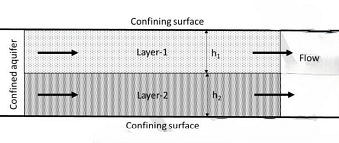
Inlet concentrations in both the reactors are same. - Consider two horizontal layers of an aquifer as shown in figure. Each layer is isotropic and homogeneous. Flow is parallel to the stratification. Thickness and horizontal hydraulic conductivity of layer-1 are $h_1$i and $K_1$, respectively. Thickness and horizontal hydraulic conductivity of layer-2 are $h_2$ and $K_2$, respectively, where $h_1$ is not equal to $h_2$. The equivalent horizontal conductivity $K_x$ for the aquifer system is given by _____
- Water is flowing FULL through a rectangular tunnel of size 3 m (width) × 2 m (height). The average velocity of flow is 1 m/s. The frictional head loss is observed to be 1 m per km. Consider acceleration due to gravity (g) as 10 \(m/s^2\). The correct statement(s) is/are
Top GATE ES Hydrology Questions
- For flood routing, consider the following statements:
P: Hydrologic routing method uses continuity equation and momentum equation
Q: Hydraulic routing method uses continuity equation and energy equation
Choose the correct option from the following: - Multiple effect evaporator is commonly used, in the zero liquid discharge (ZLD) scheme, for ________
- An unconfined aquifer of areal extent 20 km × 20 km has hydraulic conductivity of 4 m/day, porosity of 0.32, and storage coefficient (specific yield) of 0.18. If the initial saturated thickness of the aquifer is 30 m, and 4×10^8 m\(^3\) of water is extracted from the aquifer, then the decline in the saturated thickness is ____________ m.
- Consider the following figure of an activated sludge process (ASP), depicting the flow (Q), substrate (S), and microorganism concentration (X) at various points in the system, where subscripts “0”, “r”, “w”, “e”, and “i” indicate influent, recycle line, wastage, effluent, and flow from aeration tank to settling tank, respectively. Note that influent to the ASP has microbes too. V is volume of aeration tank. Choose the correct option for net rate of formation of microorganisms in the system at steady state, from the following
- Choose the correct option(s) from the following regarding the solubility in water:
Top GATE ES Questions
- Ten cards in a pack are numbered as 1, 2, 3, . . .10. The probability of drawing a card with an even number or a number which is a multiple of 5 from the pack is
- Hardness in water is NOT caused by ______
- The maximum coordination number of \( \text{Sn}^{4+} \) is \(\_\_\_\_\)
- Rod shaped bacterial cells are called _______.
- Tuberculosis is predominantly caused by ________.