Question:
An ultrasound beam traversing through 5 cm of a material is attenuated at a rate of 2 dB/cm. The intensity of the beam at the exit of the material is \(I_{exit}\) and the intensity at the entry into the material is \(I_{entry}\).
The ratio \(\dfrac{I_{exit}}{I_{entry}} = \)
An ultrasound beam traversing through 5 cm of a material is attenuated at a rate of 2 dB/cm. The intensity of the beam at the exit of the material is \(I_{exit}\) and the intensity at the entry into the material is \(I_{entry}\).
The ratio \(\dfrac{I_{exit}}{I_{entry}} = \)
The ratio \(\dfrac{I_{exit}}{I_{entry}} = \)
Show Hint
Total attenuation = 2 dB/cm x 5 cm = 10 dB; ratio = 10^(-dB/10) = 0.1.
Updated On: Aug 7, 2026
- 0.5
- 0.9
- 0.1
- 0.7
Show Solution

Verified By Collegedunia
The Correct Option is C
Solution and Explanation
Step 1: Find the total attenuation over the path.
The beam loses \(2\) dB for every centimeter it travels. Over a path length of \(5\) cm, the total attenuation is
\[ \text{Total loss} = 2 \ \text{dB/cm} \times 5 \ \text{cm} = 10 \ \text{dB} \]
Step 2: Recall what a negative dB value means for an intensity ratio.
Attenuation is a loss, so the exit intensity is smaller than the entry intensity. In decibels, this loss is written as
\[ 10\log_{10}\left(\frac{I_{exit}}{I_{entry}}\right) = -10 \ \text{dB} \]
The negative sign shows the ratio is a fraction less than \(1\).
Step 3: Solve for the ratio.
\[ \log_{10}\left(\frac{I_{exit}}{I_{entry}}\right) = \frac{-10}{10} = -1 \]
\[ \frac{I_{exit}}{I_{entry}} = 10^{-1} = 0.1 \]
Step 4: Why the other options are wrong.
Option (A) \(0.5\) would correspond to about \(3\) dB of loss, the loss from only about \(1.5\) cm of travel, not the full \(5\) cm.
Option (B) \(0.9\) corresponds to under \(1\) dB of loss, far too little for \(10\) dB of attenuation.
Option (D) \(0.7\) corresponds to roughly \(3\) dB, again much less than \(10\) dB.
Final Answer:
The ratio \(I_{exit}/I_{entry}\) is \(0.1\).
\[ \boxed{0.1} \]
The beam loses \(2\) dB for every centimeter it travels. Over a path length of \(5\) cm, the total attenuation is
\[ \text{Total loss} = 2 \ \text{dB/cm} \times 5 \ \text{cm} = 10 \ \text{dB} \]
Step 2: Recall what a negative dB value means for an intensity ratio.
Attenuation is a loss, so the exit intensity is smaller than the entry intensity. In decibels, this loss is written as
\[ 10\log_{10}\left(\frac{I_{exit}}{I_{entry}}\right) = -10 \ \text{dB} \]
The negative sign shows the ratio is a fraction less than \(1\).
Step 3: Solve for the ratio.
\[ \log_{10}\left(\frac{I_{exit}}{I_{entry}}\right) = \frac{-10}{10} = -1 \]
\[ \frac{I_{exit}}{I_{entry}} = 10^{-1} = 0.1 \]
Step 4: Why the other options are wrong.
Option (A) \(0.5\) would correspond to about \(3\) dB of loss, the loss from only about \(1.5\) cm of travel, not the full \(5\) cm.
Option (B) \(0.9\) corresponds to under \(1\) dB of loss, far too little for \(10\) dB of attenuation.
Option (D) \(0.7\) corresponds to roughly \(3\) dB, again much less than \(10\) dB.
Final Answer:
The ratio \(I_{exit}/I_{entry}\) is \(0.1\).
\[ \boxed{0.1} \]
Was this answer helpful?
0
0
Top GATE BM Medical Imaging Systems Questions
- Which one of the following events is NOT typically encountered in diagnostic X-ray projection radiography ?
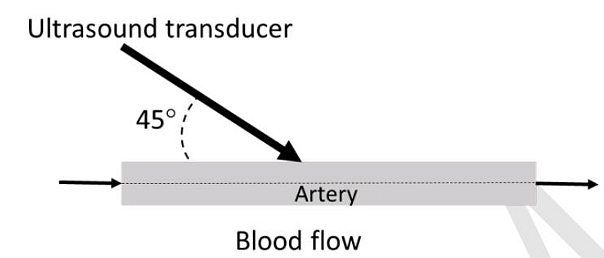
- A Doppler ultrasound transducer operating at 5 MHz gave maximum output frequency shift of 3 kHz. The velocity of sound in blood is 1500 m/s. If the probe was held at an angle of 45° to the direction of blood flow, the maximum velocity of blood flow through the artery is _______ m/s. (Give your answer rounded off to two decimal places.)
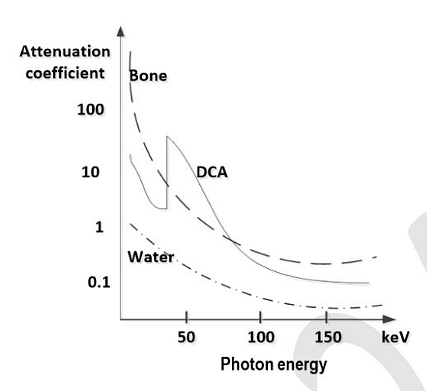
- The X-ray attenuation coefficients as a function of photon energy for three materials are shown in the figure below. A tissue phantom containing these three materials is imaged at two different X-ray photon energies of 50 keV and 150 keV. When the developed X-ray film is viewed, which of the following statements is/are TRUE ?
- An X-ray beam of initial intensity I0 of 70 keV imaging the chest is assumed to undergo attenuation through the muscle tissue for a thickness of 16 cm and further through the bone tissue for a thickness of 4 cm. The half value layer (HVL) thicknesses for the muscle and bone are 3.5 cm and 1.8 cm, respectively. The percentage of X-ray intensity transmitted through the body is ________.
Give your answer rounded off to 2 decimal places. - If a circular ultrasound transducer of radius a = 8 mm operating at a central frequency of 1 MHz has a pressure beam pattern in a medium as given below :
\(P(r,0) \propto\sin\frac{ka^2}{4r}\)
Here, k is the wave number, r is the axial distance from the center of aperture. The speed of sound in the medium is 1600 ms-1.
The reduction in intensity between r = 8 cm and r = 16 cm is _______ dB. Give your answer as a positive quantity rounded off to two decimal places.
View More Questions
Top GATE BM Ultrasound and its application Questions
- A Doppler ultrasound transducer operating at 5 MHz gave maximum output frequency shift of 3 kHz. The velocity of sound in blood is 1500 m/s. If the probe was held at an angle of 45° to the direction of blood flow, the maximum velocity of blood flow through the artery is _______ m/s. (Give your answer rounded off to two decimal places.)
- If a circular ultrasound transducer of radius a = 8 mm operating at a central frequency of 1 MHz has a pressure beam pattern in a medium as given below :
\(P(r,0) \propto\sin\frac{ka^2}{4r}\)
Here, k is the wave number, r is the axial distance from the center of aperture. The speed of sound in the medium is 1600 ms-1.
The reduction in intensity between r = 8 cm and r = 16 cm is _______ dB. Give your answer as a positive quantity rounded off to two decimal places. - Which of the following statement(s) about ultrasound waves is/are true?
- Backscattered electron detector of a scanning electron microscope is used to
- The 1stgeneration (1G) CT scanner uses a point X-ray source and a detector. The source-detector assembly can move linearly at a speed of 0.5 m.s\(^{-1}\) and it takes 0.5 s for source-detector assembly to rotate one angular increment, regardless of the angle. This scanner is expected to collect 360 projections over 180° of span. The field of view used for data collection has a diameter of 0.5 m. The scan time required is _____ s.
View More Questions
Top GATE BM Questions
- What is the value of the following complex line integral counter-clockwise ?
\(\oint_{|z|=3}\frac{8}{z(z-2)(z-4)}dz\) - To solve the equation x = 2 cos x using Newton-Raphson's method, which one of the following iterations should be used ?
- During the repolarization phase of a neuron, the cell is brought back to the resting potential by the action of a Sodium-Potassium pump. Which one of the following statements is TRUE for the active transport of Na+ and K+ ions through the cell membrane ?
- The cardiac rhythm in a healthy human heart originates from ______.
- Which one of the following events is NOT typically encountered in diagnostic X-ray projection radiography ?
View More Questions