Question:
A train accelerating uniformly from rest attains a maximum speed of \(40 \text{ m s}^{-1}\) in 20 s. It travels at this speed for 20 s and is brought to rest with uniform retardation in further 40 s. What is the average velocity during the period?
A train accelerating uniformly from rest attains a maximum speed of \(40 \text{ m s}^{-1}\) in 20 s. It travels at this speed for 20 s and is brought to rest with uniform retardation in further 40 s. What is the average velocity during the period?
Show Hint
For motion with varying speeds, average velocity is total displacement divided by total time.
Updated On: Mar 24, 2026
- \(80 \text{ m s}^{-1}\)
- \(25 \text{ m s}^{-1}\)
- \(40 \text{ m s}^{-1}\)
- \(30 \text{ m s}^{-1}\)
Show Solution

Verified By Collegedunia
The Correct Option is B
Solution and Explanation
Step 1: Distance during acceleration: \[ s_1 = \frac{(0+40)}{2}\times 20 = 400 \text{ m} \]
Step 2: Distance at constant speed: \[ s_2 = 40 \times 20 = 800 \text{ m} \]
Step 3: Distance during retardation: \[ s_3 = \frac{(40+0)}{2}\times 40 = 800 \text{ m} \]
Step 4: Total distance \(= 2000 \text{ m}\) Total time \(= 20+20+40 = 80 \text{ s}\) \[ \text{Average velocity} = \frac{2000}{80} = 25 \text{ m s}^{-1} \]
Was this answer helpful?
0
0
Top BITSAT Physics Questions
- Two point charges $-q$ and $+ q$ are located at point's $(0, 0, - a)$ and, $(0, 0, a)$ respectively. The electric potential at a point $(0, 9, z)$, where $z > a$ is
- Which of the following must be known in order to determine the power output of an automobile?
- A large drop of oil (density $0.8 \,g / cm ^{3}$ and viscosity $\eta_{0}$ ) floats up through a column of another liquid (density $1.2\, g / cm ^{3}$ and viscosity $\eta_{L}$ ). Assuming that the two liquids do not mix, the velocity with which the oil drop rises will depend on :
- A body is projected vertically upwards at time $ t = 0$ and it is seen at a height $H$ at time $t_1$ and $t_2$ second during its flight. The maximum height attained is ($g$ is acceleration due to gravity)
- At what point of a projectile motion, acceleration and velocity are perpendicular to each other ?
View More Questions
Top BITSAT Motion in a straight line Questions
- A frictionless wire $A B$ is fixed on a sphere of radius $R$. A very small spherical ball slips on this wire. The time taken by this ball to slip from $A$ to $B$ is
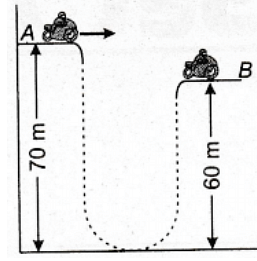
- A motorcyclist is trying to jump across a path as shown by driving horizontally off a cliff A at a speed of 5 m/s. Ignore air resistance and take g = 10m/s2 . The speed with which he touches the cliff B is?
An object moves with speed \( v_1 \), \( v_2 \), and \( v_3 \) along a line segment \( AB \), \( BC \), and \( CD \) respectively as shown in the figure. Where \( AB = BC \) and \( AD = 3 AB \), then the average speed of the object will be:

- In a reflecting telescope, a secondary mirror is used to:
A disc is rolling without slipping on a surface. The radius of the disc is \( R \). At \( t = 0 \), the topmost point on the disc is \( A \) as shown in the figure. When the disc completes half of its rotation, the displacement of point \( A \) from its initial position is:

View More Questions
Top BITSAT Questions
- Two point charges $-q$ and $+ q$ are located at point's $(0, 0, - a)$ and, $(0, 0, a)$ respectively. The electric potential at a point $(0, 9, z)$, where $z > a$ is
- Which of the following must be known in order to determine the power output of an automobile?
- A large drop of oil (density $0.8 \,g / cm ^{3}$ and viscosity $\eta_{0}$ ) floats up through a column of another liquid (density $1.2\, g / cm ^{3}$ and viscosity $\eta_{L}$ ). Assuming that the two liquids do not mix, the velocity with which the oil drop rises will depend on :
- A body is projected vertically upwards at time $ t = 0$ and it is seen at a height $H$ at time $t_1$ and $t_2$ second during its flight. The maximum height attained is ($g$ is acceleration due to gravity)
- At what point of a projectile motion, acceleration and velocity are perpendicular to each other ?
View More Questions