A simple harmonic oscillator of angular frequency $2 \,rad \,s^{-1}$ is acted upon by an external force $F= \sin\, t \,N$. If the oscillator is at rest in its equilibrium position at $t\, =\, 0$, its position at later times is proportional to :
- $\sin\, t +\frac{1}{2}\sin 2 t$
- $\sin\, t +\frac{1}{2}\cos 2 t$
- $\cos\, t -\frac{1}{2}\sin 2 t$
- $\sin\,t -\frac{1}{2}\sin\, 2 t$

The Correct Option is D
Solution and Explanation
If $x=k\left(\sin t-\frac{1}{2} \sin 2 t\right), v=\frac{d x}{d t}=K(\cos t-\cos 2 t)$
At $t=0, \nu=0$
Top JEE Main Physics Questions
- Two masses $m$ and $\frac{m}{2}$ are connected at the two ends of a massless rigid rod of length $l$. The rod is suspended by a thin wire of torsional constant $k$ at the centre of mass of the rod-mass system(see figure). Because of torsional constant $k$, the restoring torque is $\tau =k\theta$ for angular displacement $\theta$. If the rod is rota ted by $\theta_0$ and released, the tension in it when it passes through its mean position will be:
A black body is at a temperature of 2880 K. The energy of radiation emitted by this body with wavelength between 499 nm and 500 nm is U1, between 999 nm and 1000 nm is U2 and between 1499 nm and 1500 nm is U3. The Wien's constant, b = 2.88×10⁶ nm-K. Then,
- $I _{ CM }$ is the moment of inertia of a circular disc about an axis (CM) passing through its center and perpendicular to the plane of disc $I_{A B}$ is it's moment of inertia about an axis $AB$ perpendicular to plane and parallel to axis $CM$ at a distance $\frac{2}{3} R$ from center Where $R$ is the radius of the dise The ratio of $I _{ AB }$ and $I _{ CM }$ is $x: 9$ The value of $x$ is______

- A nucleus disintegrates into two smaller parts, which have their velocities in the ratio $3: 2$ The ratio of their nuclear sizes will be $\left(\frac{x}{3}\right)^{\frac{1}{3}}$ The value of ' $x$ ' is:-
- A particle starts with an initial velocity of 10.0 m/s along x-direction and accelerates uniformly at the rate of 2.0 m/s$^2$. The time taken by the particle to reach the velocity of 60.0 m/s is
Top JEE Main Waves and Oscillations Questions
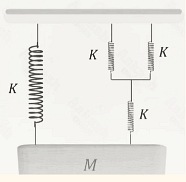
- The period of oscillation of system shown below is \(π\sqrt{\bigg(\frac{\alpha M}{5K}\bigg)}\) then \(\alpha\) is
- A simple harmonic oscillator has an amplitude \( A \) and a time period of \( 6\pi \) seconds. Assuming the oscillation starts from its mean position, the time required by it to travel from \( x = A \) to \( x = \frac{\sqrt{3}}{2} A \) will be \( \frac{\pi}{x} \) seconds, where \( x = \, \underline{\hspace{2cm}} \).
- A particle executes simple harmonic motion with an amplitude of 4 cm. At the mean position, the velocity of the particle is 10 cm/s. The distance of the particle from the mean position when its speed becomes 5 cm/s is \( \sqrt{\alpha} \) cm, where $\alpha$ = ______
- A tuning fork resonates with a sonometer wire of length 1 m stretched with a tension of 6 N. When the tension in the wire is changed to 54 N, the same tuning fork produces 12 beats per second with it. The frequency of the tuning fork is _______ Hz.
- A particle performs simple harmonic motion with amplitude \( A \). Its speed is increased to three times at an instant when its displacement is \( \frac{2A}{3} \). The new amplitude of motion is \( \frac{nA}{3} \). The value of \( n \) is _____.
Top JEE Main Questions
- Two masses $m$ and $\frac{m}{2}$ are connected at the two ends of a massless rigid rod of length $l$. The rod is suspended by a thin wire of torsional constant $k$ at the centre of mass of the rod-mass system(see figure). Because of torsional constant $k$, the restoring torque is $\tau =k\theta$ for angular displacement $\theta$. If the rod is rota ted by $\theta_0$ and released, the tension in it when it passes through its mean position will be:
What will be the equilibrium constant of the given reaction carried out in a \(5 \,L\) vessel and having equilibrium amounts of \(A_2\) and \(A\) as \(0.5\) mole and \(2 \times 10^{-6}\) mole respectively?
The reaction : \(A_2 \rightleftharpoons 2A\)- The value of is
- The number of terms of an is even. The sum of the odd terms is and of the even terms is . The last term exceeds the first by . Then the number of terms in the series is ______.
A black body is at a temperature of 2880 K. The energy of radiation emitted by this body with wavelength between 499 nm and 500 nm is U1, between 999 nm and 1000 nm is U2 and between 1499 nm and 1500 nm is U3. The Wien's constant, b = 2.88×10⁶ nm-K. Then,
Concepts Used:
Oscillations
Oscillation is a process of repeating variations of any quantity or measure from its equilibrium value in time . Another definition of oscillation is a periodic variation of a matter between two values or about its central value.
The term vibration is used to describe the mechanical oscillations of an object. However, oscillations also occur in dynamic systems or more accurately in every field of science. Even our heartbeats also creates oscillations. Meanwhile, objects that move to and fro from its equilibrium position are known as oscillators.
Read More: Simple Harmonic Motion
Oscillation- Examples
The tides in the sea and the movement of a simple pendulum of the clock are some of the most common examples of oscillations. Some of examples of oscillations are vibrations caused by the guitar strings or the other instruments having strings are also and etc. The movements caused by oscillations are known as oscillating movements. For example, oscillating movements in a sine wave or a spring when it moves up and down.
The maximum distance covered while taking oscillations is known as the amplitude. The time taken to complete one cycle is known as the time period of the oscillation. The number of oscillating cycles completed in one second is referred to as the frequency which is the reciprocal of the time period.