Question:
A particle moves along a straight line such that its position is given by \( x(t) = 3t^2 - t^3 \). What is its velocity at \( t = 2 \) seconds?
A particle moves along a straight line such that its position is given by \( x(t) = 3t^2 - t^3 \). What is its velocity at \( t = 2 \) seconds?
Show Hint
Whenever position is given as a function of time, remember:
\[
\text{Velocity} = \frac{dx}{dt}
\]
and
\[
\text{Acceleration} = \frac{d^2x}{dt^2}
\]
Differentiate carefully term-by-term using power rule.
Updated On: Oct 16, 2026
- \( 0 \text{ m/s} \)
- \( 4 \text{ m/s} \)
- \( -4 \text{ m/s} \)
- \( 12 \text{ m/s} \)
Show Solution

Verified By Collegedunia
The Correct Option is A
Solution and Explanation
Concept:
Velocity is the rate of change of position with respect to time. If the position of a particle is given by \(x(t)\), then its velocity is obtained by differentiating the position function:
\[
v(t)=\frac{dx}{dt}
\]
Step 1: Differentiate the position function to obtain velocity.
The given position function is: \[ x(t)=3t^2-t^3 \] Differentiate with respect to \(t\): \[ v(t)=\frac{d}{dt}(3t^2-t^3) \] \[ v(t)=6t-3t^2 \]
Step 2: Substitute \(t=2\) seconds into the velocity expression.
\[ v(2)=6(2)-3(2)^2 \] \[ v(2)=12-3(4) \] \[ v(2)=12-12 \] \[ v(2)=0 \] Hence, the velocity of the particle at \(t=2\) seconds is: \[ \boxed{0 \text{ m/s}} \]
Step 1: Differentiate the position function to obtain velocity.
The given position function is: \[ x(t)=3t^2-t^3 \] Differentiate with respect to \(t\): \[ v(t)=\frac{d}{dt}(3t^2-t^3) \] \[ v(t)=6t-3t^2 \]
Step 2: Substitute \(t=2\) seconds into the velocity expression.
\[ v(2)=6(2)-3(2)^2 \] \[ v(2)=12-3(4) \] \[ v(2)=12-12 \] \[ v(2)=0 \] Hence, the velocity of the particle at \(t=2\) seconds is: \[ \boxed{0 \text{ m/s}} \]
Was this answer helpful?
2
0
Top BITSAT Physics Questions
- Two point charges $-q$ and $+ q$ are located at point's $(0, 0, - a)$ and, $(0, 0, a)$ respectively. The electric potential at a point $(0, 9, z)$, where $z > a$ is
- Which of the following must be known in order to determine the power output of an automobile?
- A large drop of oil (density $0.8 \,g / cm ^{3}$ and viscosity $\eta_{0}$ ) floats up through a column of another liquid (density $1.2\, g / cm ^{3}$ and viscosity $\eta_{L}$ ). Assuming that the two liquids do not mix, the velocity with which the oil drop rises will depend on :
- A body is projected vertically upwards at time $ t = 0$ and it is seen at a height $H$ at time $t_1$ and $t_2$ second during its flight. The maximum height attained is ($g$ is acceleration due to gravity)
- At what point of a projectile motion, acceleration and velocity are perpendicular to each other ?
View More Questions
Top BITSAT Motion in a straight line Questions
- A frictionless wire $A B$ is fixed on a sphere of radius $R$. A very small spherical ball slips on this wire. The time taken by this ball to slip from $A$ to $B$ is
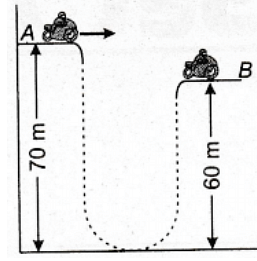
- A motorcyclist is trying to jump across a path as shown by driving horizontally off a cliff A at a speed of 5 m/s. Ignore air resistance and take g = 10m/s2 . The speed with which he touches the cliff B is?
An object moves with speed \( v_1 \), \( v_2 \), and \( v_3 \) along a line segment \( AB \), \( BC \), and \( CD \) respectively as shown in the figure. Where \( AB = BC \) and \( AD = 3 AB \), then the average speed of the object will be:

- In a reflecting telescope, a secondary mirror is used to:
A disc is rolling without slipping on a surface. The radius of the disc is \( R \). At \( t = 0 \), the topmost point on the disc is \( A \) as shown in the figure. When the disc completes half of its rotation, the displacement of point \( A \) from its initial position is:

View More Questions
Top BITSAT Questions
- Two point charges $-q$ and $+ q$ are located at point's $(0, 0, - a)$ and, $(0, 0, a)$ respectively. The electric potential at a point $(0, 9, z)$, where $z > a$ is
- Which of the following must be known in order to determine the power output of an automobile?
- A large drop of oil (density $0.8 \,g / cm ^{3}$ and viscosity $\eta_{0}$ ) floats up through a column of another liquid (density $1.2\, g / cm ^{3}$ and viscosity $\eta_{L}$ ). Assuming that the two liquids do not mix, the velocity with which the oil drop rises will depend on :
- A body is projected vertically upwards at time $ t = 0$ and it is seen at a height $H$ at time $t_1$ and $t_2$ second during its flight. The maximum height attained is ($g$ is acceleration due to gravity)
- At what point of a projectile motion, acceleration and velocity are perpendicular to each other ?
View More Questions