A convex lens of refractive index \(15\) and focal length\(18 \,cm\) in air is immersed in water. The change in focal length of the lens will be_______ cm (Given refractive index of water =\(\frac{4}{3}\))
A convex lens of refractive index \(15\) and focal length\(18 \,cm\) in air is immersed in water. The change in focal length of the lens will be_______ cm (Given refractive index of water =\(\frac{4}{3}\))
Show Hint
The focal length changes when a lens is immersed in a medium. Use \[ \mu_\text{eff} = \frac{\mu_\text{lens}}{\mu_\text{medium}} \] in the lens maker's formula.

Correct Answer: 54
Approach Solution - 1
The focal length of a lens in water is given by:
\[ \frac{1}{f_\text{water}} = \left( \frac{\mu_\text{glass}}{\mu_\text{water}} - 1 \right) \frac{2}{R} \]
For air: \[ \frac{1}{f_\text{air}} = (\mu_\text{glass} - 1) \frac{2}{R} \]
Given:
- \(\mu_\text{glass} = 1.5\),
- \(\mu_\text{water} = \frac{4}{3}\),
- \(f_\text{air} = 18 \, \text{cm}\).
The ratio of focal lengths in water and air is:
\[ \frac{f_\text{water}}{f_\text{air}} = \frac{\frac{1}{f_\text{air}}}{\frac{1}{f_\text{water}}} = \frac{\mu_\text{glass} - 1}{\frac{\mu_\text{glass}}{\mu_\text{water}} - 1} \]
Substitute the values:
\[ \frac{f_\text{water}}{f_\text{air}} = \frac{1.5 - 1}{\frac{1.5}{\frac{4}{3}} - 1} = \frac{0.5}{2 - 1} = \frac{0.5}{1} = 0.5 \]
Thus:
\[ f_\text{water} = 4 f_\text{air} = 4 \times 18 = 72 \, \text{cm} \]
The change in focal length is:
\[ \Delta f = f_\text{water} - f_\text{air} = 72 - 18 = 54 \, \text{cm} \]
Approach Solution -2
The correct answer is 54.
fH2OI=(μH2Oμg−1)(R2)
=81(R2)
=(4fair)1
So, fH2O=4fair =72cm
So change in focal length =72−18=54cm
Top JEE Main Physics Questions
- Two masses $m$ and $\frac{m}{2}$ are connected at the two ends of a massless rigid rod of length $l$. The rod is suspended by a thin wire of torsional constant $k$ at the centre of mass of the rod-mass system(see figure). Because of torsional constant $k$, the restoring torque is $\tau =k\theta$ for angular displacement $\theta$. If the rod is rota ted by $\theta_0$ and released, the tension in it when it passes through its mean position will be:
A black body is at a temperature of 2880 K. The energy of radiation emitted by this body with wavelength between 499 nm and 500 nm is U1, between 999 nm and 1000 nm is U2 and between 1499 nm and 1500 nm is U3. The Wien's constant, b = 2.88×10⁶ nm-K. Then,
- $I _{ CM }$ is the moment of inertia of a circular disc about an axis (CM) passing through its center and perpendicular to the plane of disc $I_{A B}$ is it's moment of inertia about an axis $AB$ perpendicular to plane and parallel to axis $CM$ at a distance $\frac{2}{3} R$ from center Where $R$ is the radius of the dise The ratio of $I _{ AB }$ and $I _{ CM }$ is $x: 9$ The value of $x$ is______

- A nucleus disintegrates into two smaller parts, which have their velocities in the ratio $3: 2$ The ratio of their nuclear sizes will be $\left(\frac{x}{3}\right)^{\frac{1}{3}}$ The value of ' $x$ ' is:-
- A particle starts with an initial velocity of 10.0 m/s along x-direction and accelerates uniformly at the rate of 2.0 m/s$^2$. The time taken by the particle to reach the velocity of 60.0 m/s is
Top JEE Main Ray optics and optical instruments Questions
- Two thin convex lenses of focal lengths f1 and f2 are separated by a horizontal distance d (where d < f1, d < f2) and their centers are displaced by a vertical separation Δ as shown in the figure.
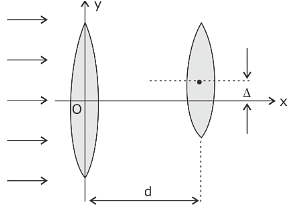
- The distance between object and its two times magnified real image as produced by a convex lens is 45 cm. The focal length of the lens used is ______ cm.
- If the distance between object and its two times magnified virtual image produced by a curved mirror is 15 cm, the focal length of the mirror must be :
A convex mirror of radius of curvature 30 cm forms an image that is half the size of the object. The object distance is:
- The distance between object and its 3 times magnified virtual image as produced by a convex lens is 20 cm. The focal length of the lens used is __________ cm.
Top JEE Main Questions
- Two masses $m$ and $\frac{m}{2}$ are connected at the two ends of a massless rigid rod of length $l$. The rod is suspended by a thin wire of torsional constant $k$ at the centre of mass of the rod-mass system(see figure). Because of torsional constant $k$, the restoring torque is $\tau =k\theta$ for angular displacement $\theta$. If the rod is rota ted by $\theta_0$ and released, the tension in it when it passes through its mean position will be:
What will be the equilibrium constant of the given reaction carried out in a \(5 \,L\) vessel and having equilibrium amounts of \(A_2\) and \(A\) as \(0.5\) mole and \(2 \times 10^{-6}\) mole respectively?
The reaction : \(A_2 \rightleftharpoons 2A\)- The value of is
- The number of terms of an is even. The sum of the odd terms is and of the even terms is . The last term exceeds the first by . Then the number of terms in the series is ______.
A black body is at a temperature of 2880 K. The energy of radiation emitted by this body with wavelength between 499 nm and 500 nm is U1, between 999 nm and 1000 nm is U2 and between 1499 nm and 1500 nm is U3. The Wien's constant, b = 2.88×10⁶ nm-K. Then,
Concepts Used:
Ray Optics and Optical Instruments
Optics, deals with the determination of behaviour and the properties of light, along with its interactions with the matter and also with the instruments that are used to detect it.
Ray optics is also known as the geometrical optics and it is a branch of science which describes light propagation.
Reflection is the change in direction of light at an interface in-between two different media so that the wave-front returns into a medium from which it was originated.
Speed of light is the rate at which the light travels in free space.
A phenomenal change in image formed when the light is passed from one medium to another which is called Refraction.
Total Internal Reflection is the reflection of light when the light ray enters into a rarer medium from a denser medium and the angle of incidence is higher than the critical angle of incidence then that light ray will be reflected back to the denser medium.
Read More: Ray Optics and Optical Instruments