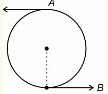
A block of mass \( m \) is at rest w.r.t. a hollow cylinder which is rotating with angular speed \( \omega \), radius of the cylinder is \( R \). Find the minimum coefficient of friction between the block and the cylinder.
Show Hint
To prevent slipping in rotating systems, the frictional force must counterbalance the centrifugal force. The relationship between the coefficient of friction, angular speed, and radius can be derived using this balance.
Step 1: Understanding the problem.
The block is at rest with respect to the rotating hollow cylinder. The block will experience a centrifugal force due to the rotation of the cylinder, which can be balanced by the frictional force between the block and the cylinder. To prevent the block from slipping, we need to find the minimum coefficient of friction that ensures the block stays at rest.
Step 2: Forces acting on the block.
The centrifugal force on the block is given by:
\[
F_{\text{centrifugal}} = m R \omega^2
\]
This force tends to push the block outward.
The frictional force \( F_{\text{friction}} \) is given by:
\[
F_{\text{friction}} = \mu m g
\]
where \( \mu \) is the coefficient of friction, and \( g \) is the acceleration due to gravity.
For the block to stay at rest with respect to the rotating cylinder, the frictional force must equal the centrifugal force. Therefore,
\[
F_{\text{friction}} = F_{\text{centrifugal}}
\]
\[
\mu m g = m R \omega^2
\]
Step 3: Solving for \( \mu \).
Cancelling \( m \) from both sides:
\[
\mu g = R \omega^2
\]
\[
\mu = \frac{R \omega^2}{g}
\]
Thus, the minimum coefficient of friction is:
\[
\mu = \frac{g}{\omega^2 R}
\]