A particle connected with light thread is performing vertical circular motion. Speed at point B (Lowermost point) is sufficient, so that it is able to complete its circular motion. Ignoring air friction, find the ratio of kinetic energy at A to that at B. (A being top-most point)
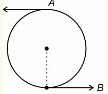
- \(1 : 5\)
- \(5 : 1\)
- \(1: 7\sqrt2\)
- \(1: 5\sqrt2\)

The Correct Option is A
Solution and Explanation
The correct option is (A): \(1 : 5\)
Top JEE Main Physics Questions
- Two masses $m$ and $\frac{m}{2}$ are connected at the two ends of a massless rigid rod of length $l$. The rod is suspended by a thin wire of torsional constant $k$ at the centre of mass of the rod-mass system(see figure). Because of torsional constant $k$, the restoring torque is $\tau =k\theta$ for angular displacement $\theta$. If the rod is rota ted by $\theta_0$ and released, the tension in it when it passes through its mean position will be:
A black body is at a temperature of 2880 K. The energy of radiation emitted by this body with wavelength between 499 nm and 500 nm is U1, between 999 nm and 1000 nm is U2 and between 1499 nm and 1500 nm is U3. The Wien's constant, b = 2.88×10⁶ nm-K. Then,
- $I _{ CM }$ is the moment of inertia of a circular disc about an axis (CM) passing through its center and perpendicular to the plane of disc $I_{A B}$ is it's moment of inertia about an axis $AB$ perpendicular to plane and parallel to axis $CM$ at a distance $\frac{2}{3} R$ from center Where $R$ is the radius of the dise The ratio of $I _{ AB }$ and $I _{ CM }$ is $x: 9$ The value of $x$ is______

- A nucleus disintegrates into two smaller parts, which have their velocities in the ratio $3: 2$ The ratio of their nuclear sizes will be $\left(\frac{x}{3}\right)^{\frac{1}{3}}$ The value of ' $x$ ' is:-
- A particle starts with an initial velocity of 10.0 m/s along x-direction and accelerates uniformly at the rate of 2.0 m/s$^2$. The time taken by the particle to reach the velocity of 60.0 m/s is
Top JEE Main Uniform Circular Motion Questions
- A cyclist starts from the point P of a circular ground of radius 2 km and travels along its circumference to the point S. The displacement of a cyclist is :

- A car of 800 kg is taking a turn on a banked road of radius 300 m and angle of banking 30°. If the coefficient of static friction is 0.2, then the maximum speed with which the car can negotiate the turn safely: (Given $g = 10 \, \text{m/s}^2$, $\sqrt{3} = 1.73$).
- A uniform disc of radius $ r $ is rotating about an axis passing through its diameter with angular speed 800 rpm. A torque of magnitude $ 25\pi \, \text{Nm} $ is applied on the disc for 40 sec. If the final angular speed of the disc is 2100 rpm, find the diameter of the disc if its mass is 1 kg.
In case of vertical circular motion of a particle by a thread of length \( r \), if the tension in the thread is zero at an angle \(30^\circ\) as shown in the figure, the velocity at the bottom point (A) of the vertical circular path is ( \( g \) = gravitational acceleration ).

- A body of mass 200 g is tied to a spring of spring constant 12.5 N/m, while the other end of the spring is fixed at point \( O \). If the body moves about \( O \) in a circular path on a smooth horizontal surface with constant angular speed 5 rad/s, then the ratio of extension in the spring to its natural length will be:
Top JEE Main Questions
- Two masses $m$ and $\frac{m}{2}$ are connected at the two ends of a massless rigid rod of length $l$. The rod is suspended by a thin wire of torsional constant $k$ at the centre of mass of the rod-mass system(see figure). Because of torsional constant $k$, the restoring torque is $\tau =k\theta$ for angular displacement $\theta$. If the rod is rota ted by $\theta_0$ and released, the tension in it when it passes through its mean position will be:
What will be the equilibrium constant of the given reaction carried out in a \(5 \,L\) vessel and having equilibrium amounts of \(A_2\) and \(A\) as \(0.5\) mole and \(2 \times 10^{-6}\) mole respectively?
The reaction : \(A_2 \rightleftharpoons 2A\)- The value of is
- The number of terms of an is even. The sum of the odd terms is and of the even terms is . The last term exceeds the first by . Then the number of terms in the series is ______.
A black body is at a temperature of 2880 K. The energy of radiation emitted by this body with wavelength between 499 nm and 500 nm is U1, between 999 nm and 1000 nm is U2 and between 1499 nm and 1500 nm is U3. The Wien's constant, b = 2.88×10⁶ nm-K. Then,
Concepts Used:
Uniform Circular Motion
A circular motion is defined as the movement of a body that follows a circular route. The motion of a body going at a constant speed along a circular path is known as uniform circular motion. The velocity varies while the speed of the body in uniform circular motion remains constant.
Uniform Circular Motion Examples:
- The motion of electrons around its nucleus.
- The motion of blades of the windmills.
Uniform Circular Motion Formula:
When the radius of the circular path is R, and the magnitude of the velocity of the object is V. Then, the radial acceleration of the object is:
arad = v2/R
Similarly, this radial acceleration is always perpendicular to the velocity direction. Its SI unit is m2s−2.
The radial acceleration can be mathematically written using the period of the motion i.e. T. This period T is the volume of time taken to complete a revolution. Its unit is measurable in seconds.
When angular velocity changes in a unit of time, it is a radial acceleration.
Angular acceleration indicates the time rate of change of angular velocity and is usually denoted by α and is expressed in radians per second. Moreover, the angular acceleration is constant and does not depend on the time variable as it varies linearly with time. Angular Acceleration is also called Rotational Acceleration.
Angular acceleration is a vector quantity, meaning it has magnitude and direction. The direction of angular acceleration is perpendicular to the plane of rotation.
Formula Of Angular Acceleration
The formula of angular acceleration can be given in three different ways.
α = dωdt
Where,
ω → Angular speed
t → Time
α = d2θdt2
Where,
θ → Angle of rotation
t → Time
Average angular acceleration can be calculated by the formula below. This formula comes in handy when angular acceleration is not constant and changes with time.
αavg = ω2 - ω1t2 - t1
Where,
ω1 → Initial angular speed
ω2 → Final angular speed
t1 → Starting time
t2 → Ending time

Also Read: Angular Motion