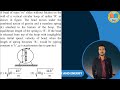
A bead of mass \( m \) slides without friction on the wall of a vertical circular hoop of radius \( R \) as shown in figure. The bead moves under the combined action of gravity and a massless spring \( k \) attached to the bottom of the hoop. The equilibrium length of the spring is \( R \). If the bead is released from the top of the hoop with (negligible) zero initial speed, the velocity of the bead, when the length of spring becomes \( R \), would be (spring constant is \( k \), \( g \) is acceleration due to gravity):
Show Hint
In problems involving energy conservation, always account for both kinetic and potential energy.
The bead moves under the influence of gravity and the restoring force from the spring. Step 1: Apply energy conservation. At the top of the hoop, the bead has potential energy due to gravity and the spring. At the bottom, the bead will have kinetic energy. Step 2: At the top, the potential energy is: \[ U_{\text{top}} = mgh = mg(2R) \] where \( h = 2R \) is the height of the bead from the bottom. Step 3: The spring potential energy at the top is zero since the spring is at its equilibrium length. Step 4: At the bottom, the kinetic energy is: \[ K_{\text{bottom}} = \frac{1}{2} m v^2 \] The spring at the bottom has a compression of \( R \), so the spring potential energy is: \[ U_{\text{spring}} = \frac{1}{2} k R^2 \] Step 5: Apply conservation of mechanical energy: \[ m g (2R) = \frac{1}{2} m v^2 + \frac{1}{2} k R^2 \] Step 6: Solve for \( v \): \[ v = \sqrt{\frac{2gR + kR^2}{m}} \] Final Conclusion: The velocity of the bead when the spring becomes \( R \) is given by \( \sqrt{\frac{2gR + kR^2}{m}} \), which is Option (3).