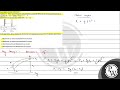
Given below are two statements: Statement I: When the speed of liquid is zero everywhere, the pressure difference at any two points depends on the equation $$ P_1 - P_2 = \rho g (h_2 - h_1). $$ Statement II: In the ventury tube shown, $$ 2gh = v_1^2 - v_2^2. $$ In the light of the above statements, choose the most appropriate answer from the options given below.
Statement I is incorrect but Statement II is correct.
Both Statement I and Statement II are incorrect.
Statement I is correct but Statement II is incorrect.
Show Solution
Verified By Collegedunia
The Correct Option isD
Solution and Explanation
Analyze Statement I: Statement I states that when the speed of liquid is zero everywhere, the pressure difference at any two points depends on the equation: \[ P_1 - P_2 = \rho g(h_2 - h_1) \] This is correct and is based on the hydrostatic pressure difference, which applies when the fluid is at rest or moving uniformly without velocity gradients.
Analyze Statement II Using Bernoulli’s Equation: In a venturi tube, where the fluid is in motion, we can apply Bernoulli’s equation: \[ P_1 + \rho gh + \frac{1}{2}\rho v_1^2 = P_2 + \rho gh + \frac{1}{2}\rho v_2^2 \]
Simplifying for the pressure difference, we get: \[ P_1 - P_2 = \frac{1}{2}\rho (v_2^2 - v_1^2) \] The statement given, \(2gh = v_2^2 - v_1^2\), is not a general result of Bernoulli’s equation and is incorrect as presented.
Conclusion: Therefore, Statement I is correct (it applies to a static fluid or uniform motion with no speed variations), but Statement II is incorrect in the context of the venturi tube.