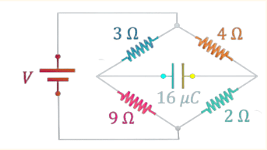
If a source of electromagnetic radiation having power $15 kW$ produces $10^{16}$ photons per second, the radiation belongs to a part of spectrum is(Take Planck constant $h =6 \times 10^{-34} Js$ )
The maximum potential energy of a block executing simple harmonic motion is $25 J$ A is amplitude of oscillation At $A / 2$, the kinetic energy of the block is
The initial speed of a projectile fired from ground is $u$ At the highest point during its motion, the speed of projectile is $\frac{\sqrt{3}}{2} u$ The time of flight of the projectile is :
The effect of increase in temperature on the number of electrons in conduction band $\left( n _{ e }\right)$ and resistance of a semiconductor will be as:
Which one of the following statements is correct for electrolysis of brine solution?
When $Cu ^{2+}$ ion is treated with $KI$, a white precipitate, $X$ appears in solution The solution is titrated with sodium thiosulphate, the compound $Y$ is formed $X$ and $Y$ respectively are
Identify $X , Y$ and $Z$ in the following reaction (Equation not balanced) $ClO + NO _2 \rightarrow \underline{ X } \stackrel{ H _2 O }{\longrightarrow} \underline{ Y }+\underline{Z}$
Adding surfactants in non polar solvent, the micelles structure will look like
The methods NOT involved in concentration of ore areA LiquationB LeachingC ElectrolysisD Hydraulic washingE Froth floatationChoose the correct answer from the options given below :
A protein ' $X$ ' with molecular weight of $70,000 u$, on hydrolysis gives amino acids One of these amino acid is
A bag contains 6 balls Two balls are drawn from it at random and both are found to be black The probability that the bag contains at least 5 black balls is
The number of real roots of the equation $\sqrt{x^2-4 x+3}+\sqrt{x^2-9}=\sqrt{4 x^2-14 x+6}$, is:
$( S 1)(p \Rightarrow q) \vee(p \wedge(\sim q))$ is a tautology(S2) $((\sim p) \Rightarrow(\sim q)) \wedge((\sim p) \vee q)$ is a contradictionThen
Let the shortest distance between the lines $L: \frac{x-5}{-2}=\frac{y-\lambda}{0}=\frac{z+\lambda}{1}, \lambda \geq 0$ and $L_1: x+1=y-1=4-z$ be $2 \sqrt{6}$ If $(\alpha, \beta, \gamma)$ lies on $L$, then which of the following is NOT possible?
Let $\alpha \in(0,1)$ and $\beta=\log _e(1-\alpha)$ Let $P_n(x)=x+\frac{x^2}{2}+\frac{x^3}{3}+\ldots+\frac{x^n}{n}, x \in(0,1)$ Then the integral $\int\limits_0^\alpha \frac{t^{50}}{1-t} d t$ is equal to
Let $A=\begin{pmatrix}1 & 0 & 0 \\ 0 & 4 & -1 \\ 0 & 12 & -3\end{pmatrix}$ Then the sum of the diagonal elements of the matrix $(A+I)^{11}$ is equal to :
For all $z \in C$ on the curve $C_1:|z|=4$, let the locus of the point $z+\frac{1}{z}$ be the curve $C_2$ Then:
Let $R$ be a relation on $N \times N$ defined by $(a, b) R (c, d)$ if and only if $a d(b-c)=b c(a-d)$ Then $R$ is
A wire of length $20 m$ is to be cut into two pieces A piece of length $l_1$ is bent to make a square of area $A_1$ and the other piece of length $l_2$ is made into a circle of area $A_2$ If $2 A_1+3 A_2$ is minimum then $\left(\pi l_1\right): l_2$ is equal to:
Let $y=f(x)$ represent a parabola with focus $\left(-\frac{1}{2}, 0\right)$ and directrix $y=-\frac{1}{2}$ Then $S=\left\{x \in R : \tan ^{-1}(\sqrt{f(x)})+\sin ^{-1}(\sqrt{f(x)+1})=\frac{\pi}{2}\right\}$ :
Match List I with List II
Choose the correct answer from the options given below.
Under the same load, wire A having length $50 m$ and cross section $25 \times 10^{-5} m ^2$ stretches uniformly by the same amount as another wire $B$ of length $60 m$ and a cross section of $30 \times 10^{-5}$ $m ^2$ stretches The ratio of the Young's modulus of wire $A$ to that of wire $B$ will be :
A body is moving with constant speed, in a circle of radius $10 m$ .The body completes one revolution in 4 s .At the end of 3 rd second, the displacement of body (in mi) from its starting point is :
Considering a group of positive charges, which of the following statements is correct ?
The $H$ amount of thermal energy is developed by a resistor in $10 s$ when a current of $4 A$ is passed through it If the current is increased to $16 A$, the themal energy developed by the resistor in $10 s$ will be: