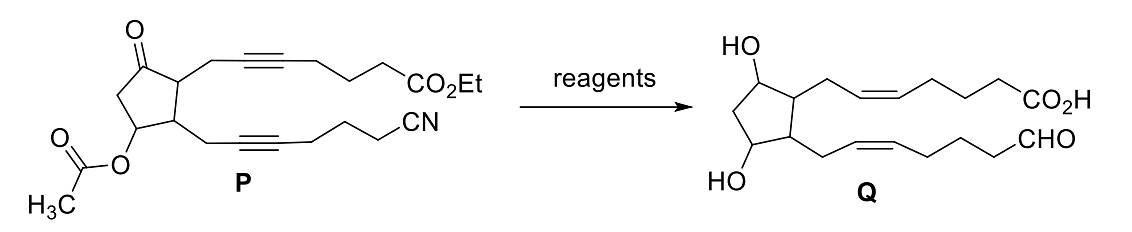
The major product (P) in the reaction
is
The correct structure of product ‘A’ formed in the following reaction, (Ph is – C6H5) is
Identify the major product formed in the following sequence of reactions:
CNG is an important transportation fuel. When 100 g CNG is mixed with 208 g oxygen in vehicles, it leads to the formation of CO2 and H2O and produced large quantity of heat during this combustion, then the amount of carbon dioxide, produced in grams is _____. [nearest integer] [Assume CNG to be methane]
\(Cu(S)+Sn^{2+} (0.001M) Cu^{2+} (0.01M) + Sn(s)\)The Gibbs free energy change for the above reaction at 298 K is x × 10-1 × kJ mol-1. The value of x is ________ .[nearest integer][Given \(E^{-}_{cu^{2+} / cu} = 0.34V; E^{-}_{Sn^{2+} / Sn} = - 0.14V; F = 96500 C ∼ mol^{-1}\)]
Catalyst A reduces the activation energy for a reaction by 10 kJ mol–1 at 300 K. The ratio of rate constants,\(\frac{Κ′ , Catalysed}{Κ,Uncatalysed}\)is ex. The value of x is ____.[nearest integer][Assume that the pre-exponential factor is same in both the cases Given R = 8.31 J K–1 mol–1]
A solution of Fe2(SO4)3 is electrolyzed for ‘x’ min with a current of 1.5 A to deposit 0.3482 g of Fe. The value of x is _______. [nearest integer]
Given : 1 F = 96500 C mol–1.
Atomic mass of Fe = 56 g mol–1
Consider the following reactions.
\(PCl_3+H_2→A+HCL\)
\(A+H_2o→B+HCL\)
The number of ionisable protons present in the product B is