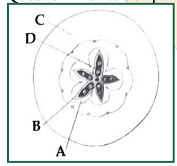
Which part of the fruit, labelled in the given figure makes it a false fruit?
Which part of the fruit, labelled in the given figure makes it a false fruit?
- A - Mesocarp
- B - Endocarp
- C - Thalamus
- D - Seed

The Correct Option is C
Solution and Explanation
In botany, a fruit is defined as the mature ovary of a flowering plant, usually containing seeds. However, a "false fruit" or "pseudocarp" includes other floral parts in addition to the ovary. In this context, the part of the fruit which contributes to making it a false fruit is the thalamus.
Explanation:
- The mesocarp is the middle layer of the pericarp, typically fleshy, and forms part of the true fruit structure.
- The endocarp is the innermost layer surrounding the seeds and is also a part of the true fruit structure.
- The thalamus is not part of the ovary itself but rather a part of the flower's receptacle and contributes to forming the fruit structure, thus creating a false fruit.
- The seed is the result of fertilized ovules and is contained within the fruit.
Thus, in the provided figure, the part labeled as the thalamus (option C) is responsible for making it a false fruit.
Top NEET Biology Questions
- The chronological order of human evolution from early to the recent is
- Upper part of sea/aquatic ecosystem contains
- Where is respiratory electron transport system (ETS) located in plants ?
- Which among the following are the smallest living cells, known without a definite cell wall, pathogenic to plants as well as animals and can survive without oxygen ?
- Three of the following pairs of the human skeletal parts are correctly matched with their respective inclusive skeletal category and one pair is not matched. Identify the non-matching pair. .
Pair of skeletal parts Category (a)$\,\,$ Sternum and ribs$\,\,$ Axial skeleton (b)$\,\,$ Clavicle and glenoid cavity$\,\,$ Pelvic girdle (c)$\,\,$ Flumerus and ulna$\,\,$ Appendicular skeleton (d)$\,\,$ Malleus and stapes$\,\,$ Ear ossicles
Top NEET Morphology of flowering plants Questions
- An example of a seed with perisperm and caruncle is
- An example of axile placentation is
- Micropyle of seed is involved in the passage of
- Juicy hair-like structures observed in the lemon fruit develop from:
- Which of the following is a nucleotide?
Top NEET Questions
- A $100.0\, mL$ dilute solution of $Ag ^{+}$is electrolysed for $15.0$ minutes with a current of $1.25 \,mA$ and the silver is removed completely. What was the initial $\left[ Ag ^{+}\right]$?
- The time constant of C-R circuit is
- The chronological order of human evolution from early to the recent is
- The correct Boolean operation represented by the circuit diagram drawn is :
- The driver of a car travelling with speed $30\, m/sec$ towards a hill sounds a horn of frequency $600\, Hz.$ If the velocity of sound in air is $330\, m/s,$ the frequency of reflected sound as heard by driver is
Concepts Used:
Morphology of Flowering Plants
Morphology in flowering plants tells us that every plant has two systems such as a root system and a shoot system. The root system digs deep into the ground and structures a system of its own. On the other hand, the shoot system is the one that is above ground level and includes various plant parts.
Root System
The descending part of the plant grows under the soil roots. During the germination process, the radicle from the seed grows earthward and branches out. The branches along with the primary root are called the root system. Roots lack chlorophyll and therefore they are not green in color. Roots are positively geotropic and hydrotropic, that is, they grow downwards ground and water, and negatively phototropic, which is growing away from light.
There are three types of root systems found in plants are as follows:
- TapRoot System
- Fibrous Root System
- Adventitious Root System
Shoot System
The stem is also an essential element of the plant. It is the ascending portion of the plant axis that bears branches, flowers, leaves, and fruits, as well as aiding in water and mineral conduction. It is the plant's aerial portion, brought about from an embryo's plumule or germinating seeds. Young stems are ordinarily green, but they finally turn woody and brown.