Question:
Which one of the following will not coagulate when placed on a glass slide that does not have any surface coatings?
Which one of the following will not coagulate when placed on a glass slide that does not have any surface coatings?
Show Hint
Serum is what is left after blood has already clotted once, so ask what it no longer contains.
Updated On: Aug 7, 2026
- Blood serum
- Fresh blood obtained from an artery
- Fresh blood obtained from a vein
- Blood depleted of neutrophils alone
Show Solution

Verified By Collegedunia
The Correct Option is A
Solution and Explanation
Step 1: Recall what coagulation needs.
Blood clots on an uncoated glass surface mainly through the intrinsic (contact activation) pathway of the coagulation cascade. Contact with a foreign, negatively charged surface like plain glass activates factor XII, which triggers a chain of clotting factor activations ending in fibrinogen being converted to fibrin, the mesh that forms a clot.
For this to happen, the sample needs an active supply of clotting factors, especially fibrinogen and prothrombin, still present and functional.
Step 2: Check fresh whole blood from an artery or a vein.
Fresh whole blood, whether drawn from an artery or a vein, still carries its full set of clotting factors and platelets. Placed on plain glass, contact activation proceeds normally, and the sample clots. Arterial vs venous origin does not change which clotting factors are present, only the oxygen content of the blood, so both (B) and (C) will coagulate.
Step 3: Check blood depleted of neutrophils alone.
Neutrophils are white blood cells involved in immune defence, not in the core clotting cascade. Removing only neutrophils leaves fibrinogen, prothrombin, platelets, and the rest of the clotting factors untouched, so this sample still clots normally on glass. So (D) will also coagulate.
Step 4: Check blood serum.
Serum is what remains after whole blood is allowed to clot and the clot, containing fibrin and cells, is removed. In other words, serum is blood plasma with the clotting factors, especially fibrinogen, already used up in forming the earlier clot.
Since serum no longer has usable fibrinogen or an active clotting cascade, placing it on glass again cannot trigger a fresh clot. There is nothing left to convert into fibrin.
Step 5: Compare all four options.
Options (B), (C), and (D) all still contain a working clotting cascade with fibrinogen intact, so all three coagulate on contact with plain glass. Only serum has already had its clotting factors consumed in an earlier clotting event, so it is the one sample that will not coagulate again.
Final Answer:
Blood serum will not coagulate on an uncoated glass slide, because its clotting factors are already spent.
Blood clots on an uncoated glass surface mainly through the intrinsic (contact activation) pathway of the coagulation cascade. Contact with a foreign, negatively charged surface like plain glass activates factor XII, which triggers a chain of clotting factor activations ending in fibrinogen being converted to fibrin, the mesh that forms a clot.
For this to happen, the sample needs an active supply of clotting factors, especially fibrinogen and prothrombin, still present and functional.
Step 2: Check fresh whole blood from an artery or a vein.
Fresh whole blood, whether drawn from an artery or a vein, still carries its full set of clotting factors and platelets. Placed on plain glass, contact activation proceeds normally, and the sample clots. Arterial vs venous origin does not change which clotting factors are present, only the oxygen content of the blood, so both (B) and (C) will coagulate.
Step 3: Check blood depleted of neutrophils alone.
Neutrophils are white blood cells involved in immune defence, not in the core clotting cascade. Removing only neutrophils leaves fibrinogen, prothrombin, platelets, and the rest of the clotting factors untouched, so this sample still clots normally on glass. So (D) will also coagulate.
Step 4: Check blood serum.
Serum is what remains after whole blood is allowed to clot and the clot, containing fibrin and cells, is removed. In other words, serum is blood plasma with the clotting factors, especially fibrinogen, already used up in forming the earlier clot.
Since serum no longer has usable fibrinogen or an active clotting cascade, placing it on glass again cannot trigger a fresh clot. There is nothing left to convert into fibrin.
Step 5: Compare all four options.
Options (B), (C), and (D) all still contain a working clotting cascade with fibrinogen intact, so all three coagulate on contact with plain glass. Only serum has already had its clotting factors consumed in an earlier clotting event, so it is the one sample that will not coagulate again.
Final Answer:
Blood serum will not coagulate on an uncoated glass slide, because its clotting factors are already spent.
Was this answer helpful?
0
0
Top GATE BM Human Anatomy and Physiology Questions
- During the repolarization phase of a neuron, the cell is brought back to the resting potential by the action of a Sodium-Potassium pump. Which one of the following statements is TRUE for the active transport of Na+ and K+ ions through the cell membrane ?
- The cardiac rhythm in a healthy human heart originates from ______.
- Consider the following layers: subcutaneous fat, viable epidermis, stratum corneum, and dermis. Which one of the following represents the correct sequence of the layers from skin surface to within ?
- Macrophages that are resident in the liver are ________.
- Match the different chambers/locations of a healthy human heart in Column-1 to the ranges of diastolic pressures in Column-2.
Column-1 Column-2 (P) Arterial (I) 2-6 mm Hg (Q) Pulmonary artery (II) 8-12 mm Hg (R) Right ventricle (III) 60-80 mm Hg
View More Questions
Top GATE BM Cardiovascular system Questions
- The cardiac rhythm in a healthy human heart originates from ______.
- Match the different chambers/locations of a healthy human heart in Column-1 to the ranges of diastolic pressures in Column-2.
Column-1 Column-2 (P) Arterial (I) 2-6 mm Hg (Q) Pulmonary artery (II) 8-12 mm Hg (R) Right ventricle (III) 60-80 mm Hg - The end-diastolic ventricular volume is found to be 125 mL and the end-systolic ventricular volume is found to be 50 mL. If the heart rate is 65 beats/minute, what is the cardiac output in liters per minute? (Rounded off to 2 decimal places.)
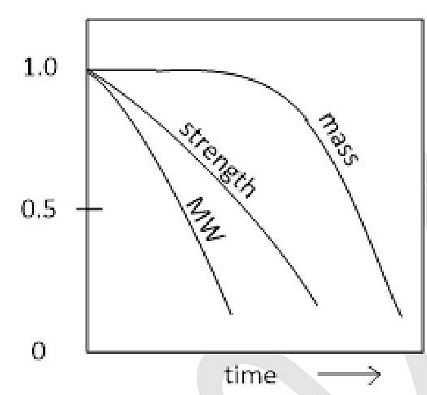
- An orthopaedic implant when monitored over 6 months showed the following normalized curves for polymer molecular weight (MW), mass of implant and mechanical strength. Among the choices, what is the most probable reason for the observed changes ?
- In an attempt to integrate engineered tissue with native tissue, three samples of engineered tissue, X, Y, Z, with identical material properties, were co-cultured adjacent to three different native tissues (bone, cartilage and liver). The adhesive strengths of X, Y, Z were observed after 8 weeks as follows.
Adhesive strength for X = 150 kPa, Y= 250 kPa, Z= 350 kPa
Match the native tissue that were used to co-culture X, Y and Z from the following.
I : Liver Tissue
II : Articular Cartilage
III: Devitalized Bone
View More Questions
Top GATE BM Questions
- What is the value of the following complex line integral counter-clockwise ?
\(\oint_{|z|=3}\frac{8}{z(z-2)(z-4)}dz\) - To solve the equation x = 2 cos x using Newton-Raphson's method, which one of the following iterations should be used ?
- During the repolarization phase of a neuron, the cell is brought back to the resting potential by the action of a Sodium-Potassium pump. Which one of the following statements is TRUE for the active transport of Na+ and K+ ions through the cell membrane ?
- The cardiac rhythm in a healthy human heart originates from ______.
- Which one of the following events is NOT typically encountered in diagnostic X-ray projection radiography ?
View More Questions