Question:
Which one of the following statements about viruses is correct ?
Which one of the following statements about viruses is correct ?
Updated On: May 23, 2026
- Viruses possess their own metabolic system
- All viruses contain both RNA and DNA
- Viruses are obligate parasites
- Nucleic acid of viruses is known as capsid
Show Solution

Verified By Collegedunia
The Correct Option is C
Solution and Explanation
Viruses contain a protein coat known as capsid which encloses a single type of nucleic acid, either RNA or DNA. They do not have enzymes for protein synthesis. They multiply only inside the living host cell and for multiplication they take over the machinery of the host cell. Thus viruses are obligatory intercellular parasites. They lack cell division and enzymes for protein synthesis. They do not have cell organelles like mitochondria, Golgi complex, lysosomes, ribosomes etc. so they cannot live or reproduce separately.
Was this answer helpful?
0
0
Top NEET Biology Questions
- The chronological order of human evolution from early to the recent is
- Upper part of sea/aquatic ecosystem contains
- Where is respiratory electron transport system (ETS) located in plants ?
- Which among the following are the smallest living cells, known without a definite cell wall, pathogenic to plants as well as animals and can survive without oxygen ?
- Three of the following pairs of the human skeletal parts are correctly matched with their respective inclusive skeletal category and one pair is not matched. Identify the non-matching pair. .
Pair of skeletal parts Category (a)$\,\,$ Sternum and ribs$\,\,$ Axial skeleton (b)$\,\,$ Clavicle and glenoid cavity$\,\,$ Pelvic girdle (c)$\,\,$ Flumerus and ulna$\,\,$ Appendicular skeleton (d)$\,\,$ Malleus and stapes$\,\,$ Ear ossicles
View More Questions
Top NEET biological classification Questions
- Which among the following are the smallest living cells, known without a definite cell wall, pathogenic to plants as well as animals and can survive without oxygen ?
- The unequivocal proof of DNA as the genetic material came from the studies on a
- Chromosomes in a bacterial cell can be 1–3 in number and:
- Two crosses between the same pair of genotypes or phenotypes in which the sources of the gametes are reversed in one cross, is known as:
Top NEET Questions
- A $100.0\, mL$ dilute solution of $Ag ^{+}$is electrolysed for $15.0$ minutes with a current of $1.25 \,mA$ and the silver is removed completely. What was the initial $\left[ Ag ^{+}\right]$?
- The time constant of C-R circuit is
- The chronological order of human evolution from early to the recent is
- The correct Boolean operation represented by the circuit diagram drawn is :
- The driver of a car travelling with speed $30\, m/sec$ towards a hill sounds a horn of frequency $600\, Hz.$ If the velocity of sound in air is $330\, m/s,$ the frequency of reflected sound as heard by driver is
View More Questions
Concepts Used:
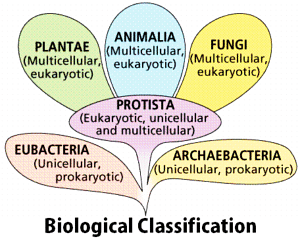
Biological Classification
The process of grouping living organisms into categories is called biological classification. The most modern 5-kingdom classification was put ahead by an eminent scientist R.H.Whittaker. The five-kingdom classification is based on the criteria like cell structure, mode of nutrition, body form, and reproduction. One of the most important characteristics of this system is that it follows the evolutionary sequence of living organisms. The organisms are classified into distinct taxa or levels like Kingdom, Phylum, Division, Class, Order, Family, Genus, and Species. The 5 kingdoms are as follows: