Question:
Which of these is a criterion for conservative treatment in a ureteric calculus?
Which of these is a criterion for conservative treatment in a ureteric calculus?
Show Hint
Small stones under about 6 mm have a high chance of passing on their own.
Updated On: Jul 8, 2026
- Infection and hydronephrosis present
- Size under 6 mm
- No movement for 2 weeks
- Highly symptomatic
Show Solution

Verified By Collegedunia
The Correct Option is B
Solution and Explanation
Step 1: Understanding the Question:
We need to pick the feature of a ureteric stone that supports watching and waiting (conservative treatment) instead of an active procedure.
Step 2: Key Concept:
Conservative, or expectant, management of a ureteric stone means giving pain relief, fluids, and sometimes medical expulsive therapy, and waiting for the stone to pass on its own. The main factor that decides whether a stone is likely to pass by itself is its size, since small stones can travel through the narrow parts of the ureter while larger ones get stuck.
Step 3: Detailed Explanation:
Stones under about 5 to 6 mm have a high chance, roughly 70 percent, of passing on their own within a few weeks, so small size is the classic criterion for conservative treatment.
Infection with hydronephrosis (option A) is actually a warning sign for urgent drainage, an infected obstructed kidney is a urological emergency that needs prompt decompression, not watchful waiting.
No movement for 2 weeks (option C) suggests the stone is impacted and not progressing, which favors intervention rather than continued conservative care.
Being highly symptomatic (option D) with severe, uncontrolled pain also pushes toward active treatment rather than conservative management.
Step 4: Final Answer:
A stone size under 6 mm is the recognized criterion favoring conservative treatment of a ureteric calculus.
We need to pick the feature of a ureteric stone that supports watching and waiting (conservative treatment) instead of an active procedure.
Step 2: Key Concept:
Conservative, or expectant, management of a ureteric stone means giving pain relief, fluids, and sometimes medical expulsive therapy, and waiting for the stone to pass on its own. The main factor that decides whether a stone is likely to pass by itself is its size, since small stones can travel through the narrow parts of the ureter while larger ones get stuck.
Step 3: Detailed Explanation:
Stones under about 5 to 6 mm have a high chance, roughly 70 percent, of passing on their own within a few weeks, so small size is the classic criterion for conservative treatment.
Infection with hydronephrosis (option A) is actually a warning sign for urgent drainage, an infected obstructed kidney is a urological emergency that needs prompt decompression, not watchful waiting.
No movement for 2 weeks (option C) suggests the stone is impacted and not progressing, which favors intervention rather than continued conservative care.
Being highly symptomatic (option D) with severe, uncontrolled pain also pushes toward active treatment rather than conservative management.
Step 4: Final Answer:
A stone size under 6 mm is the recognized criterion favoring conservative treatment of a ureteric calculus.
Was this answer helpful?
0
0
Top NEET PG Surgery Questions
- A 55-year-old male presented with verrucous carcinoma around the glans of the penis. Examination reveals that the inguinal lymph nodes are not enlarged. What is the appropriate management for this patient?
- Identify the procedure being performed in the image given below.
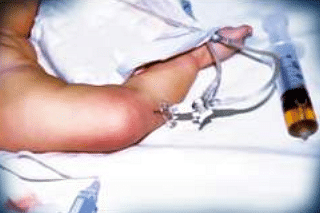
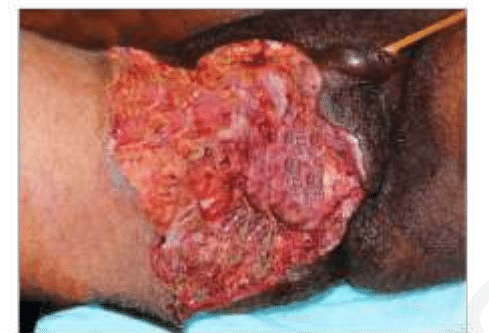
- A diabetic patient presents with sudden-onset perineal pain. On examination, foul-smelling discharge, and necrotic tissue as seen in the image is noted. Which of the following is true about the given condition?
- Which of the following is the most common complication following ligation of the first vessel during abdominoperineal resection for rectal carcinoma?(APR Abdominoperineal resection)
- A patient presents to the clinic with the lesion given in the image. He had a traumatic injury to the chest one year ago. What is the most likely diagnosis?
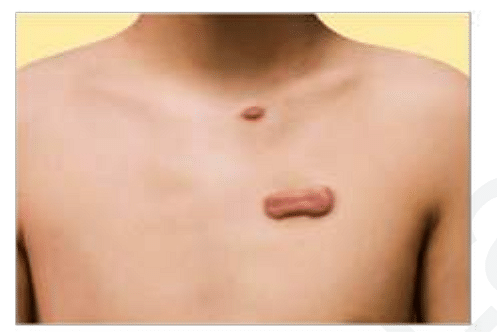
View More Questions
Top NEET PG Breast carcinoma management Questions
- Which of the following is true about the treatment of early breast carcinoma?
- Which is NOT correct?
- What is the appropriate management of a carcinoma of the lateral border of the tongue after primary resection?
- Carcinoma of the breast is least commonly seen in which quadrant?
- A young sewage worker is brought to hospital with a history of exhaustion, abdominal pain, vomiting, fever and shock. His heart rate is 120/min, respiratory rate is 30/min and blood pressure is 100/70 mmHg. His clinical features are suggestive of peritonitis. What is the next step of management?
View More Questions
Top NEET PG Questions
- A patient hailing from Delhi presents with fever, arthralgia, and extensive petechial rash for 3 days. Lab investigations revealed a hemoglobin of 9 g/ dL, a white blood cell count of 9000 cells/mm3, a platelet count of 20000 cells/mm3, and a prolonged bleeding time. The clotting time was normal. What is the most likely diagnosis?
- Which of the following statements is true about Trichomonas vaginalis?
- A lady from West Rajasthan presented with an ulcer surrounded by erythema on the right leg. Microscopy of the biopsy from the edge of the ulcer showed organisms with dark staining nuclei and kinetoplast. What is the most likely causative agent?
- A child presents with a fever and a rash. Urine examination showed cells with owl's eye appearance. What is the most likely diagnosis?
- Infection with Clonorchis sinensis is associated with an increased risk of__?
View More Questions